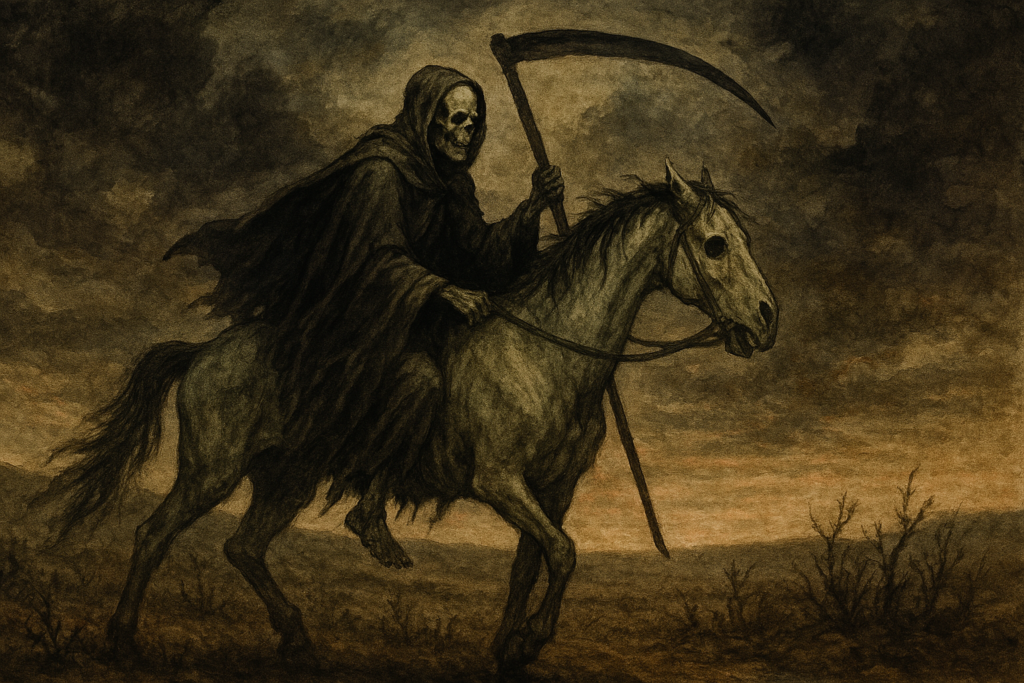
The article APO012 studies the fourth seal of Revelation (Rev 6.7-8) and the appearance of the pale horse ridden by Death. As the culmination of the three previous horsemen, this rider is given power to kill a quarter of humanity by war, famine, plagues and wild beasts. The article stresses the divine sovereignty that frames this terrible judgment, and places this event within the prophetic unfolding of the end times.
41 min
fourth sealpale horsehorseman of deathRevelationdivine judgment
31 verses
7 books
The fourth seal brings forth the pale horse, ridden by Death, followed by the Realm of the Dead. He is given a limited power, a quarter of the earth, to kill by war, famine, plagues and beasts.
This scene shows the culmination of the three previous horsemen and reminds us that, even in the face of Death itself, God sets the limits of the judgment.
When the Lamb opens the fourth seal, John hears the voice of the , the one who is like a flying eagle, say: “Come.” Then a pale horse appears, and the one who rides it is named Death, accompanied by Hades. He is given power over a quarter of the earth, to kill with the sword, with famine, with death, and by the wild beasts.
This vision marks a dramatic intensification in the series of horsemen: after conquest (white horse), war (red horse) and famine (black horse), now comes death itself, personified and universal. The pale color of the horse, greenish, livid, the color of a corpse, directly evokes decomposition and the end of life. Unlike the previous horsemen, this one is explicitly named: Death, which underlines the gravity and finality of his action.
The fourth seal reveals the ultimate fragility of human existence: war, famine and plagues converge toward death, which spreads over a significant portion of the earth. But it also reminds us that this power acts only within the limits set by God: “power was given to them over a fourth of the earth,” and no more. Divine sovereignty frames even the most terrible judgment.
Thus, the opening of the fourth seal introduces the most fearsome of the horsemen, and prepares the reader to understand that God’s judgments are not merely occasional crises, but realities that touch the human condition in its essence: life and death.
We have reached the fourth section of the book, entitled “The things which shall be hereafter,” and we are now dealing with the second subject: the opening of the seven seals.
The outline of the book, chapter IV B
Section
Subsection
Description
References
I
—
Introduction
Revelation 1.1-3
II
—
The things past: “what you have seen”
Revelation 1.4-20
III
—
The things present: “what is,” message to the seven Churches
Revelation 2.1 à Revelation 3.22
IV
A
The throne of Christ; the sealed book
Revelation 4.1 à Revelation 5.14
B
Opening of the 7 seals
Revelation 6.1 à Revelation 8.1
C
Parenthesis: Jews and Gentiles saved during the tribulation
Revelation 7.1-17
D
Judgment announced by the seven trumpets
Revelation 8.2 to Revelation 9.21 and Revelation 11.15-19
E
Parenthesis: prelude to the seventh trumpet
Revelation 10.1 à Revelation 11.14
F
Dominant figures
Revelation 12.1-17
G
Advent and reign of the Beast and the false prophet
Revelation 13.1-18
H
Parenthesis: prophetic visions
Revelation 14.1-20
I
Judgments announced by the seven bowls of the wrath of God
Revelation 15.1 à Revelation 16.21
J
Condemnation of Babylon the Great
Revelation 17.1 à Revelation 19.6
K
Preparations for Armageddon and the thousand-year reign
Revelation 19.7 à Revelation 20.6
L
Last Judgment; description of the holy city
Revelation 20.7 à Revelation 22.5
V
—
Conclusion: the last message of the Bible
Revelation 22.6-21
This outline comes from Scofield’s commentaries.
I. The text
Revelation 6.7-8 (King James Version) :
And when he had opened the fourth seal, I heard the voice of the fourth beast say, Come and see.And I looked, and behold a pale horse: and his name that sat on him was Death, and Hell followed with him. And power was given unto them over the fourth part of the earth, to kill with sword, and with hunger, and with death, and with the beasts of the earth.
King James Version (1769), domaine public — texte : eBible.org
John witnesses a striking moment when the Lamb opens the fourth seal. At that very instant, the last of the four living creatures speaks and proclaims in a loud voice: “Come.” This solemn invitation marks the beginning of a dramatic scene: a greenish horse then appears, ridden by a horseman whose name is: Death.
This horseman, carrying a specific mission given by God, receives the authority to take the life of a quarter of humanity. As soon as he is invested with this task, he sets about carrying it out. Thus begins a period characterized by the massive death of a considerable number of people, marking a fearsome stage in the succession of the events described.
II. The symbolic elements
Summary of the paragraph:
The fourth seal unveils the pale horse, the color of a corpse, a symbol of a deadly power that runs through history. Its rider, explicitly named Death, is followed by the Realm of the Dead, showing that the judgment touches both life and its outcome. They are given a limited power, a quarter of the earth, to strike by war, famine, plagues and wild beasts.
This scene represents the culmination of the horsemen: after conquest, war and famine, comes death itself. Yet even this extreme judgment remains framed by God, and Revelation later announces the over Death and Hades.
Full text:
This analysis examines in detail the symbolic aspects of the fourth seal (Revelation 6.7-8). This passage presents a great richness of images and meanings.
Pale horse
Pale color (greenish, livid): Evokes the pallor of a corpse, decomposition and the absence of vitality; it is a color of death, sickness and dread. It is distinguished from black (famine) by its direct association with agony and the end of life.
Impersonal force: Like the other horses, it represents a power that runs through history; its hue signals that this power is specifically deadly and widespread.
Rider named Death
Explicit name: Unlike the previous horsemen, this one is named “Death,” which makes his function unmistakable and personifies the final reality of the judgments.
Universal scope: He does not target a single category of punishment; he sums up and concentrates the effects of the previous calamities in their ultimate outcome: death.
The realm of the dead that follows
Hades (realm of the dead): A collective figure that follows Death as its extension: the sphere where the departed go. It indicates that death is not only an event, but a condition that carries off multitudes.
Death–Hades pairing: Together, they show the extent of the judgment: not only the cessation of life, but the massive harvest of souls.
Power over a quarter of the earth
Numerical limitation: “Power over a fourth of the earth” indicates a significant but not total extent; God sets bounds on the judgments, even the most terrible.
Instructive reading: Helps us understand that the visions do not describe complete annihilation but limited, orchestrated and measured waves.
Instruments of death
Sword: Open war, armed violence, massacres. Extends and intensifies the theme introduced by the red horse.
Famine: Scarcity and rationing, the logical consequence of conflicts and social disorganization.
Death (pestilence): Diseases and plagues, non-military mortality; completes the range of causes of death on a large scale.
Wild beasts: Ecological disorder and withdrawal of protection from humanity; symbolizes creation turning against man when order is broken.
The voice of the fourth living creature
Heavenly origin of the call: The living creature like an eagle says “Come,” linking the liturgy of the throne to earthly judgments. The eagle suggests vigilance and a high vantage point over events.
Mediating function: The call introduces the scene, attesting that the initiative comes from heaven, not from autonomous forces of chaos.
The formula “it was given”
Divine passive: Power “was given” to Death and to Hades: the judgments unfold under divine permission, not through anarchy.
Framing sovereignty: Reminds us that God remains above the crises, controlling their scope and duration.
Theological significance
Culmination of the horsemen: Death is the ultimate consequence of human crises (war, famine, plagues), revealed as a permitted and limited judgment.
Existential fragility: Lays bare the human condition: life is precarious, and no earthly security suffices in the face of Death and Hades.
Call to lucidity: This scene invites us to read history from a spiritual perspective: behind events, an unveiling of divine justice and sovereignty.
Conclusion: The fourth seal
The fourth seal reveals the most fearsome power among the horsemen: Death, accompanied by the Realm of the Dead. The pale horse, the color of a corpse, embodies the ultimate fragility of human existence. Unlike the previous horsemen, this one is explicitly named, which underlines the gravity of his role.
His power is vast, a quarter of the earth, but limited: God sets the bounds of his action. The instruments of death (sword, famine, pestilence, wild beasts) show that human life can be struck in many ways, all under divine sovereignty.
This seal is the culmination of the judgments of the horsemen: after conquest, war and famine, comes death itself. But it also reminds us that death is not the ultimate end: it is framed by God, and Revelation later announces the over death and the realm of the dead.
The
Is the disappearance of a quarter of humanity conceivable?
Causing the death of 2 billion individuals?
III. The fourth living creature
A reminder of the four living creatures (Revelation 4.6-8) placed around the throne of God.
Each has a different appearance:
First: like a lion.
Second: like a calf.
Third: having a face like that of a man.
Fourth: like a flying eagle.
All are full of eyes and each has six wings, recalling the cherubim of Ezekiel and the seraphim of Isaiah.
The role of the fourth living creature
In Revelation 6.7: it is he who says “Come!” when the Lamb opens the fourth seal.
Symbolism of the eagle:
The eagle is a symbol of vigilance, height and speed.
It evokes the ability to see from afar and to oversee events.
In the context of the fourth seal, he introduces the vision of the pale horse and of the horseman named Death.
The four living creatures represent the whole creation in its worship and vigilance around the throne.
The fourth, the eagle, embodies the heavenly and prophetic dimension: he announces the most fearsome judgment, that of death.
Their role is to serve as mediators between the throne and earthly events: each seal is introduced by the call of a living creature.
The , like a flying eagle, is the one who introduces the vision of the pale horse and of Death in Revelation 6.7-8. He symbolizes heavenly vigilance and the divine vantage point, reminding us that even the most terrible judgment is announced from the throne of God and remains under his sovereignty.
?
IV. The horseman
Summary of the paragraph:
The rider of the greenish horse is explicitly named Death, followed by the Realm of the Dead. His livid color evokes sickness and decomposition. He is given a limited power, a quarter of the earth, to strike by war, famine, plague and wild beasts.
This horseman represents the culmination of the three previous plagues and underlines that, even in the face of Death itself, God remains sovereign and sets the limits of the judgment.
Full text:
The rider of the greenish horse in Revelation 6.7-8 is explicitly named: Death, accompanied by the realm of the dead (Hades). He is given a limited, yet terrible power over a quarter of the earth to kill by war, famine, plague and wild beasts.
Context of the fourth seal
Opening of the seal: The Lamb opens the fourth seal, and the (like an eagle) says: “Come.”
Vision: John sees a greenish horse (chlōros in Greek, a sickly, livid color, evoking putrefaction).
Horseman: The one who rides it is named Death (Thanatos), and behind him comes Hades, the personification of the realm of the dead.
Symbolism of the greenish color
The term chlōros means “pale green,” “livid,” like the color of a sick or decomposing body.
In contrast to white (victory), red (war) and black (famine), the greenish color embodies the ultimate consequence: physical and spiritual death.
This color is unique in Revelation, reinforcing the visual and instructive impact.
Powers granted
The text specifies that Death and Hades receive authority over a quarter of the earth:
By the sword → wars, violence, terrorism.
By famine → direct consequence of the third seal.
By plague → diseases, epidemics, human frailty after war and malnutrition.
By wild beasts → natural dangers, animal attacks, but also symbols of uncontrolled hostile forces.
Theological significance
Explicit name: Unlike the other horsemen, this one is named: Death.
Death–Hades association: A double personification that underlines the gravity of the judgment: biological end and spiritual destiny.
Limited power: Only a quarter of the earth, showing that God remains sovereign and that the destruction is not total.
Link with Matthew 24.7: Jesus had announced wars, famines and plagues as signs of the end times.
Essential teaching points
Synthesis of the plagues: This horseman is the result of the three previous ones (war, famine, social disorder).
Eschatological dimension: Death is not only biological, it is also spiritual, for Hades follows to gather the victims.
Visual impact: The sickly color and the explicit name strike the imagination of readers and listeners.
Synthesis
The rider of the greenish horse is Death personified, followed by the realm of the dead. His sickly color symbolizes putrefaction and the end of life. He is given a limited but frightening power to strike by war, famine, disease and wild beasts. He embodies the culmination of the calamities of the three previous horsemen and reminds us that God remains sovereign, even in the midst of judgment.
The
Is the disappearance of a quarter of humanity conceivable?
Causing the death of 2 billion individuals?
Summary of the paragraph:
The greenish horse of Revelation 6.7-8 takes its name from the Greek term chlōros, a sickly “pale green” evoking disease, putrefaction and the look of a corpse. Unlike the other horses with symbolic colors (victory, war, famine), this one refers directly to biological death.
Its hue alone suffices to convey a visual lesson: the fragility of life and the reality of judgment. The same word that designates “green grass” (Mark 6.39) becomes here an allegory of death.
In short, the greenish horse is a chromatic image of death and corruption, whose color alone suffices to reveal its role.
Full text:
Let us now focus on the greenish horse of Revelation 6.7-8.
The greenish horse
Greek term: chlōros means “pale green,” “greenish,” sometimes translated as “livid.”
Sickly color: This is not a bright green, but a hue that evokes: sickness and putrefaction and the look of a lifeless body.
Singularity: It is the only mount described with a color that refers directly to biological death. The other horses (white, red, black) bear more symbolic colors (victory, war, famine).
Instructive symbolism
Striking image: The greenish horse is a visual embodiment of the fragility of life.
Didactic: Its color alone suffices to evoke the end, without needing to name the rider.
Contrast: It stands out from the others by its sickly look, which lets listeners/readers immediately grasp its role.
Biblical significance
Link with nature: The word chlōros is also used to describe greenery (Mark 6.39: “the green grass”). Here, the same term takes on a negative connotation: not plant life, but the hue of death.
Visual effect: The greenish horse is a chromatic allegory: color alone becomes a theological language.
In summary: the greenish horse is a visual figure of death and corruption, its sickly color sufficing to convey the idea of finitude and judgment.
Yes, a clear link can be established between the discourse and the fourth horseman, but we must be very precise: this link does not rest on a single verse, but on the overall logic of Jesus’ discourse.
Here is the most accurate summary, centered solely on the fourth horseman: Death.
1. The fourth horseman: Death as the outcome of the crises
VI. Connection with the Olivet Discourse
In Revelation 6.7-8, the greenish horse represents:
Widespread death,
By war,
By famine,
By plagues,
And by natural disorder (wild beasts).
▸ The fourth horseman is not an isolated plague: he is the final consequence of the three previous ones.
2. In the Olivet Discourse, Jesus announces the same progression
In Matthew 24.6-7, Jesus describes:
Wars,
Famines,
Plagues (Luke 21.11),
Terrors and catastrophes.
These things are not the end, but the beginning of birth pains.
▸ This sequence corresponds exactly to the first three horsemen… …and prepares the ultimate consequence: death, even though Jesus does not personify it.
3. The precise link: Death as the result of the signs announced by Jesus
Jesus does not describe a horseman, but he clearly announces that:
Wars,
Famines,
Plagues,
Earthquakes,
will bring about the death of multitudes (Matthew 24.7-8, Luke 21.11 ).
In other words:
The Olivet Discourse describes the causes.
The fourth horseman shows the outcome: Death, which reaps what the crises have sown.
4. The major point of convergence
In both texts:
Mass death is not an isolated event, but the result of a chain of crises.
Jesus: wars → famines → plagues → death.
Revelation: red horse → black horse → greenish horse (Death).
▸ The fourth horseman embodies what Jesus describes.
5. Common theological dimension
In both cases:
Death is not out of control,
It acts within limits set by God,
It is part of a process of judgment,
It reveals human frailty.
Revelation shows it explicitly: “Power was given to them over a fourth of the earth,” a limited power.
Jesus, for his part, says: “But the end is not yet,” a controlled progression.
Yes: the fourth horseman corresponds to the mass death announced by Jesus in the discourse, as the result of wars, famines and plagues. Jesus describes the causes; Revelation personifies their ultimate consequence: Death under divine mandate.
Daniel shows corrupt kingdoms judged by God; Revelation presents the greenish horse, a symbol of putrefaction and death, acting over a limited portion of the earth.
Both announce a progression of calamities leading to the final judgment, underlining that human history is under divine control and directed toward its eschatological outcome.
Points of convergence between Daniel and Revelation
The points of convergence between Daniel and Revelation 6.7-8 lie in the theme of apocalyptic visions: colors, beasts and judgments symbolize the fragility of human life and divine authority over history.
Major convergences
1. Symbolism of colors and appearances
VII. Is there a connection with the information given by Daniel?
In Daniel 7, the four beasts represent successive earthly powers. Their monstrous appearance reflects the moral corruption and the fragility of human kingdoms.
In Revelation 6.7-8, the greenish horse (chlōros) reflects the corruption and putrefaction of life.
Convergence: the use of appearance (beasts or a sickly color) to signify the mortality and fragility of human powers.
2. Limited but real power
In Daniel 7.12, the beasts are given a limited time to exercise their dominion.
In Revelation 6.8, Death and Hades receive power over a quarter of the earth, not over the whole.
Convergence: God remains sovereign; the destructive forces have only a restricted power.
3. Judgment and final destiny
Daniel 7.9-10: the throne is set up, the books are opened, and the beasts are judged.
Revelation 6.8: Death is followed by Hades, recalling the ultimate destiny of men and the coming judgment.
Convergence: the visions depict the end of earthly powers and the divine judgment.
4. Chain of calamities
In Daniel 7, each beast embodies a stage of human history, leading to the final confrontation.
In Revelation 6, each horse embodies a calamity (conquest, war, famine, death), culminating with the greenish horse.
Convergence : dramatic progression toward an intensification of the plagues, up to universal death.
Daniel 12.1-2 announces the resurrection and the final judgment.
Revelation 6.8 evokes Death and Hades, which foreshadow the judgment and the eternal destiny.
Convergence : both books link the visions to the end times and the ultimate fate of men.
Daniel: visions of monstrous beasts representing empires, limited in time, judged by God.
Revelation 6.7-8: vision of the greenish horse, the color of putrefaction, limited to a quarter of the earth, announcing death and judgment.
Common ground: both use powerful images (beasts, colors, death) to show that human powers and earthly life are fragile, limited, and subject to divine judgment.
The fourth horseman, Death, presents an indirect parallel with the ten plagues of Egypt: in both cases, a series of increasing plagues culminates in death, the ultimate judgment yet strictly limited by God.
The horseman’s instruments of death (war, famine, plague, wild beasts) recall several of the plagues, and both accounts show a creation turning against man. Theologically, death is not only a punishment: it prepares a deliverance — the exodus for Israel, the final victory of the Lamb in Revelation.
Yes, there is a link, but an indirect one, between the fourth horseman (Death) and the ten plagues of Egypt. This link is not literal, but thematic, theological and structural.
1. Major common point: Death as the final judgment
VIII. Is it possible to establish a correlation with the ten plagues of Egypt?
In both accounts, death appears as the last and most fearsome of the judgments.
Tenth plague: death of the firstborn (Exodus 12.29-36).
Fourth horseman: Death itself, followed by the realm of the dead (Revelation 6.8).
▸ In both cases, death is the ultimate consequence of a series of plagues.
2. Progression of the plagues: a crescendo leading to death
The ten plagues follow an increase in intensity: water → animals → diseases → darkness → death.
The horsemen follow the same logic: conquest → war → famine → death.
▸ The fourth horseman plays the role of culmination, like the tenth plague.
The fourth horseman kills by:
Sword → violence, war
Famine → scarcity
Plague → diseases
Wild beasts → hostile nature
Several plagues of Egypt fall into the same categories:
Animal plagues (plague 5)
Boils (plague 6)
Destructive hail (plague 7)
Locusts (plague 8)
Darkness (plague 9)
Death (plague 10)
▸ Same logic: creation turns against man.
4. Divine sovereignty in both accounts
In both cases:
The plagues are not anarchic,
They are triggered and limited by God,
They serve a theological purpose: to reveal his justice and sovereignty.
Revelation 6.8: “Power was given to them…” → limited power.
Exodus: Each plague is sent at God’s command, with a precise scope.
5. The strongest theological link
In both accounts, death is not only a biological event: it is an act of judgment, but also a prelude to deliverance.
In Egypt: the death of the firstborn precedes the liberation of Israel.
In Revelation: Death and Hades will be defeated (Revelation 20.14).
▸ Death is a judgment, but also a passage toward God’s victory.
Yes: the fourth horseman and the ten plagues of Egypt converge in their structure and theology, a series of increasing plagues culminating in Death, an instrument of divine judgment yet always under control and directed toward the final deliverance.
IX. Commentary
Summary of the paragraph:
The apocalyptic text reminds us that death remains a powerful reality, not yet totally defeated. The fourth seal announces the disappearance of a quarter of humanity, an immense figure yet credible within the framework of the end times.
Cette mortalité résulte d’un ensemble de fléaux, guerre, famine, épidémies, bouleversements naturels, et inclut même les « bêtes » invisibles comme les microbes.
The example of COVID‑19 shows how a tiny agent can destabilize the whole world, making the figures of Revelation not imaginary, but plausible from an eschatological perspective.
Full text:
The reality of death remains self-evident in the apocalyptic text, since it has not yet been totally defeated by the Messiah Jesus (Revelation 1.18, Revelation 12.11, Revelation 20.14). This passage forcefully underlines the impressive number of human beings who will perish during these plagues: it speaks of a quarter of humanity, about two billion people.
This striking figure causes unease and questions. Some readers prefer to see it as a symbol, simply expressing a great number of victims, yet limited in history. According to this reading, a few thousand deaths might seem a more reasonable interpretation, whereas the idea of two billion victims seems hard to conceive.
Yet John’s vision concerns the final period of the history of the world as we know it. From this perspective, the information given retains its credibility and is not an exaggeration.
The number of deaths mentioned does not result from a single factor, but from the combination of several plagues: war, famine, epidemics, as well as upheavals of nature. When wild beasts are mentioned, we should not limit ourselves to the image of big cats or sharks; it also involves less visible threats, such as microbes, which are invisible “beasts” but just as dangerous to man.
The recent example of COVID-19 shows how a microbe, invisible to the naked eye, can upset the economic, political and social balance of the planet, with nearly seven million deaths officially recorded worldwide, not counting tens of millions of severe cases. This invites us to reconsider the scope of the figures put forward in John’s vision: far from belonging to the imagination, they fit into a reality that is now tangible.
The
Is the disappearance of a quarter of humanity conceivable?
Causing the death of 2 billion individuals?
Conclusion
Summary of the paragraph:
The third horseman shows that famine and economic injustice flow from human conflicts. The black horse evokes mourning, the scale evokes rationing.
Despite this crisis in which necessities are lacking and inequalities explode, the opening of the seal reminds us that God remains sovereign. The message is clear: material security is fragile, only divine providence remains reliable.
Full text:
The third horseman, riding the black horse and holding a scale, embodies the famine and economic injustice that strike humanity. His presence reminds us that wars and human ambitions inevitably lead to deprivation and suffering. The black color expresses mourning and desolation, while the scale underlines the fragility of resources and the harshness of rationing.
This seal reveals the precariousness of earthly life: a day’s wage no longer suffices to feed a family, and yet luxury goods remain untouched, a sign of glaring social injustice. But behind this somber image, the text also underlines the sovereignty of God: it is the Lamb who opens the seal, and it is the heavenly voice that sets the limits of the judgment.
Thus, the third horseman is not only a vision of famine; it is a spiritual lesson: human peace and subsistence are fragile, and only divine providence ensures true security. This seal invites believers not to place their trust in riches or economic systems, but to seek the justice and peace that come from God.
A title, a person, a place, a reference (“Luke 15”)…
opens in a new window
Bible reference
INF259
Information note
INF259 - Why do the four living creatures symbolize creation?
Why do the four living creatures symbolize creation?
The four living creatures represent the whole of creation because their biblical symbolism (lion, ox, man, eagle) points to the great categories of the created order, and because Revelation places them around the throne as figures of universal worship.
Biblical origin
Ezekiel 1 and 10: the four living creatures already appear in the prophet’s vision, each having the faces of a man, a lion, an ox and an eagle. Ezekiel identifies them as cherubim, linked to the throne of God.
Revelation 4.6-8: John takes up this vision but simplifies the figures: a lion, an ox, a man and an eagle. They are placed “in the midst of the throne and around the throne,” and sing unceasingly: “Holy, Holy, Holy.”
Symbolism of the four figures
Lion: strength, kingship, animal power.
Ox (or calf): fertility, service, domestic power.
Man: intelligence, reason, spiritual dimension.
Eagle: sky, height, vigilance, swiftness.
These four figures cover the great spheres of creation:
Wild animals (lion),
Domestic animals (ox),
Humanity (man),
Winged/celestial creatures (eagle).
Theological interpretation
Universal worship: their presence around the throne means that all creation is included in the praise of God.
Cosmic vigilance: their eyes “all around” symbolize vigilance and universal knowledge.
Patristic tradition: the Church Fathers (Irenaeus, Jerome) saw in these four living creatures not only creation, but also the four evangelists, each reflecting one facet of Christ.
Synthesis
The four living creatures represent the whole of creation because:
Their symbolism covers the main categories of the created order (wild, domestic, human, heavenly).
Their position around the throne directly associates them with universal worship.
Revelation does not separate theology and cosmology: salvation concerns the whole of the created order
INF260
Information note
INF260 - The link between the fourth living creature and the last horseman?
The link between the fourth living creature and the last horseman?
Here is the essential link between the fourth living creature and the fourth horseman, a link that is at once symbolic, liturgical and theological.
Le fourth living creature et le dernier cavalier, un appel céleste qui introduit le jugement ultime
The fourth living creature: the eagle
In Revelation 4, the fourth living creature is described as an eagle in flight:
A symbol of vigilance,
Of height,
Of piercing sight,
Able to see danger coming from afar.
It represents the heavenly dimension of creation, the one that observes history from God’s perspective.
Its role in Revelation 6.7
It is he who says: “Come!” when the Lamb opens the fourth seal.
In other words:
He introduces the most fearsome horseman,
He announces Death,
He acts as a mediator between the throne and the judgment.
Each living creature introduces a horseman, but here, the eagle introduces the last and most terrible one.
Why the eagle for Death?
This choice is not arbitrary.
The eagle evokes:
The speed with which death strikes,
The height from which judgment comes,
The divine vigilance that sees everything,
The inescapable dimension of the final judgment.
In the Old Testament, the eagle is often associated with:
Swift judgment (Deuteronomy 28.49, Jeremiah 48.40, Hosea 8.1),
The suddenness of catastrophes (Lamentations 4.19, Habakkuk 1.8).
The eagle is therefore the most fitting living creature to announce Death, because it symbolizes the overall vision and the swiftness of judgment.
Theological link: the sovereignty of the throne
The deep link is this:
The last horseman does not appear out of chaos, but at the call of heaven.
The eagle reminds us that:
Even Death answers to a heavenly order,
It does not act alone,
It is under the sovereignty of God,
Its power is given, limited to a quarter of the earth.
The fourth living creature guarantees that the ultimate judgment remains framed by the throne.
Synthesis
The fourth living creature, the eagle, introduces the last horseman, Death, to show that this extreme judgment comes from the throne of God: swift, inescapable, but strictly limited by divine sovereignty.
INF253
Information note
INF253 - To whom is the command “Come” addressed?
To whom is the command “Come” addressed?
In Revelation 6.1-8, at the opening of each of the first four seals, one of the four living creatures says: “Come” (or “Come and see,” according to some translations).
Two main interpretations
A call addressed to John (the seer)
Meaning: the living creatures invite John to draw near and behold the vision that is about to unfold.
Argument: John’s role is to “see” and to “report” what he beholds. The “Come” is therefore a liturgical invitation to take part in the revelation.
Consequence: this underlines that the revelation is given to the Church through John.
A call addressed to the horseman
Meaning : the living creatures call the horseman to go forth and fulfil his mission.
Argument: immediately after the “Come,” the horse and its rider appear. The word works as an order to enter the scene.
Consequence: this underlines that the judgments are set in motion by divine authority, relayed by the living creatures.
Linguistic nuance
The Greek simply says “Erchou” = “Come.”
The text does not explicitly state who is being addressed.
Both readings are possible, and many commentators recognize a double function:
For John: an invitation to see.
For the horseman: an order to go forth.
Theological significance
If addressed to John: this highlights the prophetic calling, to see and to pass on.
If addressed to the horseman: this highlights divine sovereignty; the judgments are set in motion only at heaven’s command.
Integrated reading: the two meanings complement each other. John is invited to see what God commands, and the horsemen go forth because God calls them.
Synthesis
When the living creatures say “Come,” the text can be understood both as an invitation to John (come and behold) and as an order to the horseman (come and act). This ambiguity is deliberate: it underlines that the revelation is given to the prophet, but that the judgments are also set in motion by divine authority.
INF245
Information note
INF245 - The Fourth Living Creature, the Eagle
The Fourth Living Creature, the Eagle
The fourth living creature of Revelation 4.7, “like an eagle in flight”, is rich in symbolism.
The Greek word
The text says: « τὸ τέταρτον ζῷον ὅμοιον ἀετῷ πετομένῳ » — to tetarton zōon homoion aetō petomenō.
ζῷον (zōon)** = “living creature”, a generic term for an animate creature.
ἀετός (aetos)** = “eagle”.
πετόμενος (petomenos)** = present participle of “to fly”, hence “in flight”. The translation “like an eagle in flight” is accurate and faithful to the Greek.
What does this fourth creature represent?
Transcendence and height: The eagle is the bird that flies the highest, a symbol of divine vision and of closeness to heaven.
Vigilance and swiftness: In the Bible, the eagle is associated with vigilance and strength (Deuteronomy 32.11; Isaiah 40.31).
Spiritual dimension: It embodies the capacity of creation to rise toward God, to see from afar and to act swiftly.
Complementarity: With the lion (strength), the ox (sacrifice), and man (intelligence), the eagle represents transcendence and spiritual vigilance.
Its role in the rest of Revelation
Revelation 6.7–8: The fourth living creature says “Come!” and introduces the pale horseman (death).
Revelation 4.8: Like the others, it takes part in the perpetual praise (Holy, Holy, Holy).
Revelation 7.11: It joins the angels and the other living creatures in worship. ? It is therefore active in the unfolding of the judgments and in the heavenly liturgy.
Why this description?
Link with Ezekiel 1.10: One of the faces of the cherubim is that of an eagle. John takes up this image but makes it a distinct creature.
Link with Isaiah 6.2: Like the seraphim, each of the living creatures has six wings and proclaims the holiness of God.
Theology: The eagle in flight symbolizes the transcendent dimension of creation, which rises toward God and takes part in his plan.
Teaching purpose: Its description completes the picture of the four living creatures, representing the whole of creation:
Lion → royal power
Ox → sacrifice and service
Man → intelligence and relationship
Eagle → transcendence and vigilance
Synthesis
The Greek word is well translated: “eagle in flight”.
This fourth creature represents the transcendence, the vigilance and the spiritual dimension of creation.
It acts actively in the revelation (seals, praise, handing over of the judgments).
Its description aims to show that the whole creation, in all its dimensions, is associated with worship and with the divine plan.
INF256
Information note
INF256 - The death of a quarter of humanity
The death of a quarter of humanity
The text
Revelation 6.8 says: “Power was given to them over a fourth of the earth, to kill with the sword, with famine, with death, and by the wild beasts.”
Analysis
The fourth seal introduces Death and the realm of the dead. The text specifies that their power extends over a quarter of the earth. The means of death mentioned (sword, famine, pestilence, wild beasts) overlap with the judgments already introduced by the previous horsemen (war and famine).
Interpretation
Not a cumulative addition: the quarter of the earth is not the sum of the deaths of the previous seals plus those of the fourth.
The previous horsemen (red and black) announce war and famine as realities.
The fourth seal encompasses these realities and associates them with death itself.
An overall figure: the quarter of the earth represents the total portion affected by Death and Hades, including the effects of wars, famines and pestilences.
In other words, the deaths from war and famine are counted within this quarter, since they are explicitly mentioned as instruments of Death.
Symbolic scope: the quarter is not an exact statistic, but a limit set by God.
This shows that the judgment is severe but not total. God keeps sovereignty by setting bounds to the extent of death.
Synthesis
The deaths linked to war and famine are included in the quarter of humanity struck by the fourth seal. This figure is not added to the previous ones, but represents an overall whole: Death and Hades are given power over a quarter of the earth, through all the instruments of destruction (sword, famine, pestilence, wild beasts).
INF305
Information note
INF305 - The Mount of Olives
The Mount of Olives
The Mount of Olives is one of the most important places in biblical geography. Located east of Jerusalem, it is separated from the city by the Kidron Valley (2 Samuel 15.30 ; John 18.1). Its name comes from the many olive trees that once covered its slopes.
Geographical Setting
The Mount of Olives forms a long ridge running north to south, reaching about 820 meters in elevation, slightly higher than Jerusalem. From its summit one enjoys a remarkable view of the city and of the site of the Temple.
Its proximity to Jerusalem explains why Jesus and his disciples went there frequently (Luke 21.37). According to Luke, the place of the ascension was about one “Sabbath day’s journey” from Jerusalem, or approximately one kilometer (Acts 1.12).
A Place Associated with Many Biblical Events
In the Old Testament
David crossed the Kidron brook and climbed the Mount of Olives weeping as he fled from his son Absalom (2 Samuel 15.30).
The prophet Ezekiel describes the glory of God leaving Jerusalem and stopping on the mountain east of the city, generally identified with the Mount of Olives (Ezekiel 11.23).
The prophet Zechariah announces that on the day of the Lord, the feet of the Eternal will stand on the Mount of Olives (Zechariah 14.4).
In the Life of the Messiah Jesus
The Mount of Olives holds a special place in the Gospels:
Jesus stays there frequently (Luke 22.39);
he gazes upon Jerusalem and weeps over the city (Luke 19.41-44);
there he delivers the eschatological discourse on the end of the age (Matthew 24.3 ; Mark 13.3);
he spends his nights on this mountain during the last days before his death (Luke 21.37);
at the foot of the mountain lies the garden of Gethsemane, where he prays before his arrest (Matthew 26.36 ; Luke 22.39-46);
it is also from the area around Bethany, on the eastern slope of the mountain, that he blesses his disciples and is taken up into heaven (Luke 24.50-51 ; Acts 1.9-12).
The Mount of Olives and the Ascension
Acts indicates that the disciples returned to Jerusalem “from the mount called Olivet” after the ascension (Acts 1.12). Luke specifies in his Gospel that Jesus led them as far as Bethany before leaving them (Luke 24.50).
These two indications are perfectly compatible, since Bethany is located on the eastern slope of the Mount of Olives, about three kilometers from Jerusalem (John 11.18).
A Prophetic Dimension
For several interpreters, the choice of the Mount of Olives as the place of the ascension is probably no accident. The prophet Zechariah already announced that on the day of the Eternal, he would stand on this mountain (Zechariah 14.4). Thus, the place from which Jesus leaves his disciples could also be the one associated with his glorious return, in keeping with the words of the angels:
“This same Jesus, who was taken up from you into heaven, will come in the same way as you saw him go into heaven” (Acts 1.11).
Thus, the Mount of Olives appears as a place steeped in history and symbolism. It is at once the stage of the Messiah’s sufferings, of his teaching about the times to come, of his ascension and, according to several prophetic interpretations, of the place associated with his future return.
INF236
Information note
INF236 - He has overcome
The Messiah Jesus has overcome
In Revelation 5.5, it is said: “Do not weep, for the lion of the tribe of Judah, the offshoot of the root of David, has overcome so that he can open the scroll and its seven seals.”
Analysis :
The verb “has overcome” is central. But what does this victory mean?
It is not a military or political victory, like that of a roaring lion.
It is a victory through self-giving, revealed immediately afterward by the image of the Lamb offered in sacrifice (Revelation 5.6).
What did he overcome?
Evil and death, by giving himself.
The impossibility of access to meaning: no one was able to open the scroll, but he, through his sacrifice, makes the divine plan accessible.
The logic of closed power: he does not take the scroll by force, but because he is recognized as worthy.
How did he overcome?
By humility and sacrifice, not by domination.
By becoming the Lamb standing, marked by suffering but alive and active.
In summary:
“He has overcome” means that he passed through death, that he offered his life, and that this offering gives him the moral and spiritual authority to open the scroll. His victory is a victory of love over closedness, of giving over exclusion.