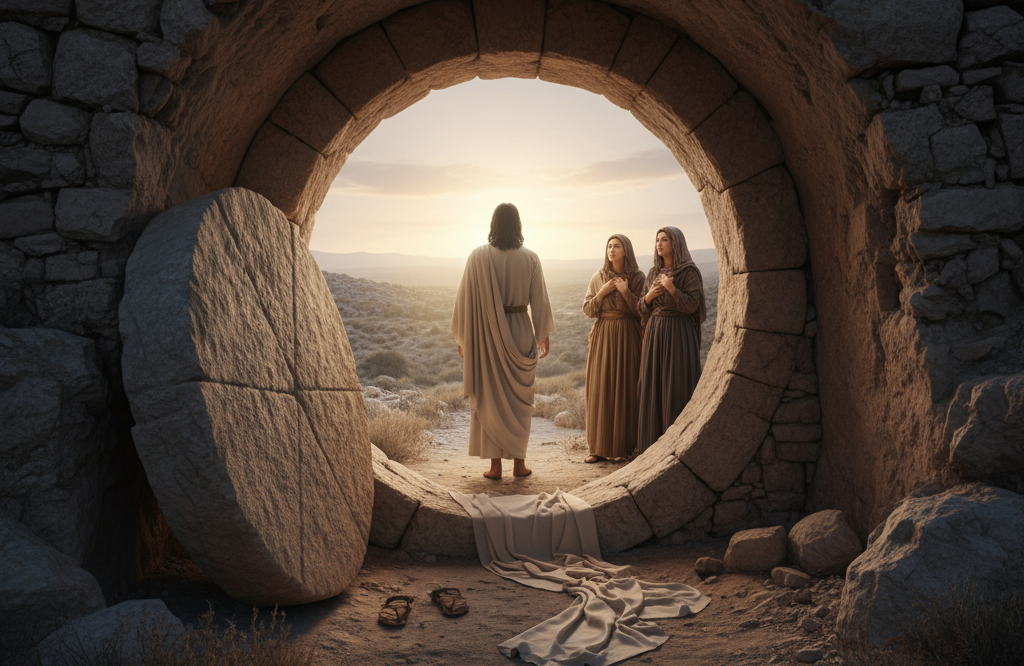
This article examines the resurrection of Jesus and its theological impact, discussing the predictions and the reactions of the witnesses, as well as the measures taken by the Jewish authorities to secure the tomb. The Gospel accounts and their consistency are analyzed in order to highlight the importance of this central event of Christianity.
60 min
resurrectionJesuswitnessesGospelspredictions
75 verses
6 books
On April 3 of AD 33, a notable event took place: the resurrection of Jesus, in accordance with his earlier predictions. The first witnesses of this event were at first perplexed, struggling to understand the significance of what they were seeing.
In this study, we will analyze the various texts relating to this resurrection, paying particular attention to the many warnings that Jesus had given to his disciples. It is important to note that they were in a state of denial, unable to imagine the death of their Master.
I. The resurrection
The resurrection may seem so extraordinary that some judge it impossible. However, a multitude of witnesses confirms the authenticity of the facts reported. How can a person die and then come back to life after a few days?
The episode of Lazarus (John 11.1-44) is well documented. This event had drawn the attention of many inhabitants of Jerusalem and stirred up various controversies. However, the eyewitnesses, including , confirmed that this man, their own brother, was now alive, taking part in everyday activities such as eating and drinking.
Moreover, several accounts relate the story of the son of a widow from the , near Nazareth (Luke 7.11-17), as well as that of the daughter of the ruler of the of Capernaum, Jairus (Mark 5.22, Luke 8.41).
The Master had also predicted several times his own death and resurrection. The disciples, however, had not understood these predictions, or perhaps had simply refused to believe them.
It is clear that Matthew is referring to a particularly significant memory that was fully understood only after the events mentioned. However, at the moment when the Messiah Jesus spoke these words, neither he nor the other disciples grasped their importance (Matthew 16.21, Mark 8.31, Luke 9.22, John 2.19).
II. The fear of the Jewish authorities
While the disciples struggled to grasp the meaning of these words (Matthew 20.17-19), the religious authorities did not seem to face the same obstacles.
Indeed, on the day after the crucifixion, that is, April 2, AD 33 according to our analysis, a day, some , members of the , went early in the morning to meet the Roman prefect Pontius Pilate in order to ask him to have the tomb guarded.
According to Matthew’s account, it is likely that the chief of the priests at that time was the High Priest Caiaphas. This hypothesis is plausible because only a Jewish figure had the authority needed to meet the Roman prefect.
Pericope PER363: The visit of the to Pilate
It is undeniable that these individuals correctly interpreted the words of the Messiah Jesus, which further shows that his words were not addressed exclusively to the disciples.
III. The rumor in Jerusalem
To what event do these soldiers refer? Matthew 28.11 mentions Mary Magdalene and the other Mary, mother of James and Joseph, who had come to the tomb and were leaving at that moment. They knew the location because they had followed Joseph and Nicodemus on Thursday evening (Matthew 27.56).
The soldiers, witnesses of these events, went to Jerusalem on Sunday morning to see the and not their superior, Pontius Pilate, evidently fearing his reaction (Matthew 28.14). They knew the truth, but lied for money. Many Jews preferred to believe what seemed most rational to them: the disciples must have stolen the body of their Master in order to deceive everyone!
A resurrection would have confirmed the teachings of this Prophet and put the in a difficult position. Caiaphas and his colleagues thus succeeded in keeping control of the situation. It is important to note that they remain firm in their reasoning and strategy, without questioning their actions, and seek instead to adjust the facts in order to validate their interpretation.
IV. The testimonies
It is important to note that Jesus the Messiah appeared to his disciples discreetly after his resurrection. Why did he not choose to appear on the Temple esplanade, where his presence could have been recognized by everyone? Such a situation could have stirred up reactions among the population.
However, it appears that the Master’s intention was not to incite a popular revolution. Such an action would have led to Roman intervention and heavy loss of life. Indeed, according to our analysis, Pontius Pilate would not have hesitated to crush this demonstration, regarded in his eyes as a revolt, in a bloodbath.
We will examine how the appearance of the risen Messiah Jesus differed so much from his appearance before his death that his disciples did not recognize him, which would have caused great confusion during a major public appearance.
The Messiah Jesus appeared alive several times to those close to him over a period of 40 days. Thus, according to our various conclusions, many disciples witnessed the reality of this resurrection between April 3 and May 13, AD 33.
In his second work, Luke presents in brief the forty days of the Master’s presence, from his resurrection to his ascension.
In his speech of May 22, AD 33, Peter directly addresses the themes of the crucifixion and the resurrection. For the whole audience, made up of about 3,000 witnesses, these events were a historical reality. We will now examine in detail the texts that mention this resurrection and try to answer the many questions that this event raises.
V. No one recognizes him
First of all, it is notable that the disciples have difficulty identifying Jesus after his resurrection.
Mary Magdalene was the first to meet the risen Jesus. John mentions that “she did not know that it was he.” This difficulty in identifying their Master recurs at each of his appearances.
There is no contradiction between Mark’s account, mentioning that “he appeared in another form,” and Luke’s, stating that “their eyes were kept from recognizing him.” In reality, these two accounts complement each other. The disciples were unable to identify the Master because of the change in his appearance.
The Messiah Jesus has to prove to his frightened disciples that he is truly himself. It should be remembered that they had witnessed the raising of Lazarus a few weeks earlier.
The disciples, who were close to Jesus, are surprised and do not recognize their risen Master. Two weeks later, at the , they still have doubts in the face of this astonishing event.
The disciples are convinced by the Master’s teachings. It can be deduced that the appearance of the risen Jesus had changed to the point that those close to him could no longer identify him clearly.
Moreover, the resurrection is not a common event. Such a phenomenon is liable to surprise and even unsettle the most devoted believers.
VI. The differences
The wounds caused by the whip, the crown of thorns, the nails or the spear now seem to have healed in only three days. Although some marks remain, his body is in a state of healing.
With the disciples, and his companion, he suddenly disappears. Afterwards, he appears in the midst of the Apostles gathered in Mary’s house in Jerusalem. Note that they had not observed any visible wounds or scars, for they would have mentioned it.
The renewed body of the Messiah Jesus is not subject to the same physical constraints. Luke, as a physician, emphasizes this point, because the phenomenon goes beyond his understanding, as it does ours at present.
VII. An astonishing passage
Look at the NEG version of John 20.17-18.
The Messiah Jesus asks Mary Magdalene not to touch him, explaining: “for .”
If we interpret that he is referring here to the ascension, which would take place only in about 40 days, we notice a divergence with the text of Luke that follows.
Why does the Messiah Jesus ask Mary Magdalene not to touch him, when he urges the opposite on the disciples? John’s expression “Do not touch me,” from the translation (NEG), is rendered as “” in the translation (S21).
The word “Haptomai” (Strong’s reference 680) used by John has several meanings: do not touch me (handle me) or do not hold on to me. It can also mean to attach oneself or to cling. The most plausible interpretation would be: do not attach yourself to me in this way in order to hold me back with emotional ties.
The Messiah Jesus is not destined to continue his earthly ministry, as Mary Magdalene might wish at that moment. His work is finished. He demonstrates by his presence alone that everything is accomplished. He is returning to his Father.
The word used by Luke is different: “Pselaphao” (Strong’s reference 5584), which means to touch or to feel about. It is a purely physical action.
There is therefore no contradiction between these two texts. Mary Magdalene’s approach is simply different from that of the disciples.
VIII. Where was the Messiah Jesus apart from his appearances?
After his resurrection, the Messiah Jesus no longer lived continuously with his disciples as during his public ministry of about three and a half years. The Gospel accounts show instead that he appeared occasionally, and sometimes unexpectedly, to various witnesses: to Mary Magdalene (John 20.14-18), to the women returning from the tomb (Matthew 28.9-10), to the disciples at Emmaus (Luke 24.13-35), to the apostles gathered in Jerusalem (Luke 24.36-49; John 20.19-23), and then again in the presence of Thomas (John 20.26-29). He also showed himself on the shore of the , where the second miraculous catch of fish took place (John 21.1-14). The apostle Paul adds that he appeared to more than five hundred brothers at once, and to James (1 Corinthians 15.5-7).
The main purpose of these appearances was to confirm the physical reality of his resurrection and to prepare the disciples for their future mission. Jesus still taught them the things concerning the kingdom of God (Acts 1.3), opened their minds so that they could understand the Scriptures (Luke 24.44-45), and announced to them the coming of the Holy Spirit (Acts 1.4-5). This period also served to strengthen their faith after the trauma of the crucifixion and to transform still fearful disciples into future witnesses of the resurrection.
The Gospels also show that the Messiah Jesus was not constantly with them during these forty days. His appearances seem spaced out and limited in time. He would appear suddenly and then disappear again (Luke 24.31). This way of acting underscores the transition between his earthly ministry and his coming glorification.
The Scriptures, however, give little information about his activities between these appearances. It is likely that this period was devoted to teaching the disciples, to their spiritual preparation and to the gradual confirmation of their faith. As during his public ministry, it is also possible that he spent time in prayer and in communion with his Father, although the texts give no explicit details on this subject.
The Bible deliberately leaves a measure of silence concerning these forty days (Acts 1.3). The biblical authors do not seek to recount every event but to convey what is essential: the Messiah Jesus truly rose from the dead, he showed himself to many witnesses, and then he ascended to heaven after entrusting to his disciples their universal mission (Matthew 28.18-20; Acts 1.9-11).
IX. The ascension on May 13, AD 33
We now come to the end of the 40-day period noted by Luke (Acts 1.3).
Luke does not speak of a sudden appearance but simply says: “while he was with them.” It therefore seems that the Messiah Jesus, on this occasion, was with his disciples on the .
From the passage of Luke 24.13-49 we see that Luke groups together several appearances and several conversations of the Messiah Jesus with his disciples in order to arrive directly at the ascension. We have the impression that the Messiah Jesus was living with his disciples.
At a certain moment he decides to leave for Bethany accompanied by his disciples. It seems that this journey took place with the greatest discretion, since no one else joins the procession.
Furthermore, this discretion is also explained by the climate of persecution that prevailed in Jerusalem after the crucifixion of the Master.
Luke in his Gospel gives no detail; he only indicates the event that takes place while the Messiah Jesus was blessing his disciples and they were worshiping him. They will then return to Jerusalem filled with great joy.
As astonishing as it may seem, Matthew, Mark and John give no detail about this exceptional event.
Gospel of Matthew: Matthew does not explicitly mention the ascension of Jesus. The Gospel ends with the Great Commission (Matthew 28.16-20), where Jesus gives his final instructions to the disciples, but he does not speak of his ascension into heaven.
Gospel of Mark: The oldest version of the Gospel of Mark does not contain the account of the ascension. However, in the additional verses added later (Mark 16.19-20), it is mentioned that Jesus was taken up into heaven and sat down at the right hand of God.
Gospel of John: John does not directly describe the ascension of Jesus. However, the Messiah Jesus makes several allusions to his return to the Father in the discourses addressed to his disciples (John 20.17).
So, according to the Acts of the Apostles (Acts 1.9-11) and the Gospel of Luke (Luke 24.50-53), the Messiah Jesus ascended to heaven forty days after his resurrection. Here is a summary of what the Gospels tell us:
Location: The ascension took place on the , near Jerusalem.
Witnesses: The apostles were present and witnessed this event.
Promise of the Holy Spirit: Before ascending, the Messiah Jesus promised the coming of the Holy Spirit to guide and strengthen the disciples.
Final instructions: The Messiah Jesus gave instructions to his apostles, asking them to bear witness to his life and his teachings “to the ends of the earth.”
Ascent: The Messiah Jesus was lifted up and a cloud hid him from the apostles’ sight.
Angels: Two men in (often interpreted as angels) appeared and reassured the apostles, telling them that Jesus would return in the same way as he had gone up into heaven.
In reality, the event of the Ascension is reported only by Luke, both in his Gospel and in his book of the Acts of the Apostles.
The ascension symbolizes the glorification of the Messiah Jesus and marks his return to God the Father. It is also a key moment because it prepares for the coming of the Holy Spirit at Pentecost, which is celebrated by Christians as the official beginning of the Church.
X. God’s signature
The resurrection is the divine confirmation that the work of the Messiah Jesus is fully accomplished. It is therefore not comparable to that of the child of the village of Nain or of Lazarus. The Master is no longer destined to continue an earthly life, but to demonstrate that his mission has been fully accomplished. He has triumphed over death.
For all these faithful witnesses, the temptation was to find their Lord again as he had been before. They would have liked to relive those wonderful moments spent in fellowship when they proclaimed the Gospel in the region of Capernaum.
That stage is now over and a new future opens before them with another Comforter, the Holy Spirit. During these days, the Messiah Jesus hands the baton to this new team.
Nothing is over; everything is beginning.
XI. A proposed chronology of the events
Chronological harmonization of the resurrection accounts
The accounts of the resurrection of the Messiah Jesus are among the most complex sections of the Gospels. Each author selects certain details according to his theological and narrative purpose, without seeking to provide an exhaustive minute-by-minute chronology. A reading of one text in isolation can therefore give an impression of contradiction. By contrast, when all the texts are placed in a coherent order, the accounts become complementary.
The aim of this study is to propose a plausible chronological reconstruction of the events of the morning of the resurrection.
1. The women prepare spices after the Sabbath
After the weekly rest, several women prepare spices in order to complete the burial care of Jesus’ body.
(Mark 16.1) ; (Luke 23.55-56)
The Synoptics stress this preparation, while John recalls that Nicodemus had already brought a large quantity of perfumes at the burial (John 19.39-40). The women therefore do not necessarily come to perform a first, complete burial, but probably to complete or honor a burial carried out in haste before the .
2. Very early in the morning, several women go to the tomb
The women leave Jerusalem before the sun has fully risen.
“while it was still dark” (John 20.1) probably describes their departure;
“at sunrise” (Mark 16.2) corresponds to their gradual arrival at the tomb.
John focuses mainly on Mary Magdalene, while the Synoptics mention several women.
3. An earthquake occurs and an angel rolls away the stone
Matthew reports a spectacular event:
“There was a great earthquake; for an descended from heaven, came and rolled back the stone and sat on it” (Matthew 28.2).
This text does not say explicitly that the women witnessed this scene. Matthew may simply be recounting an event that occurred before their arrival.
Mark, Luke and John describe the women discovering the stone already rolled away (Mark 16.4); (Luke 24.2); (John 20.1).
The soldiers are terrified:
(Matthew 28.4)
Then they probably leave the place before the women enter the tomb.
4. Mary Magdalene sees the stone rolled away and immediately leaves
John describes here a very quick reaction on Mary’s part:
“She ran to Simon Peter and to the other disciple” (John 20.2).
Seeing the tomb open, Mary immediately concludes that the body has been moved:
“They have taken the Lord out of the tomb” (John 20.2).
At this stage:
she probably has not yet entered the tomb;
she has not yet seen the angels;
she is unaware of the resurrection.
John follows in particular the personal journey of Mary Magdalene, whereas the Synoptics are more interested in the group of women who stayed on the spot.
5. The other women enter the tomb
While Mary goes off to inform the disciples, the other women remain near the sepulcher.
They then enter the tomb:
(Mark 16.5)
(Luke 24.3-4)
Mark speaks of:
“a young man dressed in a white robe.”
Luke mentions:
“two men in dazzling clothes.”
Matthew speaks of:
“an .”
These descriptions are complementary:
the angels appear in human form;
an author may mention only the main figure;
Luke simply adds a numerical detail.
The same phenomenon exists in other Gospel accounts.
6. The angels announce the resurrection
The women then receive the central message:
“He is not here, for he has risen” (Matthew 28.6).
See also:
(Mark 16.6-7)
(Luke 24.5-7)
The angels ask the women to go and inform the disciples.
7. The women leave the tomb with fear and joy
The reactions are many:
fear;
amazement;
joy;
incomprehension.
(Matthew 28.8)
(Mark 16.8)
(Luke 24.9)
Mark stresses in particular their state of shock:
“They said nothing to anyone, for they were afraid” (Mark 16.8).
This sentence does not mean that they kept silent for good, since the other Gospels specify that they afterwards announced the news to the disciples. Mark simply describes their immediate reaction as they left the place.
8. Peter and John run to the tomb
After the testimony of Mary Magdalene:
(John 20.2)
Peter and John hurry to the tomb:
(John 20.3-10)
(Luke 24.12)
They discover:
the linen cloths lying there;
the face cloth folded up separately.
John stresses that the tomb does not look like the scene of a hasty theft.
9. Mary returns to the tomb and sees the angels
After Peter and John have left, Mary remains alone near the tomb:
(John 20.11)
It is only now that she sees two angels:
(John 20.12-13)
This confirms that she probably had not been present at the earlier angelic announcement described in the Synoptics.
10. Jesus appears to Mary Magdalene
Mary turns around and sees Jesus without recognizing him immediately:
(John 20.14-16)
This personal appearance explains why John gives such an important place to Mary’s testimony.
Mark also mentions this appearance:
11. Jesus appears to the other women
(Mark 16.9)
Matthew then reports an appearance to the other women:
(Matthew 28.9-10)
Jesus also asks them to warn the disciples.
It is possible that this appearance took place during their return to Jerusalem.
12. The guards report the events to the authorities
The soldiers go to inform the chief priests:
(Matthew 28.11-15)
An official version is then fabricated:
the disciples supposedly stole the body while the guards were asleep.
Matthew thus responds to an accusation that was already circulating among some Jews.
13. Jesus appears to the disciples at Emmaus
Later in the day:
(Luke 24.13-35)
(Mark 16.12-13)
Two disciples leave Jerusalem for Emmaus.
Jesus explains the Scriptures to them without being recognized immediately.
14. Jesus appears to the disciples gathered in Jerusalem
That same evening:
(Luke 24.36-49)
(John 20.19-23)
Thomas is absent:
(John 20.24-25)
Eight days later, Jesus appears again, with Thomas present:
Conclusion
(John 20.26-29)
The accounts of the resurrection do not present irreconcilable contradictions but complementary testimonies coming from several witnesses and perspectives.
The difficulty comes essentially from the fact that:
the authors do not all recount the same episodes;
several groups and journeys cross paths;
some events are summarized;
John follows Mary Magdalene in particular;
the Synoptics often favor the group of women.
A coherent chronological harmonization makes it possible to explain naturally:
why Mary could still believe in a removal of the body;
why some accounts speak of one angel and others of two;
why the women sometimes seem silent and sometimes announce the news immediately;
why the accounts stress different details without contradicting one another.
Conclusion
We note that the resurrection of the Messiah Jesus differs from that of Lazarus, for example. The latter came back to life without any change.
This is not the case for the Master who, although he had come back to life, was different. The reaction of the many witnesses confirms it. He ate at least three times with his friends, but had the ability to disappear and reappear in another place.
His serious wounds are no more than scars, only three days later. He speaks and explains certain points, the disciples can touch him, but he no longer lives with them.
The reality is simple, but hard for these disciples to accept. The Messiah Jesus is not destined to live with them again. That blessed time is over.
This situation during these 40 days is a transfer of power. The resurrection of the Master is the proclamation of his victory. Just as he fed the crowd with almost nothing, they too will now satisfy even greater crowds simply with their testimony.
The Messiah Jesus is only passing through; he is returning to the Father, the task is finally accomplished and the next generation is ready.
A title, a person, a place, a reference (“Luke 15”)…
opens in a new window
Bible reference
INF300
Information note
INF300 - I Have Not Yet Ascended to My Father
I Have Not Yet Ascended to My Father
The words of Jesus to Mary Magdalene, “Do Not Cling to Me, for I have not yet ascended to my Father” (John 20.17), seem at first sight difficult to reconcile with the promise made to the thief crucified beside him: “Truly I tell you, today you will be with me in paradise” (Luke 23.43). Several explanations have been proposed to harmonize these two statements.
The first observation is that the expressions used are not identical. In Luke, Jesus speaks of “paradise,” whereas in John he speaks of his ascent to the Father. Now, the New Testament does not necessarily present these two realities as absolutely synonymous. Paul himself says he was “caught up to the third heaven” before adding that he was “caught up into paradise” (2 Corinthians 12.2-4). Revelation also places paradise in relation to the presence of God (Revelation 2.7), without specifying whether this reality already implies the final fulfillment of the Kingdom.
A second difficulty lies in the punctuation of Luke 23.43. Since the ancient Greek manuscripts lack punctuation, some have proposed understanding: “I tell you today: you will be with me in paradise.” This reading, defended notably by several authors who favor the doctrine of the sleep of the dead, postpones the fulfillment of the promise to the time of the future resurrection. It avoids any contradiction with John 20.17. However, most exegetes consider that the most natural wording remains the one adopted by most modern translations: “Today you will be with me in paradise.”
If one keeps this traditional punctuation, several elements nevertheless make it possible to resolve the difficulty. Indeed, John 20.17 does not say that Jesus has not yet gone to paradise, but that he has not yet ascended to the Father. The expression “ascend” most likely refers to Christ's glorious and final ascension to the Father (Acts 1.9-11), an event that would take place only forty days after the resurrection (Acts 1.3). Thus, Jesus may have been with the thief in paradise without having yet accomplished his final ascension.
This distinction between resurrection and ascension also appears in the words addressed to Mary. Jesus does not say: “I have not yet gone to the Father,” but: “I have not yet ascended to my Father” (John 20.17). The verb used suggests a glorious and permanent elevation rather than a mere presence with God.
Other passages seem to point in the same direction. Before his death, Jesus had announced that he would return to the Father (John 16.28). After his resurrection, he remained with his disciples for forty days before his visible ascension (Acts 1.3). Finally, the author of the Epistle to the Hebrews presents the glorified Christ as having entered the heavenly sanctuary after accomplishing his sacrifice (Hebrews 9.11-12; Hebrews 9.24).
Another approach considers that Jesus and the thief shared, from the moment of their death, a blessed state in the presence of God, without this yet corresponding to the final fulfillment of the Kingdom or to the glorious ascension of Christ. This understanding agrees with the passages in which Paul expresses his desire “to depart and be with Christ” (Philippians 1.23) or affirms that to leave this body is to be “at home with the Lord” (2 Corinthians 5.8).
Finally, some interpreters, who hold to the unconscious sleep of the dead, consider that the two statements must be understood in the light of the future resurrection. They stress that the main hope of the New Testament remains the resurrection of the dead and the return of Christ (John 5.28-29; 1 Corinthians 15.20-23; 1 Thessalonians 4.13-17). From this perspective, the promise made to the thief would be certain, but its actual fulfillment would take place on the day of the resurrection.
Thus, whatever solution is adopted, these two statements are not necessarily contradictory. They rather bear witness to the difficulty that biblical authors have in describing realities that exceed human experience. On the other hand, they converge on one essential point: death did not have the last word. Thanks to Christ's victory, the hope of believers remains founded on communion with their Lord and on the certainty of the future resurrection (John 11.25-26; 1 Corinthians 15.54-57).
INF080
Information note
INF080 - The 1996 Nouvelle Édition de Genève
The 1996 Nouvelle Édition de Genève
The Nouvelle Édition de Genève (NEG) 1996 is a revised version of Louis Segond's translation, intended to modernise and refine the previous 1979 version. Here are some key points about this revision:
Background and aims
Linguistic modernisation: The 1996 revision aims to update the language to make it more understandable and fluent for contemporary readers. Incorporating new discoveries: It incorporates discoveries and advances in textual criticism made since the publication of the previous version in 1979. Improved clarity: One of the main aims was to improve the text's clarity and readability by simplifying certain expressions and using more common terms.
Main features
Faithfulness to the original texts: The NEG 1996 draws on the most reliable ancient manuscripts to ensure an accurate and faithful translation. Linguistic revision and updating: The language was revised to reflect modern French usage better while preserving the richness and depth of the biblical text. Notes and references: The version often includes explanatory notes and references to help readers understand and study Scripture.
Importance
Widespread use: The NEG 1996 is widely used in French-speaking Protestant circles, particularly for Bible study and personal reading. Accessibility: Its modernised language makes it accessible to a wider audience, including new generations of readers.
The Nouvelle Édition de Genève 1996 is therefore an important version that has helped keep Louis Segond's translation relevant while meeting the needs of modern readers.
INF143
Information note
INF143 - The information in Luke 10.38-42
The information in Luke 10.38-42
About the information in this text
This passage from Luke 10.38–42 highlights two attitudes toward Jesus’ presence: that of Martha, active and preoccupied with serving, and that of Mary, attentive and focused on listening to the Master.
Spiritual meaning and teaching
Martha represents commitment to practical tasks and the concern to do things well, but also the temptation to be overwhelmed by agitation and responsibilities.
Mary, by sitting at Jesus’ feet, embodies the contemplative attitude, deep listening, and the priority given to the divine word.
Jesus’ answer does not condemn Martha’s service, but stresses that the essential thing, “the good part,” is to be nourished spiritually, to focus on his presence and his teaching.
Theological interpretation
This text invites us to reassess our priorities: in a life often filled with activities, it reminds us that the relationship with God must not be neglected.
It teaches that intimacy with Christ is a source of peace and stability, and that it cannot be replaced by religious or social activism alone.
Mary “has chosen the good part”: this suggests that the spiritual choice is personal, free, and precious, and that it bears lasting fruit.
Personal application
In our modern lives, are we more often like Martha or like Mary?
How can we find a balance between active service and rest in the presence of God?
This passage invites us to slow down, listen, and refocus on what truly nourishes our soul.
INF082
Information note
INF082 - The Segond 21 Bible (S21)
The Segond 21 Bible (S21)
The Segond 21. Here is some key information about this version:
Background and aims
Publication date: 2007 Modernisation: The Segond 21 aims to modernise the language of Louis Segond's translation while remaining highly faithful to the original Hebrew and Greek texts. Clarity and accessibility: The emphasis is on making the text clear and accessible to contemporary readers.
Main features
Faithfulness to the original texts: The Segond 21 draws on the most reliable ancient manuscripts to ensure an accurate and faithful translation. Linguistic revision: The language was revised to reflect modern French usage better while preserving the richness and depth of the biblical text. Notes and references: The version often includes explanatory notes and references to help readers understand and study Scripture.
Importance
Widespread use: The Segond 21 is widely used in French-speaking Protestant circles, particularly for Bible study and personal reading. Accessibility: Its modernised language makes it accessible to a wider audience, including new generations of readers.
The Segond 21 was produced by a multidisciplinary team of translators, linguists and theologians and took approximately twelve years of work to complete.
These revisions show how Louis Segond's translation has evolved to adapt to linguistic changes and readers' needs over time.
INF087
Information note
INF087 - Lake Gennesaret
Lake Gennesaret
Lake Gennesaret, also known as the Sea of Galilee, Lake Tiberias or Lake Kinneret, is an important body of water in Israel, mentioned several times in the Gospels. Here are some key points about it:
Location and geography
Location: Lake Gennesaret is situated in northern Israel, in Galilee, near the Golan Heights. It lies approximately 200 metres below sea level, making it one of the lowest freshwater lakes in the world. Dimensions: The lake is about 21 kilometres long and 13 kilometres wide, with an area of 166 km². Its maximum depth is approximately 43 metres.
Names and meanings
Sea of Galilee: This name is frequently used in the New Testament. Lake Tiberias:Named after the city of Tiberias, on its western shore. Lake Kinneret: Derived from the Hebrew ‘Kinneret’ (meaning ‘harp’), because the lake's shape resembles an ancient harp.
Biblical importance
Jesus' ministry: Lake Gennesaret is a central location in the ministry of Jesus the Messiah. Many of Jesus' miracles and teachings took place around this lake, including walking on water (Matthew 14.22-33), calming the storm (Mark 4.35-41) and the miraculous catch of fish (Luke 5.1-11). Calling of the disciples: Jesus the Messiah's first disciples, such as Peter, Andrew, James and John, were fishermen working on this lake. Miracles and teachings: The lake is the setting for many of Jesus' miracles and teachings, illustrating his power over nature and his relationship with his disciples.
Historical and cultural importance
Local economy: Lake Gennesaret has always been an important source of livelihood for local fishermen and farmers. Tourism and pilgrimage: Today, the lake is a tourist destination and a place of pilgrimage for Christians from around the world, drawn by the biblical sites and the region's natural beauty.
Ecology and environment
Biodiversity: The lake supports a variety of aquatic life and migratory birds, making the region a rich and varied ecosystem. Environmental challenges: Like many bodies of water, Lake Gennesaret faces environmental challenges, including water management and pollution.
Israel has established a project to replenish Lake Gennesaret (also called the Sea of Galilee or Lake Tiberias) with desalinated water. This project aims to maintain the lake's water level, which has been affected by years of drought, irregular rainfall and water diversions.
The desalinated water comes from the Mediterranean Sea and is transported to the lake through a dedicated pipeline. This is a unique initiative to ensure a sustainable source of water for the region.
In summary, Lake Gennesaret is a place of great geographical, historical, cultural and biblical importance, playing a central role in many Gospel accounts and remaining an important site for pilgrims and tourists.
INF299
Information note
INF299 - Do Not Cling to Me
Do Not Cling to Me
The words of Jesus to Mary Magdalene, “Do not touch me” or “Do not cling to me” (John 20.17), have given rise to many interpretations throughout the history of Christianity. The Greek text uses the verb haptomai, which can mean “to touch” as well as “to attach oneself to,” “to cling to,” or “to hold on to.” That is why several modern translations render this expression as: “Do not cling to me.”
The first observation is that Jesus does not forbid all physical contact. A few verses later, he invites Thomas to touch his hands and his side in order to overcome his unbelief (John 20.27). Matthew also reports that the other women took hold of his feet and worshiped him without Jesus preventing them (Matthew 28.9). It therefore seems unlikely that Jesus is here forbidding all material contact with his risen body.
The immediate context provides an important clue. Mary has just found her Master again after believing his body had disappeared. It is likely that she seeks to prolong this encounter and to keep with her the one she thought she had lost. Jesus then makes her understand that his presence among his disciples will no longer be of the same nature as before. His earthly work is completed and his return to the Father is now near: “For I have not yet ascended to my Father; but go to my brothers and tell them that I am ascending to my Father and your Father” (John 20.17).
In this perspective, the expression could be understood thus: “Do not seek to hold me back beside you” or “Do not cling to me.” Mary must learn that the relationship with the Risen One will no longer rest on his permanent physical presence, but on faith. Jesus had already prepared his disciples for this new stage by announcing his departure and the sending of the Holy Spirit (John 14.16-18; John 16.7).
Some commentators have also seen in these words an invitation not to lose time in the emotion of the encounter, because an urgent mission awaits Mary: to announce to the disciples that Jesus is alive. Indeed, immediately after this statement, Jesus entrusts her with a particular responsibility: “Go to my brothers” (John 20.17). Mary thus becomes the first messenger of the resurrection (John 20.18).
Another, older interpretation draws a parallel with the high priest who, under the Old Covenant, had to enter the Most Holy Place alone after offering the sacrifice (Leviticus 16.15-17). According to this symbolic reading, Jesus, the true high priest (Hebrews 4.14; Hebrews 9.11-12), would not yet have completed his entry into the Father's presence. However, this explanation remains more speculative and is not explicitly developed by John's text.
In the context of the narrative, the translation “Do not cling to me” therefore seems the most natural. Jesus refuses neither the affection nor the respect of Mary Magdalene. He simply teaches her that a new stage is beginning. Communion with the Risen One will no longer rest on daily physical closeness, but on faith and on the presence of the Holy Spirit (John 14.23; 2 Corinthians 5.7).
Thus, these words are not a sign of distance or rejection toward Mary Magdalene. On the contrary, they are spoken to the one who received the exceptional privilege of being the first witness of the risen Christ (Mark 16.9). Jesus invites her to turn the joy of this encounter into testimony and to announce to the disciples the final victory over death (1 Corinthians 15.54-57).
INF305
Information note
INF305 - The Mount of Olives
The Mount of Olives
The Mount of Olives is one of the most important places in biblical geography. Located east of Jerusalem, it is separated from the city by the Kidron Valley (2 Samuel 15.30 ; John 18.1). Its name comes from the many olive trees that once covered its slopes.
Geographical Setting
The Mount of Olives forms a long ridge running north to south, reaching about 820 meters in elevation, slightly higher than Jerusalem. From its summit one enjoys a remarkable view of the city and of the site of the Temple.
Its proximity to Jerusalem explains why Jesus and his disciples went there frequently (Luke 21.37). According to Luke, the place of the ascension was about one “Sabbath day’s journey” from Jerusalem, or approximately one kilometer (Acts 1.12).
A Place Associated with Many Biblical Events
In the Old Testament
David crossed the Kidron brook and climbed the Mount of Olives weeping as he fled from his son Absalom (2 Samuel 15.30).
The prophet Ezekiel describes the glory of God leaving Jerusalem and stopping on the mountain east of the city, generally identified with the Mount of Olives (Ezekiel 11.23).
The prophet Zechariah announces that on the day of the Lord, the feet of the Eternal will stand on the Mount of Olives (Zechariah 14.4).
In the Life of the Messiah Jesus
The Mount of Olives holds a special place in the Gospels:
Jesus stays there frequently (Luke 22.39);
he gazes upon Jerusalem and weeps over the city (Luke 19.41-44);
there he delivers the eschatological discourse on the end of the age (Matthew 24.3 ; Mark 13.3);
he spends his nights on this mountain during the last days before his death (Luke 21.37);
at the foot of the mountain lies the garden of Gethsemane, where he prays before his arrest (Matthew 26.36 ; Luke 22.39-46);
it is also from the area around Bethany, on the eastern slope of the mountain, that he blesses his disciples and is taken up into heaven (Luke 24.50-51 ; Acts 1.9-12).
The Mount of Olives and the Ascension
Acts indicates that the disciples returned to Jerusalem “from the mount called Olivet” after the ascension (Acts 1.12). Luke specifies in his Gospel that Jesus led them as far as Bethany before leaving them (Luke 24.50).
These two indications are perfectly compatible, since Bethany is located on the eastern slope of the Mount of Olives, about three kilometers from Jerusalem (John 11.18).
A Prophetic Dimension
For several interpreters, the choice of the Mount of Olives as the place of the ascension is probably no accident. The prophet Zechariah already announced that on the day of the Eternal, he would stand on this mountain (Zechariah 14.4). Thus, the place from which Jesus leaves his disciples could also be the one associated with his glorious return, in keeping with the words of the angels:
“This same Jesus, who was taken up from you into heaven, will come in the same way as you saw him go into heaven” (Acts 1.11).
Thus, the Mount of Olives appears as a place steeped in history and symbolism. It is at once the stage of the Messiah’s sufferings, of his teaching about the times to come, of his ascension and, according to several prophetic interpretations, of the place associated with his future return.
INF353
Information note
INF353 - An Angel of the Lord
An Angel of the Lord
Luke’s precision: “But an angel of the Lord, opening the prison doors by night…” (Acts 5.19) is certainly not incidental. It serves several theological and historical purposes.
Emphasizing the Divine Origin of the Deliverance
Luke wants to show that the release of the apostles was neither an organized escape nor the result of human complicity. It is God himself who intervenes through one of his messengers. This detail underlines that the religious authorities can imprison God’s servants, but cannot prevent the fulfillment of his will (Psalms 34.7; Psalms 91.11).
One Angel Among Others
The expression is indefinite: “an angel” and not “the angel of the Lord”. Luke therefore makes no attempt to identify this heavenly being. His identity matters little; what counts is his origin: he comes from the Lord and acts at his command.
In Acts, several angelic interventions are reported:
to Philip (Acts 8.26);
to Cornelius (Acts 10.3);
to Peter during another deliverance (Acts 12.7);
to Paul during the storm (Acts 27.23-24).
Luke thus presents angels as servants of God charged with assisting his people (Hebrews 1.14).
An Expression Different from “the Angel of the Eternal”
In the Old Testament, the expression “the Angel of the Eternal” sometimes designates a mysterious figure who speaks as God himself (Genesis 16.7-13; Exodus 3.2-6). Some theologians see in it a preincarnate manifestation of the Messiah.
Now, Luke does not use this particular formula. He simply writes “an angel of the Lord,” which suggests an ordinary angel belonging to the heavenly court.
Emphasizing the Message More Than the Miracle
It is remarkable that the angel does not merely open the doors. He gives a command:
“Go, stand in the temple, and speak to the people all the words of this life” (Acts 5.20).
Thus, the miracle is not an end in itself. God does not deliver the apostles to give them a more comfortable existence, but so that they may continue their mission. This idea is found again later in the deliverance of Peter (Acts 12.7-11) and in that of Paul and Silas at Philippi (Acts 16.25-34).
A Contrast with the Religious Authorities
The chief priest and the Sanhedrin hold human power; but the apostles are upheld by the armies of heaven. Luke thus draws a contrast between earthly powers and the sovereign authority of God (Psalms 2.1-4; Acts 4.29-31).
In the end, the phrase “an angel of the Lord” aims less at satisfying the reader’s curiosity about the identity of this heavenly messenger than at recalling that the early Church advances under the protection and direction of God himself. Luke draws attention not to the angel, but to the Lord who sends him.
INF380
Information note
INF380 - The Jewish Authorities
The Jewish Authorities
The authorities who ordered the arrest of Peter and John in Acts 4.1-3 were a group of particularly influential religious leaders. Luke mentions three distinct groups: the priests, the captain of the Temple, and the Sadducees. Their involvement helps us better understand the balance of power that existed in Jerusalem at the beginning of the Church.
1- The Priests
The “priests” were those who carried out the daily worship of the Temple. Some belonged to the most influential priestly families, and several sat on the Sanhedrin. Their office gave them considerable authority over the religious life of the people.
The Temple was the center of Jewish life. Seeing two Galileans teach publicly within its courts, draw crowds, and perform miracles could be perceived as a challenge to their authority. The priestly leaders had already played a decisive role in the trial of Jesus (John 11.47-53; John 18.13-14) and now found themselves confronted with his disciples.
2- The captain of the Temple
Luke also mentions “the captain of the Temple” (Acts 4.1). He was probably the head of the Temple guard, a very important figure in the Jewish hierarchy. According to Jewish sources, notably the Mishnah, this official oversaw the Levites responsible for security and the maintenance of order within the sacred precincts.
He was not a Roman officer but a Jewish official. His duty was to prevent any disorder that might draw in the Roman authorities. His rank was particularly high, immediately after that of the high priest.
The arrest of Peter and John was therefore not an improvised initiative, but an official operation carried out by the recognized authorities of the Temple.
3- The Sadducees
Luke emphasizes above all the presence of the Sadducees (Acts 4.1-2). This group was made up largely of the wealthiest and most influential priestly families. They generally maintained good relations with the Roman authorities in order to preserve their privileged position.
Unlike the Pharisees, the Sadducees rejected several important doctrines:
the resurrection of the dead (Matthew 22.23);
the existence of angels and spirits (Acts 23.8);
certain oral traditions developed by the Pharisees.
The apostles’ preaching directly challenged their convictions. To announce that Jesus had risen amounted to confirming the very doctrine they were fighting against. It is therefore not surprising that Luke stresses their irritation (Acts 4.2).
4- An Opposition Jesus Had Already Encountered
It is striking that the same groups who had contributed to the condemnation of Jesus now find themselves facing his disciples. In a sense, Peter and John continue the ministry of their Master and meet the same adversaries.
This continuity appears clearly in the Gospel accounts. The religious leaders had sought to reduce Jesus to silence (Mark 14.53-65); now they try to silence his witnesses.
5- The Sanhedrin in the Background
Although the Sanhedrin is not yet explicitly mentioned in Acts 4.1-3, it already looms behind this arrest. The next day, Peter and John will indeed be brought before this supreme assembly (Acts 4.5-6).
The Sanhedrin was composed of about seventy members, including:
the high priest;
the elders of the people;
the chief priests;
the scribes and teachers of the Law;
representatives of the Sadducean and Pharisaic parties.
Under Roman rule, this institution retained broad religious and judicial authority, even though its power to carry out a death sentence was severely limited.
6- A Concern More Than Mere Doctrinal Hostility
The opposition of the Jewish authorities cannot be explained solely by theological differences. Several factors must have worried them:
the rapid growth of the Christian movement (Acts 2.41);
the growing influence of the apostles over the people;
the miracles performed publicly (Acts 4.16);
the risk of popular unrest that could provoke Roman intervention;
the implicit challenge to their own religious authority.
A few weeks earlier, they had probably thought that the crucifixion of Jesus would put a definitive end to his movement. Yet they discover with surprise that his disciples are carrying on his work with a new assurance.
7- A First Confrontation Destined to Be Repeated
This arrest inaugurates a long series of clashes between the Jewish authorities and the apostles. Peter and John will appear several times before the Sanhedrin (Acts 4.5-22; Acts 5.27-40), Stephen will be condemned to death (Acts 7.54-60), and Saul of Tarsus will become one of the Church’s chief persecutors before his conversion (Acts 8.1-3).
Paradoxically, this opposition would only contribute to the spread of Christianity, in keeping with the program announced by the Lord: “You will be my witnesses in Jerusalem, and in all Judea and Samaria, and to the ends of the earth” (Acts 1.8).
8- An Interesting Remark
Luke does not mention the Pharisees here. This silence is probably significant. The chief adversaries of the apostles in the first chapters of Acts seem to be the Sadducees and the priestly families who controlled the Temple. The Pharisees, although opposed to the Christian movement on several points, sometimes appear more moderate, as the later intervention of Gamaliel (Acts 5.34-39) will show. This nuance is important for understanding the diversity of first-century Judaism.
INF200
Information note
INF200 - A White Garment
A White Garment
The white garment that Christians will receive symbolizes purity, righteousness, victory and sharing in heavenly glory. It is a sign of spiritual transformation and of belonging to Christ.
Biblical origin of the white garment
The white garment appears several times in the Bible, notably in the book of Revelation, where it is associated with faithful believers:
_Revelation 3.5: “The one who conquers will be clothed in white garments; I will never blot his name out of the book of life.”
_Revelation 7.13-14: The elect are described as having “washed their robes and made them white in the blood of the Lamb.”
_Revelation 19.8: The Bride of the Lamb (the Church) receives a garment of fine linen, “the righteous deeds of the saints.”
Spiritual significance
The white garment represents:
_Purity and holiness: It symbolizes a life cleansed from sin by the sacrifice of Christ.
_Righteousness received from God: It is not human righteousness, but the righteousness that God grants to those who believe in Jesus.
_Victory over evil: It is promised to those who “conquer,” that is, who persevere in faith to the end.
_Resurrection and glory: It evokes the glorified state of believers in eternal life.
In the Christian tradition
_At baptism, new Christians often receive a white garment, a sign of their spiritual new birth.
_In the liturgy, priests wear white vestments at the feasts of the resurrection, recalling the victory of Christ.
_In Christian art, saints and angels are often depicted in white, reflecting their heavenly state.
A call to preparation
The white garment is not only a gift, it is also a call to live faithfully:
“Blessed are those who wash their robes, so that they may have the right to the tree of life” (Revelation 22.14)
This means that believers are invited to live in the light, to turn away from sin, and to prepare themselves for the wedding of the Lamb.
This white garment is indispensable to take part in the wedding of the Lamb, and anyone who managed to get in without this garment, if that were possible, would inevitably be driven out
INF095
Information note
INF095 - The town of Nain
The town of Nain
Nain is a small town in Galilee, mentioned only in the New Testament in the account of the raising of the widow's son by Jesus the Messiah (Luke 7.11-17). Here are some important points about Nain:
Geographical Location:
Nain is located southeast of Nazareth, on the slopes of Mount Moreh, in Galilee. It lies near the town of Shunem, where the prophet Elisha had also raised a child (2 Kings 4.8-37), establishing an interesting parallel between the two miracles.
Biblical Context:
The town is mentioned in the Gospel of Luke, where Jesus the Messiah meets a funeral procession at the gate of the town. He raises the only son of a widow, showing his compassion and his power over death. This event arouses great fear and praise among the witnesses, and the news spreads throughout the whole region.
Theological Importance:
The miracle of the raising at Nain is significant because it shows the compassion of Jesus the Messiah for those who suffer and his power to give life. The fact that he raised the only son of a widow underlines the importance of the act, since the widow would have been left without economic and social support.
Nain in its Historical and Archaeological Context
History:Although Nain is mentioned only once in the Bible, it provides an important setting for understanding the miracles and teachings of Jesus the Messiah. Archaeology: Archaeological excavations in the region of Galilee have not revealed any major discoveries specific to Nain, but the traditional location of the town is well identified and visited by pilgrims and tourists.
INF002
Information note
INF002 - The Pharisees
The Pharisees
The Pharisees were an important religious and social group in ancient Judaism, particularly during the Second Temple period. Here are some key points about them:
Origins and history
Origins: The Pharisees emerged as a distinct group after the Maccabean revolt, around 165-160 BC. They were often regarded as the spiritual descendants of the Hasideans.
Period: They flourished until the destruction of the Second Temple in AD 70. After that date, their teachings formed the basis of what became rabbinic Judaism.
Beliefs and practices
Sacred Texts: Unlike the Sadducees, who focused solely on the written law (the Pentateuch), the Pharisees believed in both a written law and an oral law (the oral Torah). Resurrection: The Pharisees believed in the resurrection of the dead and in the immortality of the soul. Rites and Laws: They stressed the importance of oral traditions and of interpretations adapted to contemporary circumstances.
Influence and Legacy Influence: The Pharisees had a great influence on Jewish liturgy and religious practice. Their teachings were incorporated into the Mishnah, a compilation of the Jewish oral tradition, around AD 200. Legacy: After the destruction of the Second Temple, the teachings of the Pharisees formed the basis of rabbinic Judaism, which continues to influence modern Judaism.
The Pharisees are often mentioned in the New Testament, notably in the Gospels and the Acts of the Apostles, where they are frequently in conflict with Jesus and the other religious figures of the time.
The Pharisees in the Bible
They are the most representative group of Judaism. Its members, drawn from the people, oppose compromise with the Roman invader, but also with Hellenism. We see them as closer to the population than the Sadducees.
They are mentioned one hundred and three times in the New Testament, ninety-three times in the Gospels, nine times in the Acts of the Apostles and once in the Epistle to the Philippians.
Their relations with the Messiah Jesus frequently appear tense and conflictual. He rebukes them at times in violent terms, such as “woe to you” and “hypocrites”, which clearly shows this opposition. They do not have access to positions of high responsibility, controlled by the Romans and therefore reserved for Sadducees sympathetic to Rome, but they form the largest group in the Sanhedrin.
They regard themselves as the great defenders of the law of Moses, on which they comment. Their interpretation becomes the rule for the people to follow. The Messiah Jesus condemns these excesses on various occasions (Matthew 23.13-29).
They often disagree with their colleagues, the Sadducees, on points of doctrine such as eternal life or angels. To the written Law of Moses they added oral principles, which allow them to get around its prescriptions. Jesus does not fail to point this out (Matthew 23.23).
Nicodemus and Joseph of Arimathea belonged to this political and religious group, which did not prevent them from converting to Christianity.
INF003
Information note
INF003 - The Sanhedrin
The Sanhedrin
The Sanhedrin was a key institution in ancient Judaism, with legislative, judicial, and religious functions. Here are some key points about it:
The Sanhedrin (or Jewish Sanhedrin) refers, in the Second Temple period (c. 2nd century BC – AD 70), to the supreme authority of religious, legal, and at times political life of Judaism in Judea.
Key points
Composition and seat: traditionally 71 members (the Nasi/president, the Av Beit Din/vice-president, and judges/sages). It sat in Jerusalem, near the Temple, probably in a hall called the “Chamber of Hewn Stone.”
Powers: interpretation of the Law (Torah), setting of religious norms, arbitration of important disputes, oversight of the calendar (sanctification of months and intercalations), validation of community ordinances, and, in theory, judgment of the gravest cases. Under Roman rule, its criminal powers were limited.
Historical sources: echoes of it are found in the Gospels (the trial of Jesus mentioning a Jewish council) and especially in rabbinic literature (Mishnah, Talmud), which describes its ideal functioning and its rules of procedure.
Procedure: testimonies examined by a panel, a strong requirement for the credibility of witnesses, a necessary quorum, votes beginning with the youngest judges to avoid the influence of the elders, a preference for acquittal in case of doubt; for capital cases, even stricter rules.
After AD 70: the destruction of the Temple by the Romans put an end to the Sanhedrin as it existed in Jerusalem. A rabbinic authority was reconstituted in Galilee (Yavneh, then Usha, Sepphoris, Tiberias), sometimes called the “Sanhedrin” by analogy, centered on study, halakha, and community organization; it declined around the 4th–5th century.
Legacy: the Sanhedrin symbolizes the ideal of a learned collegial authority in Judaism. Talmudic tractates (notably Sanhedrin, Makkot) preserve its theoretical rules, which have influenced Jewish legal thought. In the modern era, the term has been revived by analogy (e.g., the “Grand Sanhedrin” convened by Napoleon in 1807), with no ancient institutional continuity.
Key terms
Nasi: president of the Sanhedrin; traditions attribute this role to Hillel the Elder and his descendants in the later period.
Av Beit Din: “father of the court,” second to the Nasi.
Beit Din: rabbinic court; in the plural, it also refers to local courts of 23 judges (for serious cases) or 3 (for civil cases).
Limits and debates
History vs. normative ideal: Talmudic descriptions blend historical memories with legal models; historians debate the real extent of its powers in each period.
Criminal jurisdiction under Rome: the ability to carry out the death penalty is especially debated; it was probably very restricted at the end of the period.
In brief: the Sanhedrin was the highest scholarly and judicial authority of Second Temple Judaism, with a central role in the interpretation of the law and in community cohesion; its ancient form disappears after AD 70, but its model continues to inspire rabbinic organization and Jewish legal thought.
INF090
Information note
INF090 - The synagogue
The synagogue
A synagogue is a place of worship, teaching and gathering for the Jews. Here are some key points to better understand what a synagogue is:
Main functions:
Place of prayer: The synagogue is used for communal and individual prayer. It hosts regular religious services, including daily prayers, the Shabbat and the Jewish festivals. Study and education: It is a center of learning where the Torah (the first five books of the Hebrew Bible) and other sacred texts are studied. Synagogues often organize classes for children and adults. Community gathering:The synagogue serves as a gathering place for the Jewish community, offering a space for social events, community discussions and celebrations.
Architectural and symbolic elements:
Holy ark (Aron Kodesh): The holy ark is an ornate structure where the scrolls of the Torah are kept. It is usually located at the front of the synagogue, facing Jerusalem. Bimah: A raised platform from which the Torah and other texts are read during services. The bimah is often located in the center or at the front of the synagogue. Ner Tamid:An eternal lamp that burns continually near the holy ark, symbolizing the perpetual presence of God.
Key roles and people:
Rabbi: The rabbi is a spiritual leader and teacher who leads the religious services, gives sermons and offers spiritual and ethical guidance to the community. Hazzan (cantor):The hazzan leads the sung prayers and hymns during religious services. Gabbai: A person responsible for organizing the services and managing the day-to-day affairs of the synagogue.
Varieties of synagogues:
Synagogues can vary according to the religious movements within Judaism, such as Orthodox, Conservative and Reform, each with its own specific traditions and practices.
In summary, the synagogue is a vital center of religious, educational and community life for the Jews, offering a space where faith, culture and community meet.
Jesus the Messiah, through his teachings and his miracles, left a deep mark on the synagogues of his time, central places of Jewish religious life. Whether teaching with unparalleled authority or healing people possessed by unclean spirits, as the accounts of Mark 1.23-28 and Luke 4.33-37 show, Jesus the Messiah used the synagogues as places for the revelation of his ministry. In these places of worship and teaching, he proclaimed the good news of the Kingdom of God and demonstrated his divinity through acts of compassion and power, often confounding the religious authorities of the time by his profound understanding of the Scriptures and his ability to perform miracles.
INF004
Information note
INF004 - The Romans
The Romans
In 63 BC the Roman general Pompey invaded the territory of Israel and took Jerusalem. In 45 BC, thanks to Julius Caesar, Judaism became a legal religion.
Five years later, in 40 BC, Emperor Augustus put an end to the Hasmonean dynasty and appointed Herod the Great, an Idumean and therefore not of royal descent, king of the Jews.
A few years after the death of Herod the Great, in AD 6, Rome changed the status of Judea, together with Samaria and Idumea (the biblical Edom), turning them into Roman provinces placed under the responsibility of Roman procurators.
The sons of King Herod were promoted by the Roman authority to the rank of tetrarchs and governed these various provinces under the aegis of the procurators.
So during the ministry of the Messiah Jesus, a prefect, Pontius Pilate, and a tetrarch, Herod Antipas, shared power. The two men hated each other until the day of the condemnation of the Messiah Jesus (Luke 23.12).
Forty years after the crucifixion of the Messiah Jesus, the Jewish uprising, which began in AD 66, was crushed. Titus destroyed the Temple of Jerusalem in AD 70, and it all ended with the fall of Masada on May 2, AD 73.
Other revolts followed until AD 135.
In AD 130, Emperor Hadrian once again changed the status of the land of Israel by founding a new Roman colony; the name of Jerusalem was replaced by Aelia Capitolina.
The Messiah Jesus carried out His ministry in a territory occupied by the Romans, with a governor appointed by Rome.
At this point in history, three men therefore shared the leadership of the land of Israel:
Pontius Pilate, the Roman prefect, held all powers, particularly over Judea.
Herod Antipas ruled over Galilee and Perea.
The High Priest, Caiaphas, was responsible for religious matters.
INF118
Information note
INF118 - Cleopas
Cleopas
Cleopas is one of the two disciples whom Jesus met on the road to Emmaus after his resurrection. Here are some details about him:
Cleopas in the Scriptures
Luke 24.18: Cleopas is mentioned as one of the two disciples who spoke with the risen Jesus on the road to Emmaus. The name of the other disciple is not mentioned2. Mark 16.12-13: This passage also refers to Cleopas and another disciple meeting the risen Jesus.
Christian Tradition
Marriage and Offspring: According to Christian tradition, Cleopas was married to Mary Jacobe, one of the Three Marys. Together they had two sons: James the Less and Joses. Relationship to Jesus: Cleopas is often identified as the brother of Joseph, the adoptive father of Jesus, which would make him Jesus' uncle. Other Names: The name Cleopas is sometimes associated with Clopas, and it is possible that they are the same person.
Cleopas' companion on the road to Emmaus: Some scholars consider that this companion may have been his wife, which would mean that they were returning home.
These details show that Cleopas plays an important role in the accounts of Jesus' resurrection and in Christian tradition.
INF089
Information note
INF089 - The Sabbath
The Sabbath
The Sabbath is a day of rest and sanctification in Jewish tradition, observed from Friday evening to Saturday evening. Here are some important points to know about the Sabbath:
Origins and meaning
Biblical commandment: The Sabbath is one of the Ten Commandments given by God to Moses on Mount Sinai. It is mentioned several times in the Torah, notably in Exodus 20.8-11 and Deuteronomy 5.12-15. Creation: The Sabbath commemorates God's day of rest after the six days of creation, as described in Genesis 2.2-3. Deliverance from Egypt: In addition to creation, the Sabbath also recalls the Israelites' deliverance from slavery in Egypt, symbolising freedom and sanctification.
Observance and practices
Rest: The Sabbath is a day of complete rest on which creative work (called ‘melakhot’) is forbidden. This includes activities such as cooking, writing, lighting a fire and more. Celebration: The Sabbath begins on Friday evening with a festive meal, often preceded by the lighting of Sabbath candles. Special prayers, such as Kiddush (sanctification), are recited. Religious services: Observant Jews attend services in synagogues, where special readings from the Torah and prayers take place.
Family time and spirituality: The Sabbath is also a time for family gatherings, study of the Torah and spiritual reflection.
Spiritual importance
Relationship with God: The Sabbath is a time devoted to spirituality and strengthening one's relationship with God, a time of physical and spiritual rest. Community: The Sabbath encourages community and family gatherings, strengthening social and religious ties.
The meaning of the Sabbath for Jews
For Jews, the Sabbath is far more than simply a day of rest. It is a weekly reminder of the creation of the world and a symbol of the covenant between God and the people of Israel. The Sabbath is a sacred time devoted to prayer, spiritual reflection, and fellowship with family and community.
Observing the Sabbath involves refraining from all work, attending religious services at the synagogue, preparing special meals and celebrating with family. It is a time to step away from material concerns and focus on spiritual matters, thereby strengthening ties with God and loved ones.
Sabbath observance in Jesus' time
In Jesus' time, the Sabbath had great religious and social importance. Sabbath laws were scrupulously observed, and the Pharisees, along with the scribes, were particularly vigilant about their strict observance. They had developed a detailed set of rules to determine what was considered ‘work’ forbidden on the Sabbath.
Jesus, however, often challenged these rigid interpretations of Sabbath laws. For example, he healed the sick on the Sabbath, which provoked controversy with the religious authorities of his time. Jesus taught that the Sabbath was made for humanity, not humanity for the Sabbath (Mark 2.27), thus emphasising the importance of compassion and humanity over strict rules.
Jesus' approach to the Sabbath highlighted the idea that religious laws should serve people's well-being rather than become oppressive burdens. This perspective contributed to tensions between him and the religious authorities and played a part in the conflicts that ultimately led to his crucifixion.
The Sabbath is a central institution of Judaism, symbolising rest, sanctification and the relationship with God. It plays an essential role in Jewish religious and social life, offering a weekly pause devoted to reflection, prayer and fellowship with loved ones.