ADA028

Stephen's speech before the Sanhedrin

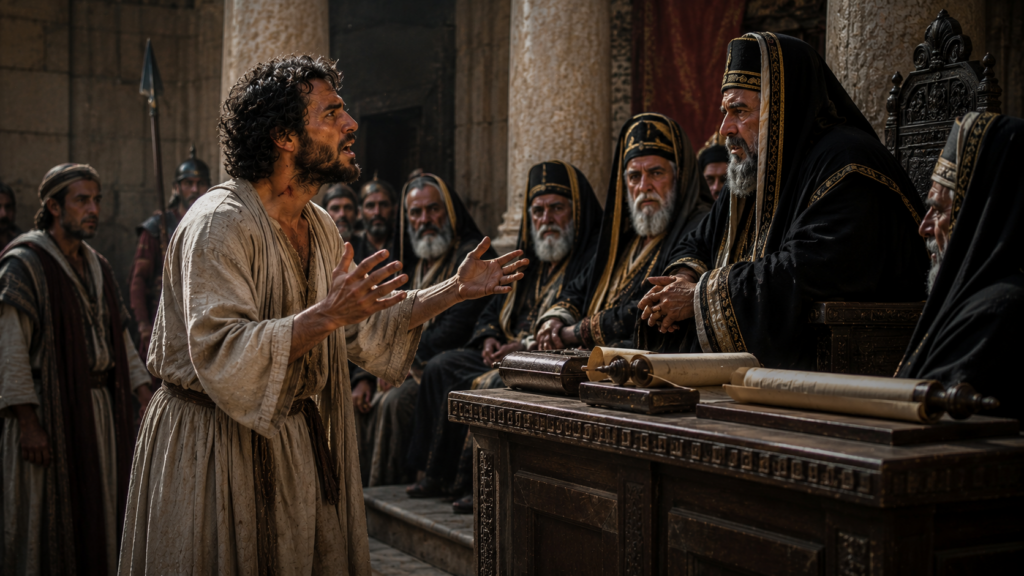
Before the Sanhedrin in Jerusalem around AD 34-35, Stephen delivers the longest speech in Acts. Retracing the history of Israel from Abraham, he shows that God's messengers have always been rejected, culminating in the rejection of the Messiah. Far from defending himself, Stephen becomes the accuser of his judges, taking his place in the line of the prophets and of Christ.

16 min Stephen's speech Sanhedrin Acts of the Apostles history of Israel Moses 19 verses 2 books

Resources

Biblical texts

Acts
Acts 7.1-53 (King James Version)

Then said the high priest, Are these things so?

And he said, Men, brethren, and fathers, hearken; The God of glory appeared unto our father Abraham, when he was in Mesopotamia, before he dwelt in Charran,

And said unto him, Get thee out of thy country, and from thy kindred, and come into the land which I shall shew thee.

Then came he out of the land of the Chaldæans, and dwelt in Charran: and from thence, when his father was dead, he removed him into this land, wherein ye now dwell.

And he gave him none inheritance in it, no, not so much as to set his foot on: yet he promised that he would give it to him for a possession, and to his seed after him, when as yet he had no child.

And God spake on this wise, That his seed should sojourn in a strange land; and that they should bring them into bondage, and entreat them evil four hundred years.

And the nation to whom they shall be in bondage will I judge, said God: and after that shall they come forth, and serve me in this place.

And he gave him the covenant of circumcision: and so Abraham begat Isaac, and circumcised him the eighth day; and Isaac begat Jacob; and Jacob begat the twelve patriarchs.

And the patriarchs, moved with envy, sold Joseph into Egypt: but God was with him,

And delivered him out of all his afflictions, and gave him favour and wisdom in the sight of Pharaoh king of Egypt; and he made him governor over Egypt and all his house.

Now there came a dearth over all the land of Egypt and Chanaan, and great affliction: and our fathers found no sustenance.

But when Jacob heard that there was corn in Egypt, he sent out our fathers first.

And at the second time Joseph was made known to his brethren; and Joseph’s kindred was made known unto Pharaoh.

Then sent Joseph, and called his father Jacob to him, and all his kindred, threescore and fifteen souls.

So Jacob went down into Egypt, and died, he, and our fathers,

And were carried over into Sychem, and laid in the sepulchre that Abraham bought for a sum of money of the sons of Emmor the father of Sychem.

But when the time of the promise drew nigh, which God had sworn to Abraham, the people grew and multiplied in Egypt,

Till another king arose, which knew not Joseph.

The same dealt subtilly with our kindred, and evil entreated our fathers, so that they cast out their young children, to the end they might not live.

In which time Moses was born, and was exceeding fair, and nourished up in his father’s house three months:

And when he was cast out, Pharaoh’s daughter took him up, and nourished him for her own son.

And Moses was learned in all the wisdom of the Egyptians, and was mighty in words and in deeds.

And when he was full forty years old, it came into his heart to visit his brethren the children of Israel.

And seeing one of them suffer wrong, he defended him, and avenged him that was oppressed, and smote the Egyptian:

For he supposed his brethren would have understood how that God by his hand would deliver them: but they understood not.

And the next day he shewed himself unto them as they strove, and would have set them at one again, saying, Sirs, ye are brethren; why do ye wrong one to another?

But he that did his neighbour wrong thrust him away, saying, Who made thee a ruler and a judge over us?

Wilt thou kill me, as thou diddest the Egyptian yesterday?

Then fled Moses at this saying, and was a stranger in the land of Madian, where he begat two sons.

And when forty years were expired, there appeared to him in the wilderness of mount Sina an angel of the Lord in a flame of fire in a bush.

When Moses saw it, he wondered at the sight: and as he drew near to behold it, the voice of the Lord came unto him,

Saying, I am the God of thy fathers, the God of Abraham, and the God of Isaac, and the God of Jacob. Then Moses trembled, and durst not behold.

Then said the Lord to him, Put off thy shoes from thy feet: for the place where thou standest is holy ground.

I have seen, I have seen the affliction of my people which is in Egypt, and I have heard their groaning, and am come down to deliver them. And now come, I will send thee into Egypt.

This Moses whom they refused, saying, Who made thee a ruler and a judge? the same did God send to be a ruler and a deliverer by the hand of the angel which appeared to him in the bush.

He brought them out, after that he had shewed wonders and signs in the land of Egypt, and in the Red sea, and in the wilderness forty years.

This is that Moses, which said unto the children of Israel, A prophet shall the Lord your God raise up unto you of your brethren, like unto me; him shall ye hear.

This is he, that was in the church in the wilderness with the angel which spake to him in the mount Sina, and with our fathers: who received the lively oracles to give unto us:

To whom our fathers would not obey, but thrust him from them, and in their hearts turned back again into Egypt,

Saying unto Aaron, Make us gods to go before us: for as for this Moses, which brought us out of the land of Egypt, we wot not what is become of him.

And they made a calf in those days, and offered sacrifice unto the idol, and rejoiced in the works of their own hands.

Then God turned, and gave them up to worship the host of heaven; as it is written in the book of the prophets, O ye house of Israel, have ye offered to me slain beasts and sacrifices by the space of forty years in the wilderness?

Yea, ye took up the tabernacle of Moloch, and the star of your god Remphan, figures which ye made to worship them: and I will carry you away beyond Babylon.

Our fathers had the tabernacle of witness in the wilderness, as he had appointed, speaking unto Moses, that he should make it according to the fashion that he had seen.

Which also our fathers that came after brought in with Jesus into the possession of the Gentiles, whom God drave out before the face of our fathers, unto the days of David;

Who found favour before God, and desired to find a tabernacle for the God of Jacob.

But Solomon built him an house.

Howbeit the most High dwelleth not in temples made with hands; as saith the prophet,

Heaven is my throne, and earth is my footstool: what house will ye build me? saith the Lord: or what is the place of my rest?

Hath not my hand made all these things?

Ye stiffnecked and uncircumcised in heart and ears, ye do always resist the Holy Ghost: as your fathers did, so do ye.

Which of the prophets have not your fathers persecuted? and they have slain them which shewed before of the coming of the Just One; of whom ye have been now the betrayers and murderers:

Who have received the law by the disposition of angels, and have not kept it.

Technical details

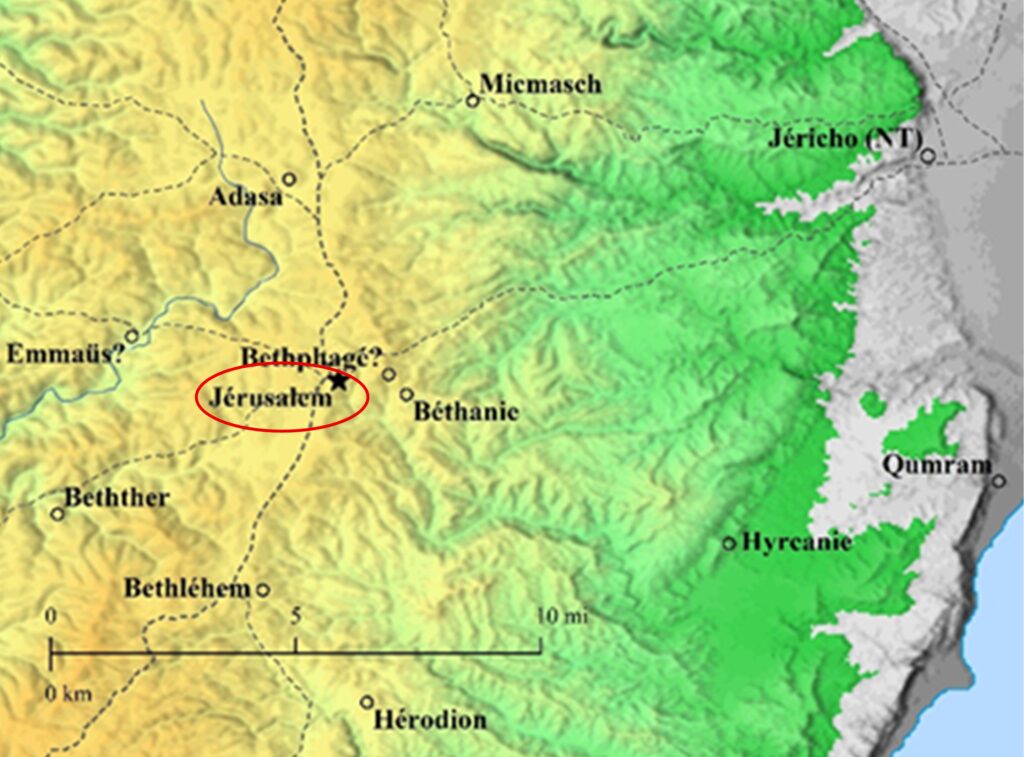
Location: City of Jerusalem

Date: the year 34 or 35

Method: We follow Luke in his second work

Note on the method: This information is found only in Luke

Map of Jerusalem and Its Surroundings

Facing the , Stephen delivers a long speech that traverses the decisive moments in the history of Israel. His aim: to show that this history finds its fulfillment in the salvation offered by Jesus Christ.

1- The longest speech in Acts

Luke devotes exceptional space to Stephen's speech, which is the longest speech reported in the book of Acts. This literary importance shows that the evangelist attributes a particular significance to it in the development of his narrative.

The considerable place given to this address suggests that Stephen had the opportunity to speak at length before the . Luke had already emphasized that his face appeared to the members of the council “like the face of an angel” (Acts 6.15). This remark might explain, at least in part, why the accused was allowed to develop his argument so extensively.

However, as with the other speeches in Acts, Luke probably did not try to reproduce the full words spoken. Faithful to the method he sets out at the beginning of his Gospel, he seems to have retained the elements he judged most significant (Luke 1.1-4).

2- An interpretation of salvation history

Stephen's argument rests on a particularly strong guiding idea. Retracing the great stages of the history of Israel, from Abraham to Solomon, he shows that God's messengers were frequently misunderstood or rejected by those to whom they were sent.

Joseph was rejected by his brothers, Moses was challenged by his people, and the prophets were persecuted. This long succession of oppositions culminates in the rejection of the Messiah himself, Jesus of Nazareth.

Stephen's speech is therefore not a mere historical retrospective. It is above all a theological interpretation of salvation history, intended to show the continuity between the unfaithfulness of past generations and the attitude of Jesus' contemporaries.

3- The central place of Moses

The considerable place given to Moses is by no means accidental. Stephen devotes the greater part of his speech to this major figure in the history of Israel and highlights in particular the episodes that reveal the rejection of the great lawgiver by his own people.

He recalls in particular that the one chosen by God to deliver Israel was at first misunderstood and pushed away by his brothers (Acts 7.25-28). Despite the wonders performed in the wilderness, the generation that came out of Egypt then turned away from him and returned to idolatry in the episode of the golden calf (Acts 7.39-41).

By a remarkable reversal, the one accused of blaspheming against Moses appears instead as the one who best grasps his place in salvation history.

4- The accused becomes the accuser

It is striking to note that Stephen does not truly seek to defend himself. To be sure, he responds indirectly to the accusations made against him concerning the Law and the Temple, by demonstrating his perfect knowledge of the Scriptures and his attachment to the heritage of Israel.

However, his main aim does not seem to be to obtain an acquittal. Like the prophets of the Old Testament, he appears more concerned with faithfulness to the message he has received than with his own fate.

After recalling the great stages of the history of Israel, he addresses the members of the directly:

“You stiff-necked people, uncircumcised in heart and ears! You always resist the Holy Spirit. As your fathers did, so do you” (Acts 7.51).

He adds:

“You who received the law as delivered by angels and did not keep it!” (Acts 7.53).

Thus the one who appears as the accused gradually becomes the accuser of his judges, who in turn find themselves placed under the judgment of the Word of God.

5- Stephen in the line of the prophets and of Christ

This reversal recalls several scenes in the Gospels in which Jesus himself, while being judged, unveils the spiritual responsibility of his adversaries.

Like his Master, Stephen does not content himself with answering the accusations made against him. His speech resembles a prophetic sermon more than a defense aimed at obtaining an acquittal.

Luke thus seems to present Stephen in continuity with the prophets of the Old Testament and in the footsteps of Christ himself. The accused becomes the faithful witness who proclaims the truth without compromise before the highest religious authorities of Judaism.

6- The effect of the speech

Stephen's words were extremely severe and could only exasperate men already hostile to his witness. In the tense context of this appearance, a violent reaction from some members of the council seems understandable.

However, it is impossible for us to assess precisely the effect this speech had on the consciences of those who heard it. Not all the members of the perhaps shared the same degree of hostility.

The presence of Saul at the (Acts 7.58) shows that this witness was borne before the man who would later become the apostle Paul. If nothing allows us to assert that Stephen's speech played a direct role in his conversion, it is hard to imagine that an event of such intensity left no trace in the memory of the future apostle.

7- A major turning point in Acts

We will not dwell here on the detailed content of the speech, which will be the subject of a particular study in the appendix entitled: “Stephen's speech.”

Let us simply point out that this address is one of the theological high points of the book of Acts. Hostility now reaches its height, and everything indicates that events will gradually slip out of control.

The appearance before the , which perhaps did not initially aim at a capital sentence, seems to degenerate in the following chapter into an outburst of collective violence.

From Luke's perspective, Stephen's witness marks a major turning point in the history of the Church. His death will cause the dispersion of the believers and will contribute, paradoxically, to the expansion of the Gospel beyond Jerusalem, in keeping with the missionary program announced by Jesus (Acts 1.8 ; Acts 8.1-4).

(Acts 1.8) ; (Acts 8.1-4) – The dispersion of the believers and the expansion of the Gospel

(Acts 6.15) ; (Luke 1.1-4) – The setting of Stephen's speech and Luke's method

(Acts 7.25-28) ; (Acts 7.39-41) – Moses rejected by his people

(Acts 7.51) ; (Acts 7.53) – The accusation made against the

(Acts 7.58) – The presence of Saul at the of Stephen


The
The
The