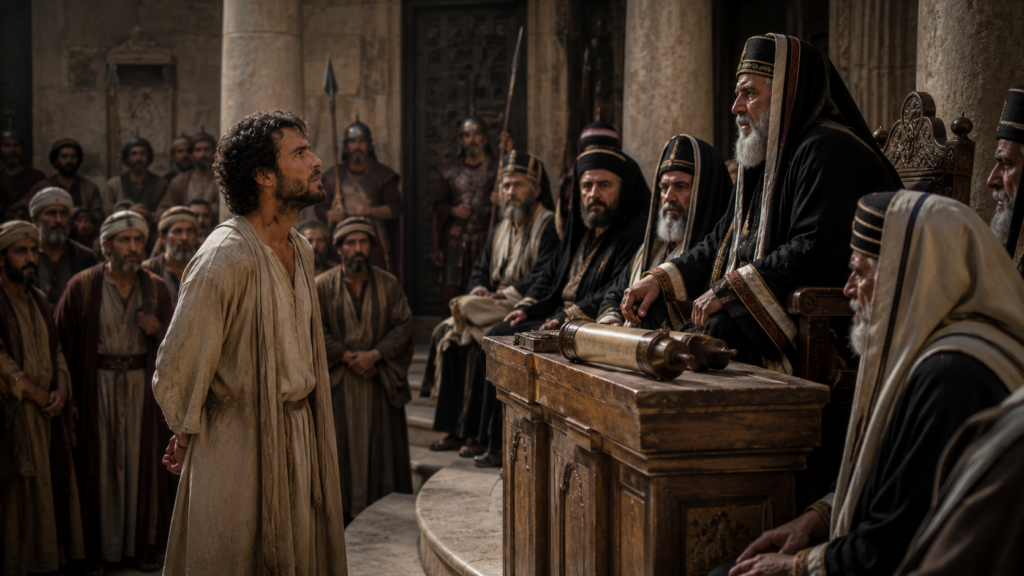
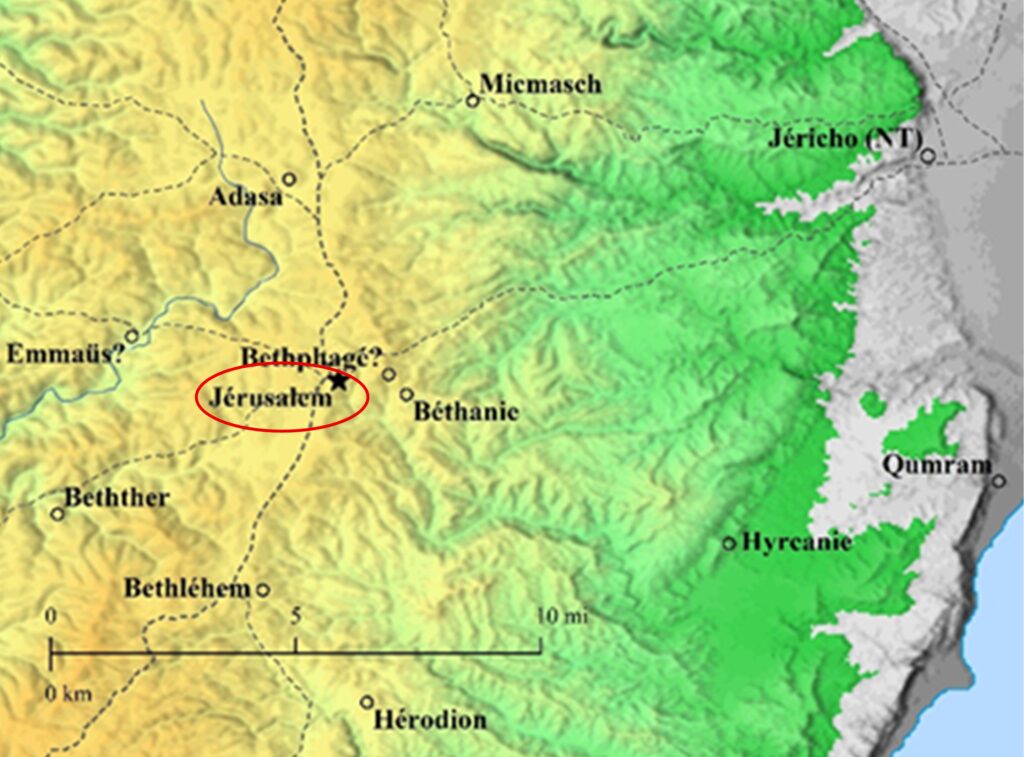
Luke gives no precise chronological indication concerning Stephen's appearance before the (Acts 6.12-15). A date around the years 34-35 seems plausible, shortly before the persecution that would break out in Jerusalem after his death (Acts 7.54-60 ; Acts 8.1-3). This proposal remains hypothetical, however.
2- The origin of the arrest
The initiative for the arrest does not seem to come directly from the high priesthood, but from opponents from the Hellenistic milieu, belonging notably to the so-called of the Freedmen as well as to groups of Jews from Cyrene, Alexandria, Cilicia, and Asia (Acts 6.9-12).
Having been unable to refute Stephen's arguments, these men stir up the people and resort to false witnesses in order to bring him before the supreme council (Acts 6.11-13).
The designation “Freedmen” probably refers to former Jewish slaves, or their descendants, who had returned to Jerusalem and were grouped together in a particular . As for the rabbinic traditions speaking of several hundred synagogues in the city, they remain difficult to verify and must be used with caution.
3- The causes of the conflict
The opposition to Stephen has its origin in public discussions. Luke specifies that his opponents “could not withstand the wisdom and the Spirit with which he spoke” (Acts 6.10). This remark recalls Jesus' promises concerning the divine assistance granted to his disciples (Luke 21.15).
Faced with their inability to refute his witness, Stephen's adversaries gradually abandon the field of discussion and resort to a legal procedure based on false accusations (Acts 6.11-13).
The narrative pattern recalls the one already observed in the Gospels and in the first chapters of Acts: success of the witness, rising opposition, popular agitation, then accusations of blasphemy or of attacking the Temple (Mark 14.55-59 ; Acts 4.1-3 ; Acts 5.17-18 ; Acts 5.27-33).
4- A procedure probably prepared in advance
Reading Acts 6.8-15 gives the impression of a very rapid succession of events. Unlike the earlier arrests of the apostles (Acts 4.3 ; Acts 5.18), no prior detention is mentioned.
However, nothing requires us to think that all these events took place within a single day. Luke himself acknowledges having carried out a work of research and selection of the facts (Luke 1.1-4). It is therefore possible that he condensed into a few verses events spread over a longer period.
The immediate presence of the false witnesses and the speed of the appearance may suggest an action prepared in advance, even if such a hypothesis cannot be demonstrated with certainty.
5- The accusations against Stephen
The accusations concern chiefly the Temple and the Law (Acts 6.13-14). They recall certain distortions already suffered by the words of Jesus (John 2.19-21) as well as the accusations made at his trial (Mark 14.58-59).
In his speech, Stephen himself will develop a conception of the Temple inherited from the prophets. Quoting Isaiah, he will recall that “the Most High does not dwell in houses made by hands” (Acts 7.48-50 ; Isaiah 66.1-2). It is therefore not a rejection of the history of Israel, but a rereading of it in the light of Christ.
6- The role of the Sanhedrin
After seizing Stephen, his adversaries bring him before the (Acts 6.12). Under Roman domination, the judicial powers of this institution were probably limited. The council could nevertheless hear a case and exercise considerable influence in a context of high tension (Acts 7.57-60).
Nothing indicates that a death sentence had already been decided. It is possible that the initial purpose of this hearing was to hear the accused or to obtain a retraction. It is only at the end of Stephen's speech (Acts 7.51-56) that the situation seems to spiral out of control.
The absence of deliberation, vote, or official sentence reported by Luke leads several exegetes to regard the of Stephen more as an outburst of collective violence than as the normal outcome of a judicial procedure.
7- The face of Stephen
Luke reports that all who sat in the saw Stephen's face “like the face of an angel” (Acts 6.15).
This expression, peculiar to Luke, evokes a grace and authority coming from God and recalls Jesus' promise concerning the assistance of the Holy Spirit in times of persecution (Luke 21.12-15). It already foreshadows the heavenly vision that Stephen will receive at the end of his speech (Acts 7.55-56).
8- Historical and literary considerations
The mention of Cilicia is of particular interest. Since Cilicia was the home region of Saul of Tarsus (Acts 21.39), several commentators have considered that he may have belonged to the group of Stephen's opponents. This hypothesis seems compatible with his presence at the (Acts 7.58) and with his own admissions concerning his past as a persecutor (Galatians 1.13). It remains, however, impossible to demonstrate with certainty.
Likewise, the close ties between Luke and Paul make it conceivable that some information about these events was passed on by the former persecutor who became an apostle (Acts 16.10-17 ; Colossians 4.14 ; 2 Timothy 4.11). This hypothesis nevertheless remains conjectural.
9- Stephen, imitator of Christ
Luke seems to have constructed his account so as to establish a striking parallel between Jesus and Stephen.
Like Jesus, Stephen is the victim of false witnesses (Mark 14.55-59 ; Acts 6.13), accused of having spoken against the Temple (Mark 14.58 ; Acts 6.14), brought before the , and confronted with authorities unable to refute his witness.
Like his Master, he commits his spirit to the Lord (Acts 7.59 ; Luke 23.46) and prays for his executioners (Acts 7.60 ; Luke 23.34). Through this literary construction, Luke presents Stephen as the first Christian martyr walking in the footsteps of Christ.
10- A turning point in Acts
The appearance of Stephen is a major turning point in the narrative. The persecution that will follow his death will cause the dispersion of the believers and promote the spread of the Gospel beyond Jerusalem (Acts 8.1-4).
From Luke's perspective, this opposition ultimately only contributes to the fulfillment of the missionary program announced by the Lord before his ascension (Acts 1.8). Thus the first martyr also becomes, in the course of the narrative, one of the instruments by which a new stage in the expansion of Christianity is opened.
(Acts 1.8) ; (Acts 8.1-4) – The dispersion of the believers and the expansion of the Gospel
(Acts 4.1-3) ; (Acts 5.17-18) ; (Acts 5.27-33) – The first persecutions against the Church
(Acts 4.3) ; (Acts 5.18) – The arrests of the apostles
(Acts 6.8-15) – The events preceding Stephen's appearance
(Acts 6.9-12) – The opposition of the Hellenistic Jews
(Acts 6.10) ; (Luke 21.15) – The wisdom inspired by the Spirit
(Acts 6.11-13) – The false witnesses against Stephen
(Acts 6.12) – Stephen brought before the
(Acts 6.13) ; (Mark 14.55-59) – The false testimonies at the trial of Stephen and of Jesus
(Acts 6.13-14) ; (John 2.19-21) ; (Mark 14.58-59) – The accusations concerning the Temple
(Acts 6.15) ; (Luke 21.12-15) – The face of Stephen and divine assistance
(Acts 7.48-50) ; (Isaiah 66.1-2) – The Most High does not dwell in temples made by human hands
(Acts 7.51-56) ; (Acts 7.57-60) – The outcome of Stephen's trial
(Acts 7.58) ; (Acts 21.39) ; (Galatians 1.13) – Saul of Tarsus and his past as a persecutor
(Acts 7.59) ; (Luke 23.46) – Stephen commits his spirit to the Lord
(Acts 7.60) ; (Luke 23.34) – Stephen's prayer for his executioners
(Acts 16.10-17) ; (Colossians 4.14) ; (2 Timothy 4.11) – The ties between Luke and Paul
(Luke 1.1-4) – Luke's historical method
The
The
The
The