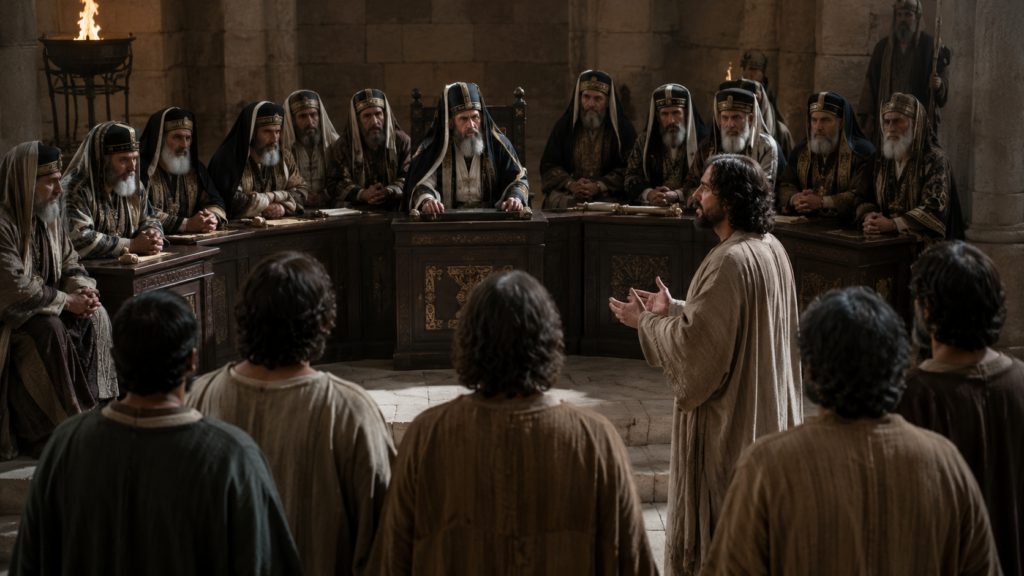

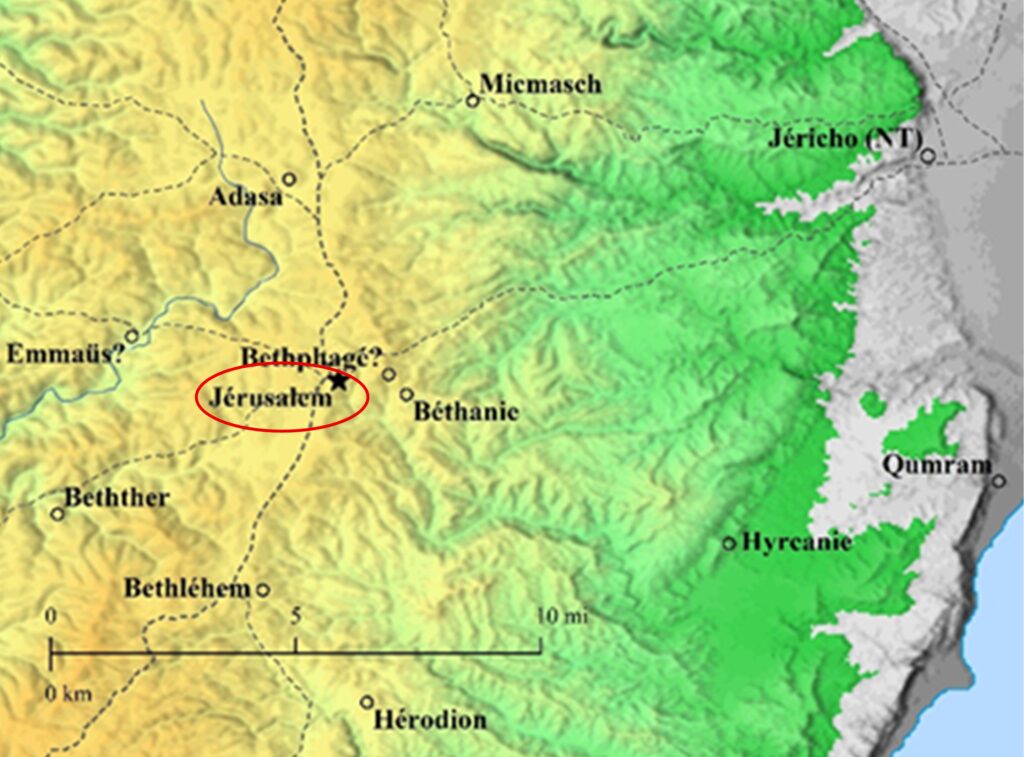
After all these events, the apostles find themselves once again before the , the assembly that represents the highest religious authorities of the Jewish nation under Roman rule (Acts 5.27). The contrast is striking. On one side stand the apostles, simple men of the people, for the most part from Galilee and lacking recognized rabbinic training (Acts 4.13); on the other, the chief priests, the elders and the scribes, invested with considerable authority.
From a human point of view, everything seems to indicate where power and authority lie. Yet appearances are deceptive. From Luke's perspective, true power is not necessarily found on the side of human institutions. Behind the prestige of the lies a profound powerlessness in the face of God's sovereign action and the work of the Holy Spirit (Acts 4.29-31 ; Acts 5.39).
2- The accusation of the high priest
It is Caiaphas, the high priest from the , who takes the initiative in the interrogation. His reproach is unequivocal:
“We strictly charged you not to teach in this name, and behold, you have filled Jerusalem with your teaching, and you intend to bring this man's blood upon us” (Acts 5.28).
Remarkably, the high priest even avoids pronouncing the name of Jesus and refers to him by the expression “this man.” Yet the one whose name he refuses to utter is the one whose message the apostles now proclaim throughout the city. Paradoxically, his accusation is also an involuntary admission of the success of the apostolic preaching, since Jerusalem has been “filled” with this teaching.
This reference to “this man's blood” is also significant. A few weeks earlier, the religious authorities had demanded the condemnation of Jesus before Pilate (John 19.6-16), and the crowd had declared: “His blood be on us and on our children” (Matthew 27.25). Now the Jewish leaders seek to free themselves of any responsibility for that condemnation.
3- Obedience to God
Peter then speaks on behalf of all the apostles. His reply bears witness to remarkable confidence and deep faithfulness to God. Taking up a fundamental principle of Judaism, he declares:
“We ought to obey God rather than men” (Acts 5.29).
The apostles do not regard themselves as rebels or revolutionaries. They see themselves above all as servants charged with carrying out the mission the risen Christ entrusted to them (Matthew 28.19-20 ; Acts 1.8). Their obedience to the Lord Jesus implicitly expresses their recognition of his divine authority.
This declaration recalls the words of Jesus himself, who had warned his disciples that they would be brought before the courts and would have to bear witness before the authorities (Matthew 10.17-20 ; Luke 21.12-15).
4- The testimony given to Christ
Peter continues his speech by proclaiming that Jesus, rejected and put to death, was raised by God and exalted to his right hand as Prince and Savior in order to grant Israel repentance and forgiveness of sins (Acts 5.30-31).
This summary of the Gospel takes up several themes already developed in the preceding apostolic speeches (Acts 2.22-24 ; Acts 3.13-15). Once again, the responsibility of the authorities in the death of Jesus is recalled, but this accusation is immediately accompanied by the announcement of divine grace. Even those who took part in the rejection of the Messiah are still called to repentance and can receive forgiveness of sins (Acts 3.17-19).
It is remarkable that the apostles do not seek to secure their own defense. Their priority remains the proclamation of the Gospel. Before the same court that had condemned Jesus a few weeks earlier (John 18.13-24), they fulfill their mission as witnesses of Christ (Acts 1.8).
5- The anger of the Sanhedrin
On hearing these words, the members of the priestly party are deeply exasperated. Luke reports that they were “enraged” and that they deliberated on how to put the apostles to death (Acts 5.33).
This reaction already foreshadows the one that will lead, a few months later, to the martyrdom of Stephen. There too, the inability to refute the Christian testimony will turn into violence (Acts 7.54-60). In both cases, the proclamation of the risen Jesus provokes growing hostility the religious authorities.
Although the no longer officially possessed the right to carry out a capital sentence without the approval of the Roman authorities (John 18.31), certain later episodes will show that acts of violence could nevertheless be tolerated or encouraged in certain circumstances.
6- The first signs of division
Another element also deserves to be underlined. From Luke's perspective, the religious authorities appear increasingly unable to check the progress of the Christian movement. The threats made to the apostles have produced no result, the prohibitions pronounced by the have remained without effect, and the disciples continue to teach with growing confidence (Acts 4.18-20 ; Acts 5.28).
Moreover, the no longer appears as a perfectly homogeneous bloc. Nothing certainly allows us to affirm that an open division already exists, but the account hints at differing sensibilities within the assembly. These differences will become clearer during the intervention of (Acts 5.34-39) and will appear openly several years later at the trial of Paul, when and publicly oppose one another (Acts 23.6-10).
7- A work that men cannot stop
By contrast, the apostles display remarkable unity and great confidence. Their attitude contrasts sharply with the embarrassment and hesitations of their opponents. Once again, Luke highlights the sovereign action of God and the work of the Holy Spirit, which enable the witnesses of Christ to pursue their mission despite opposition (Acts 4.29-31).
One of the great themes of the book of Acts thus appears with growing clarity: the irresistible progress of the Word of God. Since Christ's promise before his ascension (Acts 1.8), nothing seems able to prevent the expansion of the Gospel. This idea will recur regularly throughout the account (Acts 6.7 ; Acts 12.24 ; Acts 19.20 ; Acts 28.30-31).
A few verses later, himself will formulate this principle by declaring: “If this work is from God, you will not be able to destroy it” (Acts 5.39). From Luke's perspective, persecutions, threats and imprisonments are therefore not obstacles capable of compromising the divine purpose. On the contrary, they paradoxically help to bring out the sovereignty of God and the effectiveness of his Word (Isaiah 55.11).
(Acts 1.8) ; (Acts 6.7) ; (Acts 12.24) ; (Acts 19.20) ; (Acts 28.30-31) – The progress of the Gospel
(Acts 2.22-24) ; (Acts 3.13-15) ; (Acts 3.17-19) ; (Acts 5.30-31) – Apostolic preaching and salvation in Jesus Christ
(Acts 4.13) – The apostles before the religious authorities
(Acts 4.18-20) ; (Acts 5.28) ; (Acts 5.29) – The prohibition to preach and obedience to God
(Acts 4.29-31) ; (Acts 5.39) – The sovereign action of God and the Holy Spirit
(Acts 5.27) – The appearance of the apostles before the
(Acts 5.33) ; (Acts 7.54-60) – The anger of the and the martyrdom of Stephen
(Acts 5.34-39) ; (Acts 23.6-10) – The divisions within the
(Isaiah 55.11) – The effectiveness of the Word of God
(Matthew 10.17-20) ; (Luke 21.12-15) – The disciples brought before the authorities
(Matthew 27.25) ; (John 19.6-16) – The responsibility of the authorities in the condemnation of Jesus
(Matthew 28.19-20) – The mission entrusted to the disciples
(John 18.13-24) – Jesus before the high priest
(John 18.31) – The limits of the judicial power of the
The