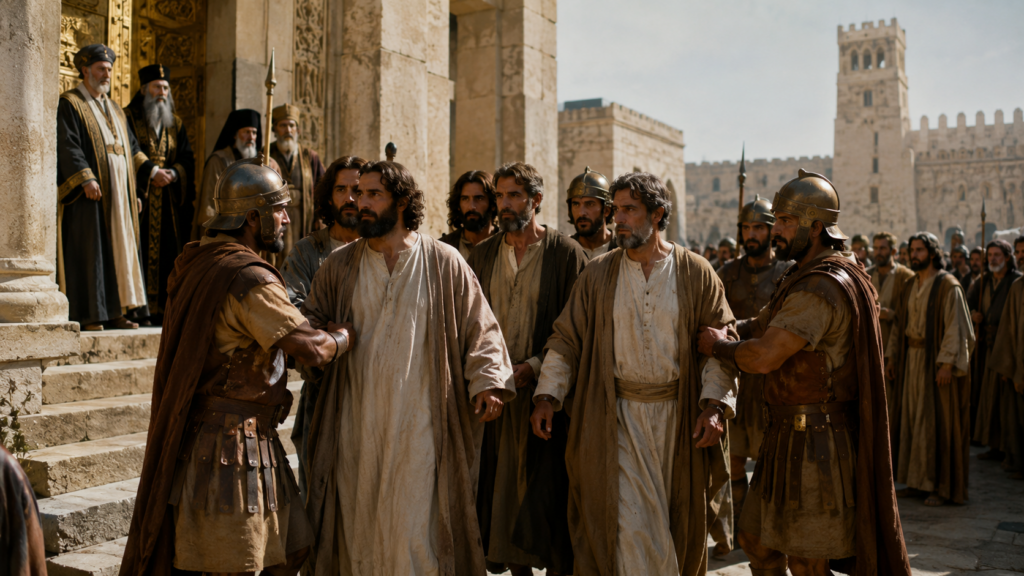

In the morning, the high priest convened the together with the assembly of the elders of Israel in order to bring the apostles before the Jewish court (Acts 5.21). What should have been an ordinary procedure was nevertheless about to take an unexpected turn.
When the guards arrived at the prison to bring the detainees out, they discovered with astonishment that the cells were empty. The surprise was all the greater because everything seemed perfectly normal: the doors were carefully locked and the guards were still at their posts (Acts 5.23). There was no clue to explain this mysterious disappearance.
Luke relates these facts with great restraint. He does not dwell on the circumstances of the miraculous deliverance, already mentioned earlier (Acts 5.19), but above all emphasizes the perplexity and embarrassment of the religious authorities. As often in the book of Acts, the main interest of the account lies not in the spectacular character of the event, but in the way God sovereignly pursues his work despite human opposition (Acts 4.27-28).
2- The embarrassment of the authorities
The situation was particularly embarrassing for those in charge of the prison. The whole had been assembled to judge the apostles, and the disappearance of the prisoners threatened to compromise the entire proceedings. The captain of the Temple and the chief priests then wondered anxiously what this affair might mean (Acts 5.24).
This remark of Luke is interesting. The authorities have no rational explanation and find themselves confronted with an event beyond their control. Yet the account gives no hint of any reconsideration of their opposition to the Christian movement. Their main concern remains the arrest of the apostles, not the meaning of what has just happened.
While they are still in uncertainty, a messenger comes to tell them that the men they are looking for are again in the Temple and are teaching the people (Acts 5.25). Instead of regarding this extraordinary event as a warning or a sign of divine intervention, the religious leaders simply decide to have the apostles arrested a second time in order to bring them before the .
3- The captain of the Temple and his guard
Luke emphasizes the precautions taken by the captain of the Temple and the guards who accompany him (Acts 5.24-26). These are not soldiers, but the placed under the authority of the high priest (Acts 4.1). This Jewish police force was responsible for maintaining order within the sacred precincts. The generally intervened only when public safety was seriously threatened.
The captain of the Temple also held an important position in the religious hierarchy. He seems to have been the person chiefly responsible for maintaining order in the Temple, and he came immediately after the high priest in the priestly organization. His involvement in the first persecutions underlines the direct implication of the religious authorities in this affair (Acts 4.1 ; Acts 5.24).
4- The fear of a popular reaction
The religious leaders had understood that the apostles enjoyed growing sympathy among a significant part of the population. The many miracles performed, as well as their teaching, had aroused deep sympathy among the people (Acts 5.12-16). Luke thus specifies that the captain of the Temple and his men avoided resorting to force, fearing that they would be stoned by the people (Acts 5.26).
This fear recalls the one that had already led the authorities to act cautiously at the first arrest of Peter and John (Acts 4.21). Some years earlier, the chief priests and the elders had likewise hesitated to arrest Jesus publicly, because they dreaded the reaction of the crowd (Matthew 21.46 ; Mark 12.12 ; Luke 20.19). From Luke's perspective, the apostles thus follow the same path as their Master and meet the same opposition.
A riot within the Temple precincts could have provoked the intervention of the Roman troops stationed in the Antonia fortress. The religious leaders had every interest in preserving public order, for their authority depended in part on their ability to keep the peace in the city.
5- A second arrest without resistance
This caution on the part of the authorities therefore appears perfectly understandable. Everything took place without incident, for the apostles offered no resistance. Nothing in the account suggests that they tried to flee or to escape their accusers. On the contrary, they agree to follow the guards in order to appear once again before the .
This peaceful attitude is in keeping with the recommendations Jesus had given his disciples when he warned them that they would be brought before governors and kings for his name's sake (Matthew 10.18-20 ; Luke 21.12-15). It also illustrates the principle that Peter will soon express before his judges: “We must obey God rather than men” (Acts 5.29).
Far from being discouraged by their arrest and their night of detention, the apostles remain convinced that the work of God cannot be stopped by human decisions. This conviction is one of the major themes of the book of Acts and will soon find its most famous expression in the words of : “If this work is from God, you will not be able to destroy it” (Acts 5.39).
(Acts 5.21) – The convening of the
(Acts 5.23) – The discovery of the empty cells
(Acts 5.24-25) – The perplexity of the religious authorities
(Acts 5.24-26) ; (Acts 4.1) – The captain of the Temple and his guard
(Acts 5.12-16) ; (Acts 5.26) ; (Acts 4.21) – The favor of the people and the caution of the authorities
(Acts 5.19) ; (Acts 4.27-28) ; (Acts 5.39) – The sovereignty of God
(Acts 5.29) ; (Matthew 10.18-20) ; (Luke 21.12-15) – The obedience of the apostles and the persecutions foretold
(Matthew 21.46) ; (Mark 12.12) ; (Luke 20.19) – The fear of the crowd among the religious leaders
The
The and the Roman garrison of the Antonia fortress