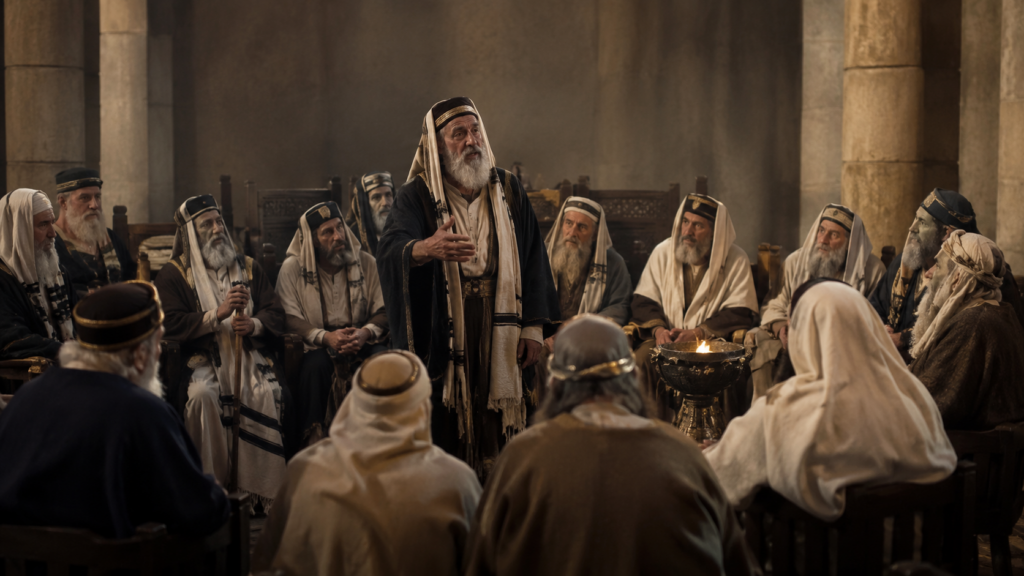

After the apostles had left, the members of the began to deliberate on the attitude to adopt in this unprecedented situation. Peter's words had aroused fierce anger among the members of the council, to the point that several of them were considering putting the apostles to death (Acts 5.33). Opposition to the Christian movement then seemed to be reaching a new level of gravity.
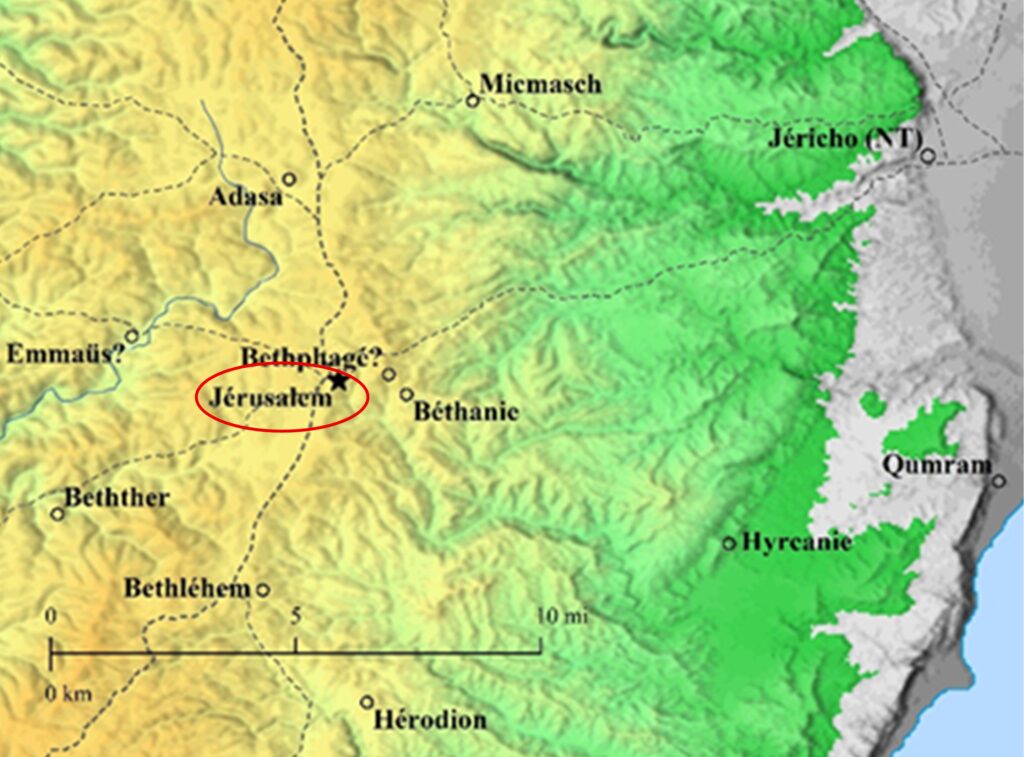
It was in this context that intervened, a , a teacher of the Law respected by all the people (Acts 5.34). Several years later, Paul would recall that he had been trained in Jerusalem at the school of this renowned master (Acts 22.3). His intervention shows that the was not a perfectly homogeneous body. Although the , represented notably by the high priest, exercised considerable influence, not all the members of the council necessarily shared the same assessment of the Christian movement.
2- A speech marked by caution
As the discussions become particularly heated, rises to speak. Thanks to the prestige he enjoys and the moderation of his speech, he manages to turn the assembly away from an extreme decision. He urges his colleagues to be cautious and reminds them of several historical precedents.
He first mentions Theudas, then Judas the Galilean, whose movements had disappeared after the death of their leaders (Acts 5.36-37). His reasoning is characterized by pragmatism: if this undertaking is of human origin, it will vanish of itself; but if it comes from God, no one will be able to destroy it. Those who sought to oppose it might even find themselves fighting against God (Acts 5.38-39).
From Luke's perspective, these words take on particular significance. Without explicitly acknowledging the divine origin of Christianity, states a principle that sums up one of the major themes of the book of Acts: the work of God cannot be stopped by men (Acts 1.8 ; Acts 5.39).
3- The prudence of Gamaliel
The bears witness above all to an attitude marked by caution and discernment. He does not explicitly recognize the divine origin of the Christian movement and does not openly take up the defense of the apostles. His aim seems rather to be to prevent a hasty decision and to recommend a wait-and-see approach.
His reasoning rests on a conviction widely shared in Judaism: time eventually reveals the true origin of a work. If the movement begun by the disciples of Jesus is purely human, it will disappear like those of Theudas and Judas the Galilean (Acts 5.36-37). If, on the other hand, this work comes from God, it would be futile and even dangerous to try to oppose it (Acts 5.38-39).
It is also possible that more practical considerations helped favor a moderate solution. Luke indeed stresses the favor the apostles enjoyed among a significant part of the people (Acts 5.13) and recalls that the guards had acted without violence for fear of a popular reaction (Acts 5.26). In this context, a death sentence risked causing disturbances that the religious authorities no doubt wished to avoid.
From Luke's perspective, however, the words of take on a deeper significance than their author probably intended. Without confessing the Christian faith, this states a principle that agrees with one of the great themes of the book of Acts: no human opposition can prevent the accomplishment of God's purpose (Acts 1.8 ; Acts 5.39).
4- The sentencing of the apostles
The members of the council allowed themselves to be persuaded by the arguments of and gave up their plan to put them to death (Acts 5.40). The apostles were then called back before the assembly.
However, the did not intend to give up its authority. After having the apostles flogged, the authorities renewed the prohibition against speaking in the name of Jesus before releasing them (Acts 5.40). This flogging, probably in keeping with the prescriptions of the Law of Moses (Deuteronomy 25.1-3), was a particularly humiliating and painful punishment.
This intermediate sentence can be understood as a compromise between the desire of some members of the council to punish the apostles severely and the more moderate attitude advocated by .
5- A powerless opposition
Once again, the religious authorities prove unable to prevent the progress of nascent Christianity. Despite threats, arrests and punishments, the apostolic preaching continues to develop in accordance with the program announced by Christ before his ascension (Acts 1.8).
From Luke's perspective, even persecutions fail to obstruct God's purpose. On the contrary, they help to bring out divine sovereignty and the effectiveness of his Word (Isaiah 55.11 ; Acts 6.7 ; Acts 12.24 ; Acts 19.20).
(Acts 1.8) ; (Acts 5.39) ; (Acts 6.7) ; (Acts 12.24) ; (Acts 19.20) – The progress of the Gospel and the work of God
(Acts 5.13) ; (Acts 5.26) – The favor of the people toward the apostles
(Acts 5.33) – The anger of the
(Acts 5.34) ; (Acts 22.3) – , teacher of the Law and teacher of Paul
(Acts 5.36-37) – Theudas and Judas the Galilean
(Acts 5.38-39) – The counsel of
(Acts 5.40) – The flogging of the apostles
(Genesis 50.20) ; (Proverbs 21.1) – God directs events according to his purpose
(Deuteronomy 25.1-3) – The punishment of flogging in the Law of Moses
(Isaiah 55.11) – The effectiveness of the Word of God
The
The
A ?