
The detail Luke provides about the time of this event is probably not insignificant. It suggests that the first disciples in Jerusalem continued to live by the rhythm of the Temple's activities and to observe the different moments of the day marked by sacrifices and prayers.
The ninth hour, which corresponds approximately to three o'clock in the afternoon, was traditionally associated with the evening prayer and with the continual sacrifice offered in the Temple (Exodus 29.39; Numbers 28.4). The various trumpet calls associated with the Temple's activities were known to the whole population and set the rhythm of Jerusalem's religious life.
2- Peter and John in the Temple
Peter and John therefore naturally go to the Temple at this busy hour (Acts 3.1). The nascent Church had not yet separated from Judaism, and the disciples continued to attend the Temple daily (Acts 2.46). This place was also an ideal setting for proclaiming the Gospel to a great number of pilgrims and inhabitants of Jerusalem.
3- The lame man and the gate called “Beautiful”
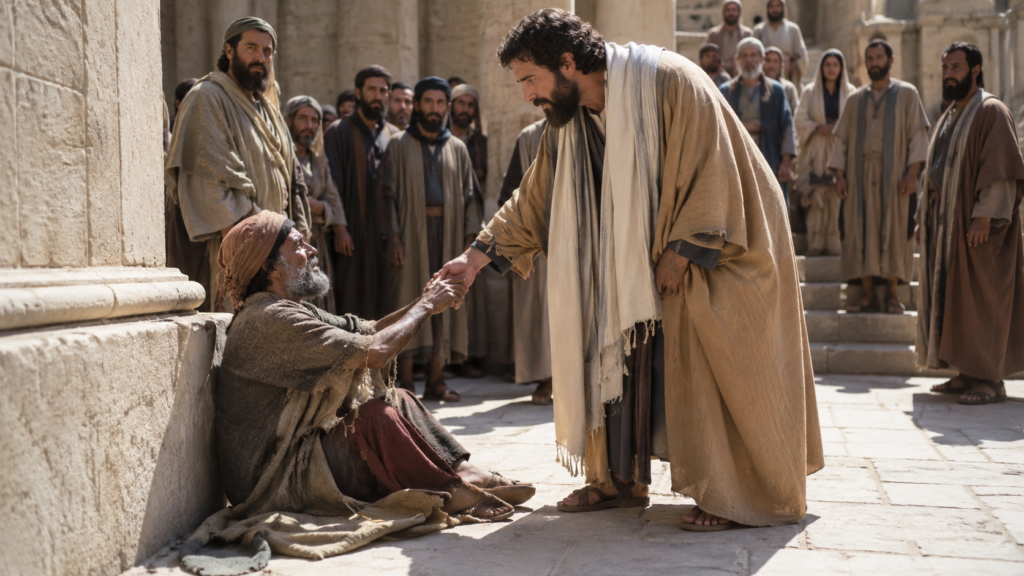
As they are about to enter the sacred precinct, the two apostles come across a man crippled from birth who was carried there every day so that he could beg from the worshipers coming to pray (Acts 3.2). Luke specifies that he was placed near the gate called “Beautiful.”
If this gate does indeed correspond to the Nicanor Gate, a hypothesis held by many scholars, the man was then in a part of the Temple reserved for Jews. Nothing in the Law of Moses forbade a disabled person from entering these courts. The restrictions mentioned in the Law concerned only the priests called to carry out their ministry (Leviticus 21.17-23).
4- A beggar among the worshipers
Like many beggars of the time, this man took advantage of the passage of worshipers to appeal to their generosity. Almsgiving was in fact considered in Judaism a work of piety of particular importance (Matthew 6.1-4). Seeing Peter and John entering the Temple, he naturally asked them for material help (Acts 3.3).
5- The ministry of the apostles under the action of the Holy Spirit
During the earthly ministry of Jesus, the disciples had already received authority to preach and to heal the sick (Matthew 10.1; Mark 6.12-13). However, their efforts were not always crowned with success, as shown by their inability to deliver the possessed boy after the transfiguration (Mark 9.17-29).
Now, after Pentecost, they could no longer turn to their Master to receive his instructions directly. The presence of the Holy Spirit, promised by Jesus himself, became indispensable for continuing the work he had entrusted to them (John 14.26; Acts 1.8).
The miracles recounted in the Acts of the Apostles should therefore not be interpreted as the manifestation of a power belonging to the apostles themselves, but as the continuation of the ministry of the risen Christ at work through his nascent Church.
6- A miracle in the service of proclaiming the Gospel
Here we witness the first miracle of Peter reported in detail by Luke. Performed before a crowd of astonished witnesses, this spectacular event is nevertheless only an introduction to the real concern of the account.
As we will see in the next study, the miracle itself is only a prelude to Peter's speech, which reveals its whole spiritual and christological meaning (Acts 3.12-26). In the Acts of the Apostles, miracles are never an end in themselves; they serve above all to draw attention to the message of salvation and to the person of Jesus the Messiah.
The
The
The