

Luke himself specifies that he has reported only part of the speech Peter delivered. He adds, in fact: “And with many other words he bore witness and continued to exhort them, saying, ‘Save yourselves from this crooked generation’” (Acts 2.40). This remark suggests that the apostle developed his argument for the messiahship of Jesus at even greater length and called his hearers to repentance and faith.
2- The impact of Peter's preaching
The effect of this preaching was considerable. The hearers, deeply touched by Peter's words, responded favorably to his appeal and asked to be baptized (Acts 2.37-41). This reaction shows that the apostolic speech had achieved its purpose.
The Jewish pilgrims present in Jerusalem, already familiar with the Scriptures and nourished by messianic hope, were particularly receptive to a demonstration based on the Law, the Psalms and the prophets (Acts 2.14-36).
3- Unexpected growth
The sudden influx of new believers must have deeply impressed the apostles and the other disciples. Now deprived of the physical presence of their Master, they could no longer turn to him to receive his instructions directly. Taking charge of a community that had just grown by about three thousand people was a considerable challenge and marked the beginning of a new stage in the history of the Church (Acts 2.41).
In this context, the coming of the Holy Spirit proved immediately indispensable in order to guide this nascent assembly spiritually and to enable the apostles to accomplish the mission the Messiah had entrusted to them (Acts 1.8; John 14.26; John 16.13).
4- The first Christian baptisms
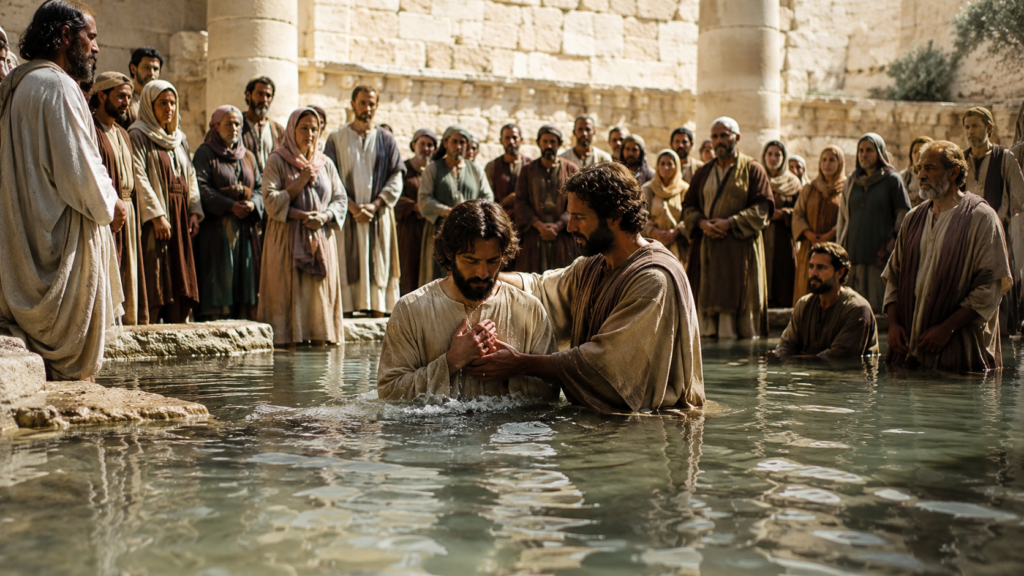
It seems probable that the group of one hundred and twenty disciples quickly organized itself to cope with this unexpected growth (Acts 1.15). The baptisms administered that day were in continuity with those previously practiced by John the Baptist (Mark 1.4-5) and by the disciples of Jesus at the beginning of his ministry (John 3.22; John 4.1-2).
Baptism now appears as the visible sign of adherence to the message of the Gospel and as the point of entry into this new community.
5- A new meaning of baptism
Immersion itself was nothing unusual for these devout Jews. For a long time the prescriptions of Judaism had provided for various ritual washings meant to symbolize purification (Leviticus 15.5-13; Mark 7.3-4). The many purification pools located around the Temple also made these immersions easy to practice.
However, Christian baptism now received a new meaning. It no longer expressed only a symbolic purification or a preparation for the coming of the Messiah, as in the preaching of John the Baptist, but was associated with repentance, the forgiveness of sins, and the redemptive work accomplished by Jesus in his death and resurrection (Acts 2.38; Romans 6.3-4).
The redemption obtained by Christ's sacrifice thus formed the very foundation of this baptism, a dimension absent from John's ministry, which only prepared hearts for the coming of the Savior (Luke 3.3-6; John 1.29).
6- A Church led by the Holy Spirit
It is likely that a considerable amount of improvisation characterized this exceptional day. None of the disciples had probably foreseen a result of such magnitude. It is precisely in this context that the action of the Holy Spirit appears as essential.
All had been filled with the Holy Spirit at the beginning of this extraordinary day (Acts 2.1-4), and this divine presence enabled the whole community, men and women, to act with wisdom and in the order needed to welcome and care for this multitude of new believers.
Thus, from its very first moments, the Church showed that it rested not on human abilities alone but on the sovereign action of the Holy Spirit, in keeping with the promise of the risen Lord (Acts 1.4-5; Zechariah 4.6).
The
The
?