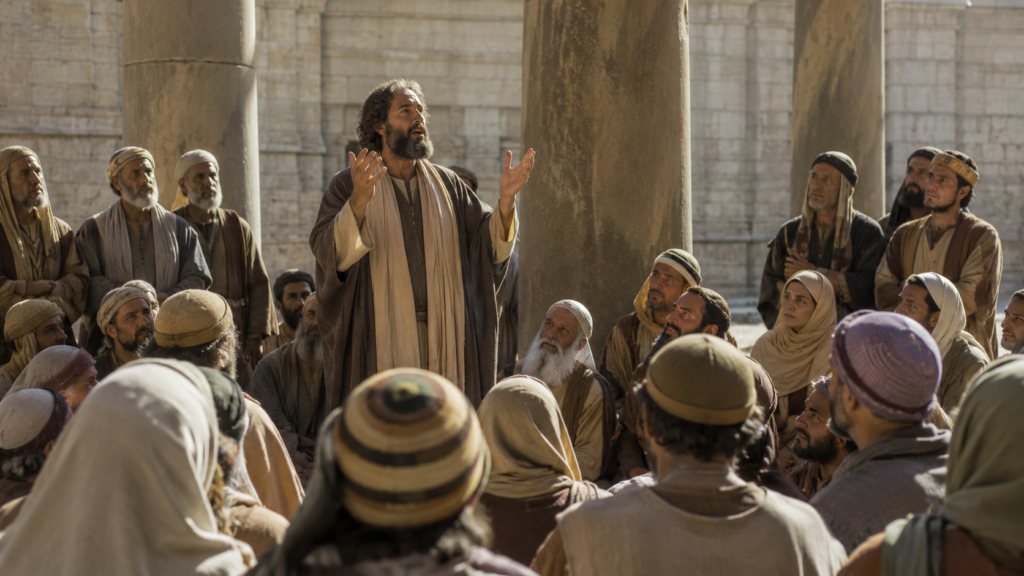

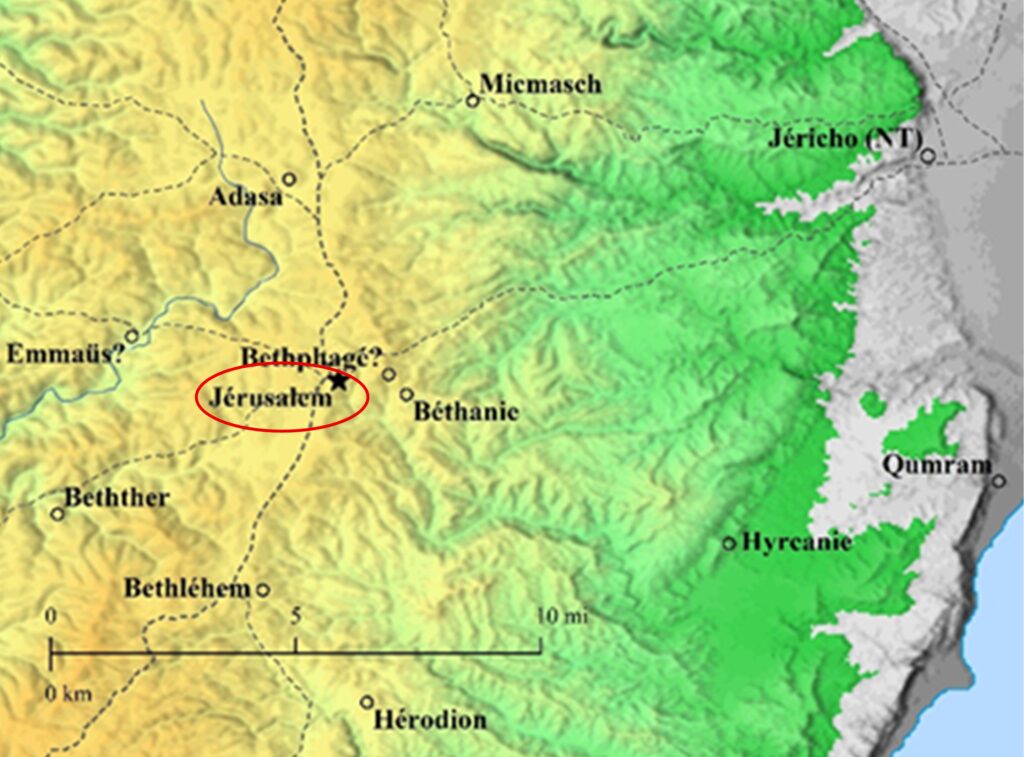
Faced with the ever-growing crowd, it seems likely that Peter and the other disciples made their way to the surroundings of the Temple, the only place able to hold such an assembly. It is in this exceptional context that Peter understands that it falls to him to speak and announce the Gospel to this multitude. In doing so, he follows the example set by his Master, whose teachings and method of evangelism had deeply marked his memory (Matthew 5.1-2; Luke 8.1).
2- The transformation of Peter
The contrast with the Peter we met a few weeks earlier is particularly striking. Fifty-three days earlier, in the courtyard of the high priest, the man who was to become the principal spokesman of the Twelve had denied his Master out of fear (Matthew 26.69-75; John 18.15-27). Now this same man stands before an immense crowd with remarkable assurance.
This inner transformation appears as one of the first concrete manifestations of the Holy Spirit's action in the lives of the apostles, in keeping with the Lord's promise: “you will receive power when the Holy Spirit has come upon you, and you will be my witnesses” (Acts 1.8).
It seems natural that Peter should take the initiative of this first great Christian speech. Since the beginning of Jesus' ministry, he frequently appears as the spokesman of the apostolic group (Matthew 16.16; John 6.68-69). Nothing indicates that he had prepared this speech in advance. The assurance he displays recalls the words of Jesus announcing that the Holy Spirit would assist his disciples when they had to bear witness (Matthew 10.19-20; Luke 12.11-12).
3- A speech grounded in the Scriptures
The speech itself stands out for its clarity and authority. Peter begins by refuting the accusation of drunkenness made by some (Acts 2.13-15), and then he interprets the events of Pentecost in the light of Joel's prophecy (Joel 2.28-29; Acts 2.16-21).
He then presents Jesus of Nazareth, recalling his ministry, his miracles, his death and above all his resurrection (Acts 2.22-24), before demonstrating, from the Psalms, that these events had been announced by the Scriptures (Psalms 16.8-11; Psalms 110.1; Acts 2.25-36). His argument thus rests on the testimony of the Scriptures and on that of the apostles, who had become witnesses of the resurrection of Jesus the Messiah (Acts 1.22).
4- A call to repentance
Peter's words deeply touch the consciences of his hearers (Acts 2.37). Many of them had probably heard of Jesus, had been present at his condemnation, or had witnessed the extraordinary phenomena that accompanied his death, notably the darkness and the earthquake (Matthew 27.45; Matthew 27.51-54). The apostolic speech now provides an interpretation of these events and presents Jesus as the Messiah announced by the prophets.
We also find in Peter's words certain accents of the ministry of John the Baptist. Like him, he calls his hearers to repentance and to water baptism (Matthew 3.1-6; Mark 1.4). However, an essential novelty appears: Peter also announces the gift of the Holy Spirit promised by God (Acts 2.38-39). This promise is one of the signs of the new covenant announced by the prophets (Jeremiah 31.31-34; Ezekiel 36.25-27).
5- Baptism in the name of Jesus Christ
Baptism is now administered in the name of the Lord Jesus Christ (Acts 2.38). By this formula, Peter underlines that the forgiveness of sins now rests on the redemptive work of the Messiah and no longer on the repetition of the Temple sacrifices (Hebrews 9.11-14; Hebrews 10.10-14).
Without immediately breaking with the practices of Judaism, this preaching lays the foundations of what would gradually become the norm of the nascent Church. The theological depth of this speech, only a few weeks after the crucifixion, is one of the most remarkable testimonies to the action of the Holy Spirit in the lives of the apostles (John 14.26; John 16.13).
6- Three thousand new believers
The result of this first Christian preaching is quite remarkable. Touched to the heart, many hearers welcome Peter's word (Acts 2.37). That day, about three thousand people join the community of disciples (Acts 2.41).
The Church thus enters a new phase of its history. What had been until then a small group of about one hundred and twenty believers (Acts 1.15) suddenly becomes a community of several thousand people. The expansion announced by Jesus begins to be realized under the action of the Holy Spirit, who immediately proves indispensable for the direction and growth of the nascent Church (Acts 1.8).
?
The