
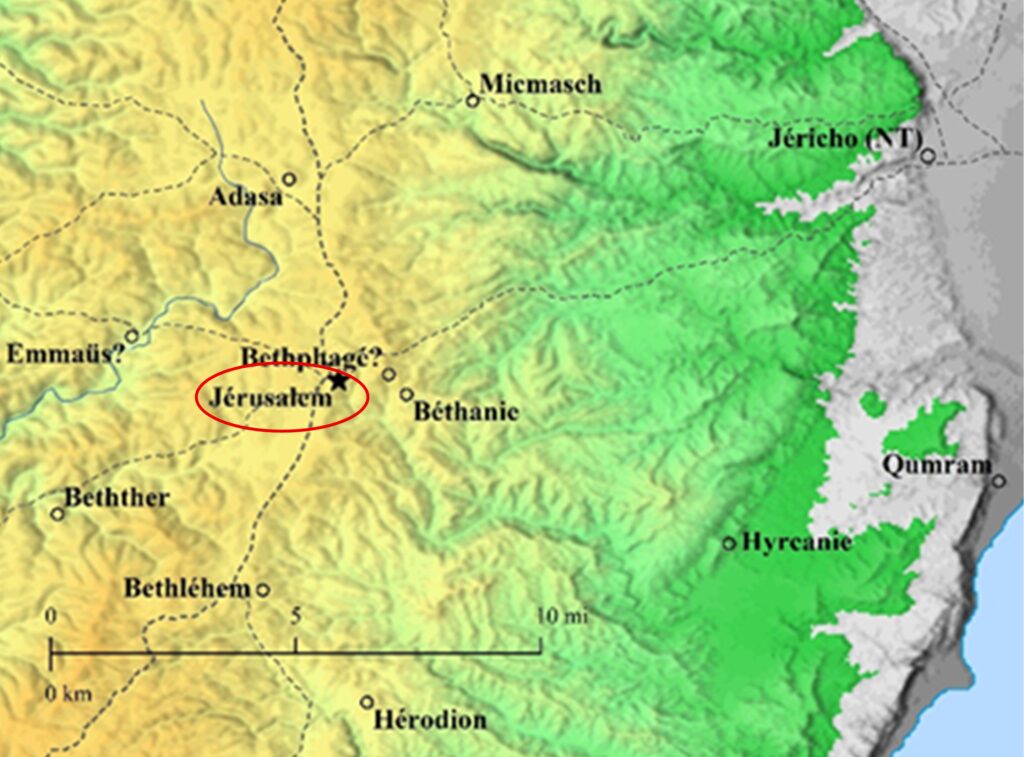

_17 The appearance before the should have taken place after sunrise at 6:38 a.m. But this was not the case, because at the moment the rooster crows the Master is, according to our interpretation of Luke’s text, taken to Pilate right after the sentence of the , which therefore waited for daybreak to pronounce it. Luke 22.66-71, Mark 15.1, Matthew 27.1-2.
_18 The first appearance before Pontius Pilate begins around 6:45 a.m. Mark 15.1-5, Matthew 27.2-14, Luke 23.1-5, John 18.28-38.
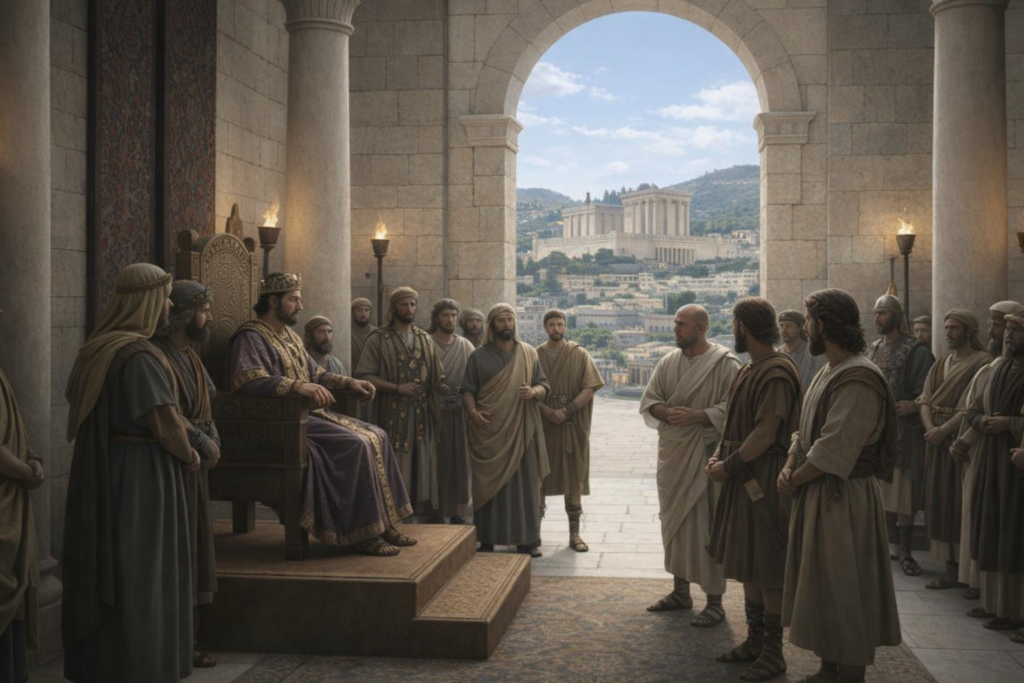
_19 We place the appearance before Herod Antipas at around 7:30 a.m. Luke 23.6-12.
You can consult the complete chronology in the study ANN026 : The hour of the crucifixion.
Commentary:
When Pilate learns that the Messiah Jesus is a Galilean, he immediately seizes the opportunity to rid himself of this delicate matter. He therefore sends him to Herod Antipas, tetrarch of Galilee, who is in Jerusalem for the feast, lodged in the royal apartments once built by his father, Herod the Great. Antipas, who was ambitious, hoped one day to become king, and he used the great feasts to assert his political presence in the capital.
This same Herod Antipas had put John the Baptist to death (Mark 6.17-28). Since then, he had heard of another powerful prophet, the Messiah Jesus, and certain rumors had even led him to believe that John might have risen again in him (Luke 9.7-9). Herod is fascinated by the spectacular. He loves marvels, extraordinary signs, displays of power. He therefore hopes that the Messiah Jesus will perform a miracle before him, as a royal entertainment.
But he is profoundly mistaken about the nature of the Son of God. The Messiah Jesus is not a wonder-worker come to satisfy the curiosity of the powerful. He is the Messiah come to carry out the Father’s plan of salvation (John 3.16-17). That is why, faced with Herod’s many questions, Jesus does not speak a single word (Luke 23.9). His silence is a judgment. He refuses to play the game of a shallow, immoral and murderous ruler.
The interview therefore quickly comes to an end. Herod, offended by this silence, would normally have had the insolent man flogged. But he does not dare go too far, because Jesus was sent to him by Pilate. So he contents himself, together with his soldiers, with mocking Jesus, dressing him in a splendid robe, perhaps a parody of a royal robe, and sending him back to Pilate (Luke 23.11).
Yet an unexpected event occurs: Pilate and Herod become friends that very day (Luke 23.12). Until then they had been on bad terms, probably because of political tensions between Judea and Galilee. But Jesus’ being sent back from one court to the other creates a rapprochement. Ironically, it is the Messiah Jesus, silent, humiliated, rejected, who becomes the unwitting instrument of this reconciliation.
Luke stages a particularly striking contrast.
On one side, Herod appears as a frivolous and curious man, but totally blind spiritually, unable to recognize in Jesus the true Messiah.
On the other, Jesus remains silent yet fully sovereign, walking willingly toward the cross without being impressed by human power.
Finally, Pilate and Herod find themselves united, not by a concern for justice, but by their shared part in the rejection of the Son of God.
In the midst of these political games, the Messiah Jesus remains the true King, the one whose kingdom is not of this world (John 18.36). His silence before Herod is not a weakness, but an affirmation of his mission: he walks toward the cross to fulfill the Father’s love for humanity (John 3.16-17).