
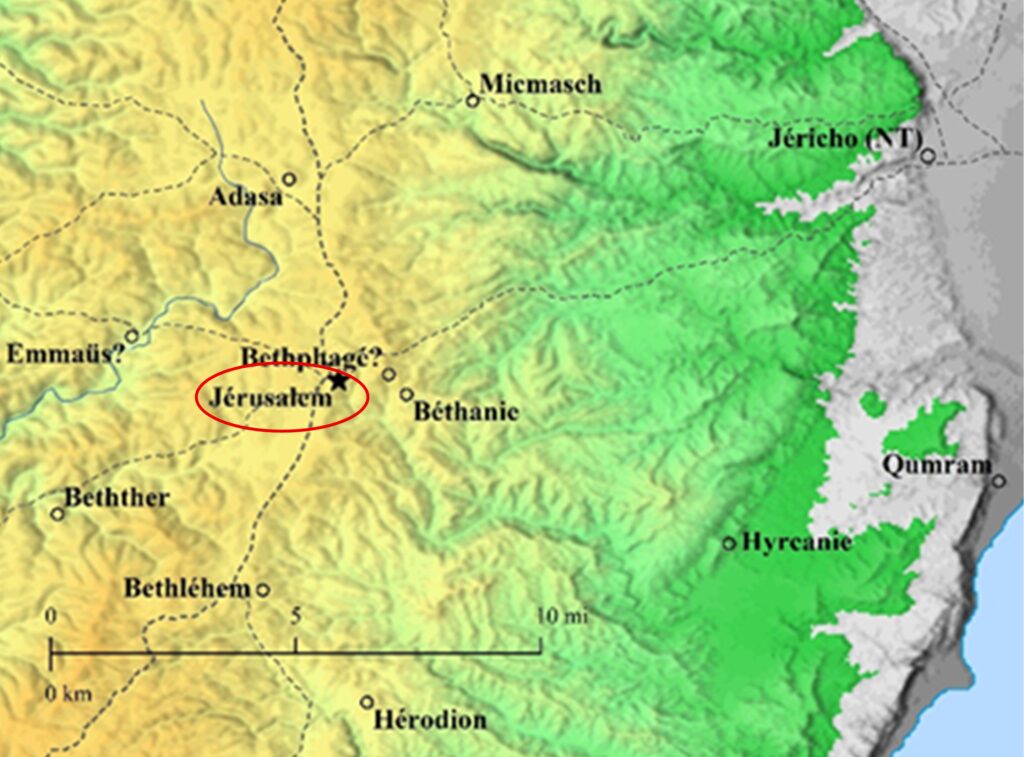

_15 The Messiah Jesus is questioned for two hours, from 4:30 to 6:30 a.m. Matthew 26.59-68, Mark 14.55-65, Luke 22.67-71, John 18.19-24.
_16 The rooster crows around 6:15 a.m., a little before sunrise. Matthew 26.74, Mark 14.72, Luke 22.61-62, John 18.27.
_17 The appearance before the should have taken place after sunrise at 6:38 a.m. But this was not the case, because at the moment the rooster crows the Master is, according to our interpretation of Luke’s text, taken to Pilate right after the sentence of the , which therefore waited for daybreak to pronounce it. Luke 22.66-71, Mark 15.1, Matthew 27.1-2.
_18 The first appearance before Pontius Pilate begins around 6:45 a.m. Mark 15.1-5, Matthew 27.2-14, Luke 23.1-5, John 18.28-38.
You can consult the complete chronology in the study ANN026 : The Hour of the Crucifixion.
Commentary:
After the condemnation of the Messiah Jesus by Caiaphas and the , Judas Iscariot suddenly realizes the scale of the consequences of his betrayal. The death sentence has not yet been carried out, but it is now unavoidable. Remorse overwhelms him. He who had followed the Master for more than three years understands too late what he has done. He would like to go back, back to that moment when the Messiah Jesus had held out his hand to him, offering him a final proof of love during the Passover meal. But that outstretched hand had not been enough to turn Judas away from his fateful plan.
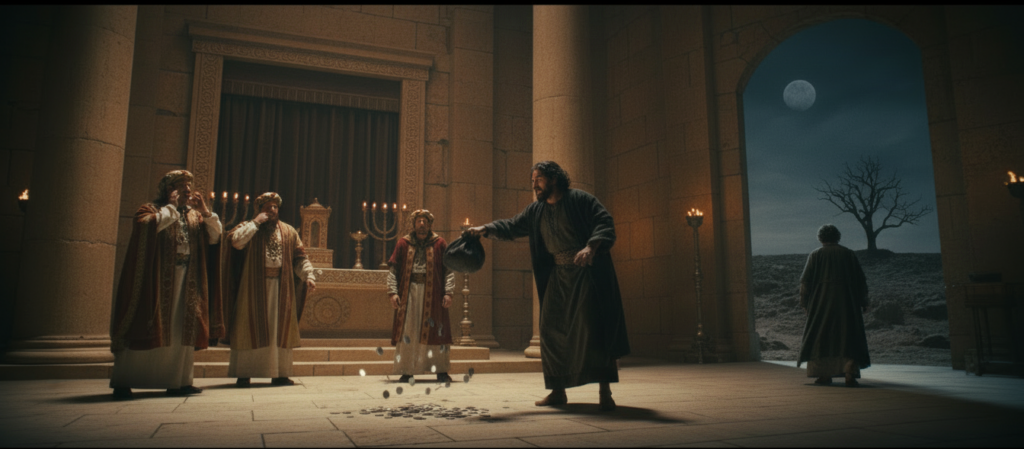
In a desperate gesture, he returns the money of the betrayal. Matthew specifies that he throws the coins into the Temple, and the term used, naos, refers not to the outer courtyard but to the sanctuary, that is, the Holy Place and the Holy of Holies (Matthew 27.5). Only the priests had the right to enter it. Judas thus deliberately breaks this sacred rule in order to hurl the thirty coins, probably shekels, at the feet of the stunned priests. This violent and symbolic gesture expresses his self-loathing and his rejection of the blood money.
Judas knows that his situation is now hopeless. The religious authorities, who used him to arrest the Messiah Jesus, would not have hesitated to extract further information from him by any means, in particular about the remaining disciples and those who supported them. He did not lead the soldiers to the house where the Passover meal was taking place; he led them straight to the Garden of Olives, because he knew the habits of the Master and of his former companions. He knows too much. He has become an inconvenient witness.
Crushed by guilt, isolated, with no refuge possible, Judas then makes the tragic decision to end his life. His suicide is not only the expression of deep despair; it is also the consequence of a chain of events he no longer controls. He did not understand that the Messiah Jesus was going willingly to the cross to fulfill the divine plan of salvation, by which God shows his love for the world (John 3.16-17).
The religious leaders, for their part, refuse to put the thirty pieces back into the Temple treasury, because they are now considered “blood money.” With this money they buy the potter’s field, thereby fulfilling, without intending to, the words of the prophets (Matthew 27.9). Their hypocrisy comes to light: they are scrupulous about the use of this money, yet feel no scruple about condemning an innocent man.
Thus Matthew shows us two parallel tragedies: that of Judas, consumed by remorse but unable to turn to mercy; and that of the religious leaders, locked into a hypocritical justice that refuses to recognize the Messiah.
In the midst of this darkness, the Messiah Jesus advances alone, but resolute, toward the fulfillment of the redemptive plan.