

PER321

Personal conversation with his disciples

The article analyzes Jesus' last interactions with his disciples, highlighting their spiritual transformation through divine revelation. Jesus calls them friends, not servants, emphasizing the importance of love and of the divine mission. The account invites us to see election and mission in theological continuity.

12 min Jesus disciples revelation friendship 17 verses 9 books

See also

Bible texts

Matthew
Matthew (King James Version) not mentioned in the book
Mark
Mark (King James Version) not mentioned in the book
Luke
Luke (King James Version) not mentioned in the book
John
John 14.1-15 (King James Version)

Let not your heart be troubled: ye believe in God, believe also in me.

In my Father’s house are many mansions: if it were not so, I would have told you. I go to prepare a place for you.

And if I go and prepare a place for you, I will come again, and receive you unto myself; that where I am, there ye may be also.

And whither I go ye know, and the way ye know.

Thomas saith unto him, Lord, we know not whither thou goest; and how can we know the way?

Jesus saith unto him, I am the way, the truth, and the life: no man cometh unto the Father, but by me.

If ye had known me, ye should have known my Father also: and from henceforth ye know him, and have seen him.

Philip saith unto him, Lord, shew us the Father, and it sufficeth us.

Jesus saith unto him, Have I been so long time with you, and yet hast thou not known me, Philip? he that hath seen me hath seen the Father; and how sayest thou then, Shew us the Father?

Believest thou not that I am in the Father, and the Father in me? the words that I speak unto you I speak not of myself: but the Father that dwelleth in me, he doeth the works.

Believe me that I am in the Father, and the Father in me: or else believe me for the very works’ sake.

Verily, verily, I say unto you, He that believeth on me, the works that I do shall he do also; and greater works than these shall he do; because I go unto my Father.

And whatsoever ye shall ask in my name, that will I do, that the Father may be glorified in the Son.

If ye shall ask any thing in my name, I will do it.

If ye love me, keep my commandments.

Technical details

AD 33

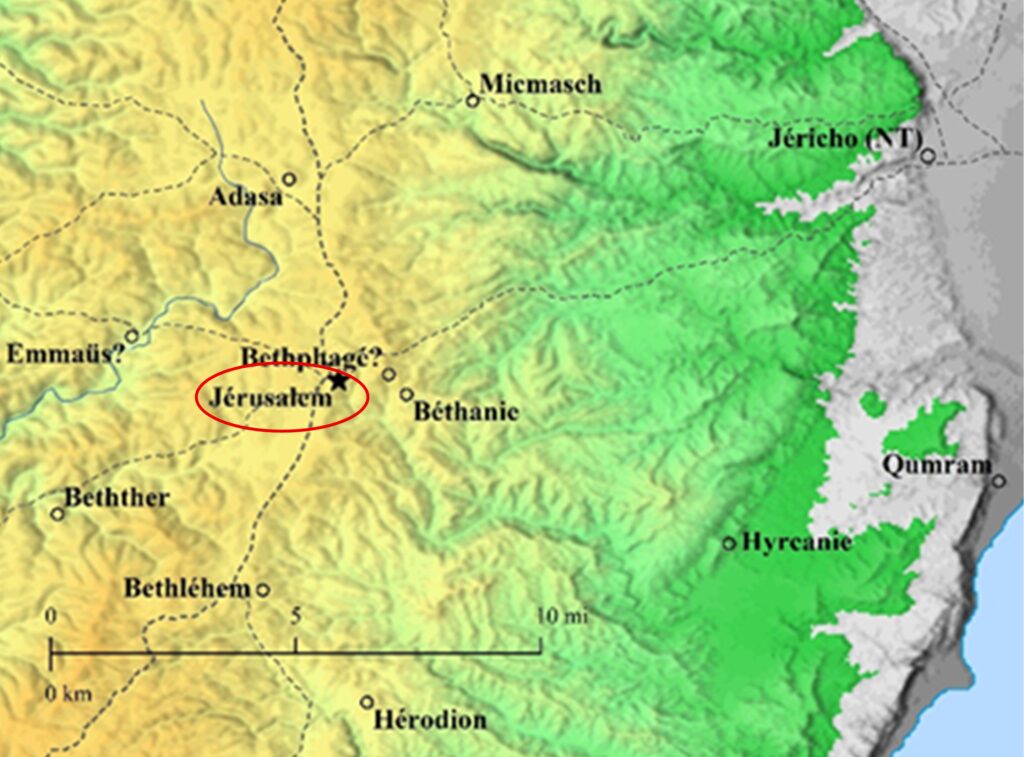
Location: The city of Jerusalem, the house of Mary, mother of John Mark

Date: Friday, April 1, very early in the morning

Method: We now follow John

Note on the method: John is the only one to record these last teachings of the Master

Map of Jerusalem and Its Surroundings
Friday bar graph

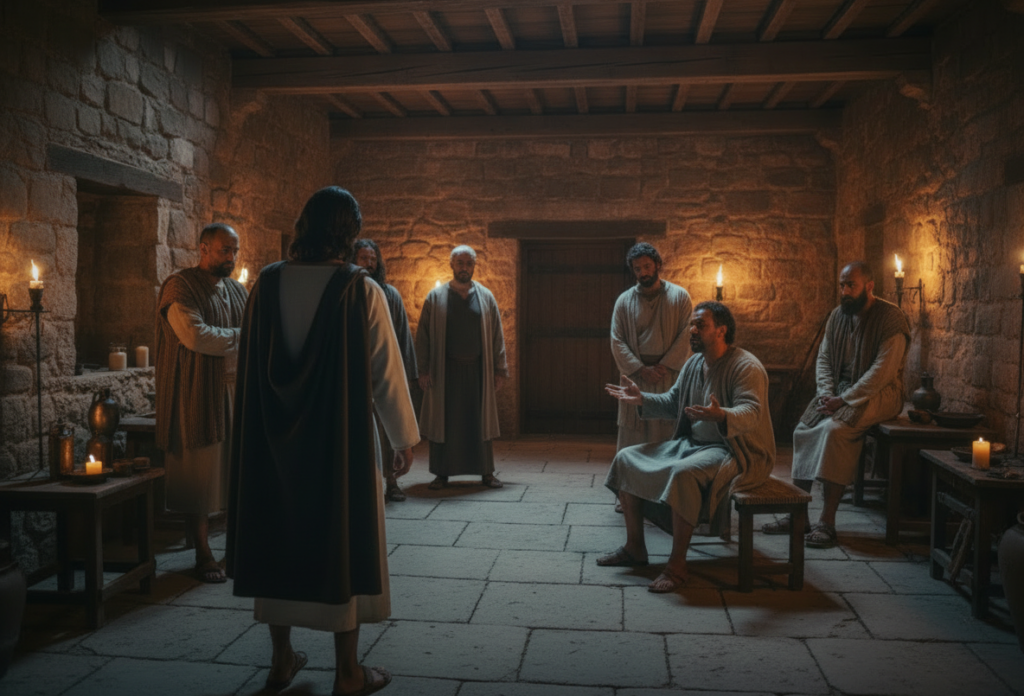
The Messiah Jesus reveals to his disciples that the relationship he establishes with them radically surpasses that of a master with his servants.

Chronological details, according to our conclusions:

_3 The house is, in our view, that of Mary, the mother of John, who was surnamed Mark. Acts 12.12.

_4 The Passover meal begins on Thursday evening, after 6 p.m. It is already Friday for the Jews (Mark 14.17, Matthew 26.20, Luke 22.14-18). This is therefore not the official Seder, which will take place on the evening of Friday John 18.28.

_5 The meal ends on Friday morning before dawn, between midnight and 2:30 a.m.

_6 Judas Iscariot left before the end of this meal. John 13.30.

You can consult the complete chronology in the study ANN026 : The Hour of the Crucifixion.

Commentary:

In John 15.15-17, Jesus reveals to his disciples that the relationship he establishes with them goes beyond that of a master with his servants, for he now calls them friends, not because they have reached a particular spiritual level, but because he has made known to them everything he heard from the Father.

He shows that divine friendship rests on transparency, revelation and participation in God's purpose, like Moses, who spoke with God face to face as a man speaks to his friend (Exodus 33.11), and like Abraham, recognized as the friend of God (James 2.23). This intimacy does not come from human initiative but from a sovereign choice of the Messiah Jesus.

It is he who chose them, called them and appointed them to bear fruit that remains, fruit that is not merely moral but tied to the mission, rooted in the sap of the true vine (John 15.1-5) and manifested in a life transformed by love, faithfulness and perseverance, echoing the fruit of the Spirit described by Paul (Galatians 5.22-23).

This lasting fruit stands in continuity with the calling of Israel, called to be a light to the nations (Isaiah 49.6). The promise of answered prayer attached to this mission is not a guarantee of obtaining everything one desires, but the assurance that prayer aligned with the Father's will is heard. The Messiah Jesus himself lived this, doing nothing of himself but accomplishing what he sees the Father doing (John 5.19).

This prayer is carried by the authority of the name of the Son. The final command to love one another is not a mere moral exhortation but the seal of the disciples' identity, the new commandment that shows the world the reality of the Kingdom (John 13.34-35).

This love reflects that of Christ, ready to lay down his life for his friends (John 15.13). It becomes the tangible proof that election, revelation and mission find their fulfillment in a community shaped by Trinitarian love, called to abide in Christ in order to bear fruit that glorifies the Father (John 15.8).