
PER270

Healings of the blind near Jericho

This article discusses Jesus’ healings of the blind near Jericho. Set within the context of the Synoptic Gospels, it explores the chronological and theological interpretation of these events, highlighting the recognition of Jesus as the Messiah and his journey to Jerusalem in AD 33.

5 min Jericho Jesus healings the blind messiah 3 verses 3 books

See also

Bible texts

Matthew
Matthew 20.29-34 (King James Version)

And as they departed from Jericho, a great multitude followed him.

And, behold, two blind men sitting by the way side, when they heard that Jesus passed by, cried out, saying, Have mercy on us, O Lord, thou Son of David.

And the multitude rebuked them, because they should hold their peace: but they cried the more, saying, Have mercy on us, O Lord, thou Son of David.

And Jesus stood still, and called them, and said, What will ye that I shall do unto you?

They say unto him, Lord, that our eyes may be opened.

So Jesus had compassion on them, and touched their eyes: and immediately their eyes received sight, and they followed him.

Mark
Mark 10.46-53 (King James Version)

And they came to Jericho: and as he went out of Jericho with his disciples and a great number of people, blind Bartimæus, the son of Timæus, sat by the highway side begging.

And when he heard that it was Jesus of Nazareth, he began to cry out, and say, Jesus, thou Son of David, have mercy on me.

And many charged him that he should hold his peace: but he cried the more a great deal, Thou Son of David, have mercy on me.

And Jesus stood still, and commanded him to be called. And they call the blind man, saying unto him, Be of good comfort, rise; he calleth thee.

And he, casting away his garment, rose, and came to Jesus.

And Jesus answered and said unto him, What wilt thou that I should do unto thee? The blind man said unto him, Lord, that I might receive my sight.

And Jesus said unto him, Go thy way; thy faith hath made thee whole. And immediately he received his sight, and followed Jesus in the way.

Luke
Luke 18.35-43 (King James Version)

And it came to pass, that as he was come nigh unto Jericho, a certain blind man sat by the way side begging:

And hearing the multitude pass by, he asked what it meant.

And they told him, that Jesus of Nazareth passeth by.

And he cried, saying, Jesus, thou Son of David, have mercy on me.

And they which went before rebuked him, that he should hold his peace: but he cried so much the more, Thou Son of David, have mercy on me.

And Jesus stood, and commanded him to be brought unto him: and when he was come near, he asked him,

Saying, What wilt thou that I shall do unto thee? And he said, Lord, that I may receive my sight.

And Jesus said unto him, Receive thy sight: thy faith hath saved thee.

And immediately he received his sight, and followed him, glorifying God: and all the people, when they saw it, gave praise unto God.

John
John (King James Version) not mentioned in the book

Technical details

AD 33

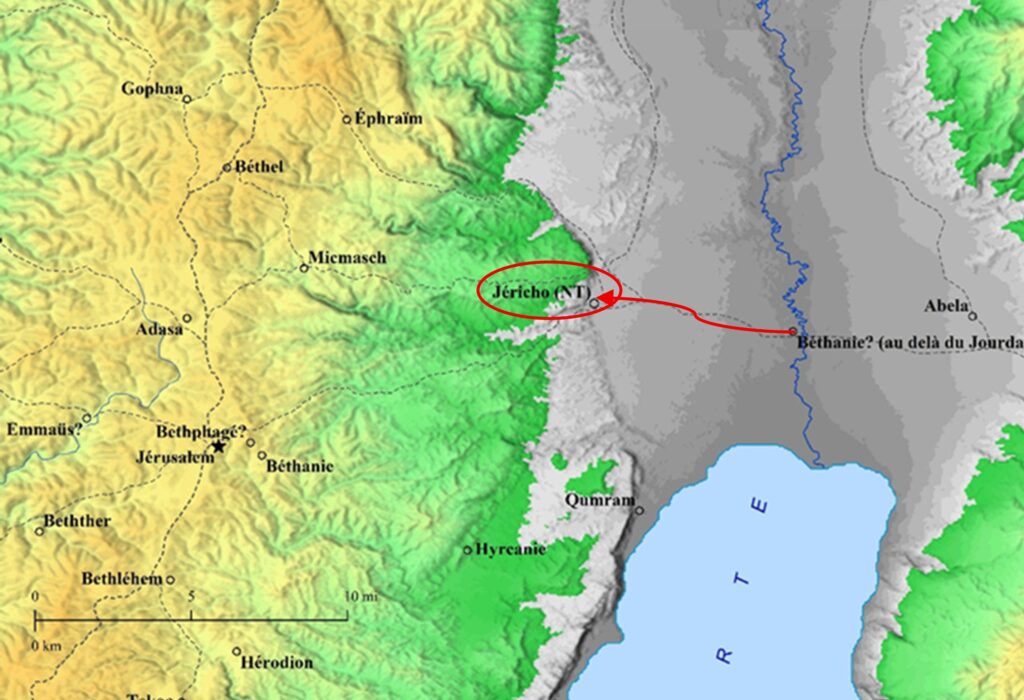
Location: City of Jericho

Date: February AD 33

Approach: We follow Mark

Note on the method: Matthew and Luke also address this subject

Map of Jericho

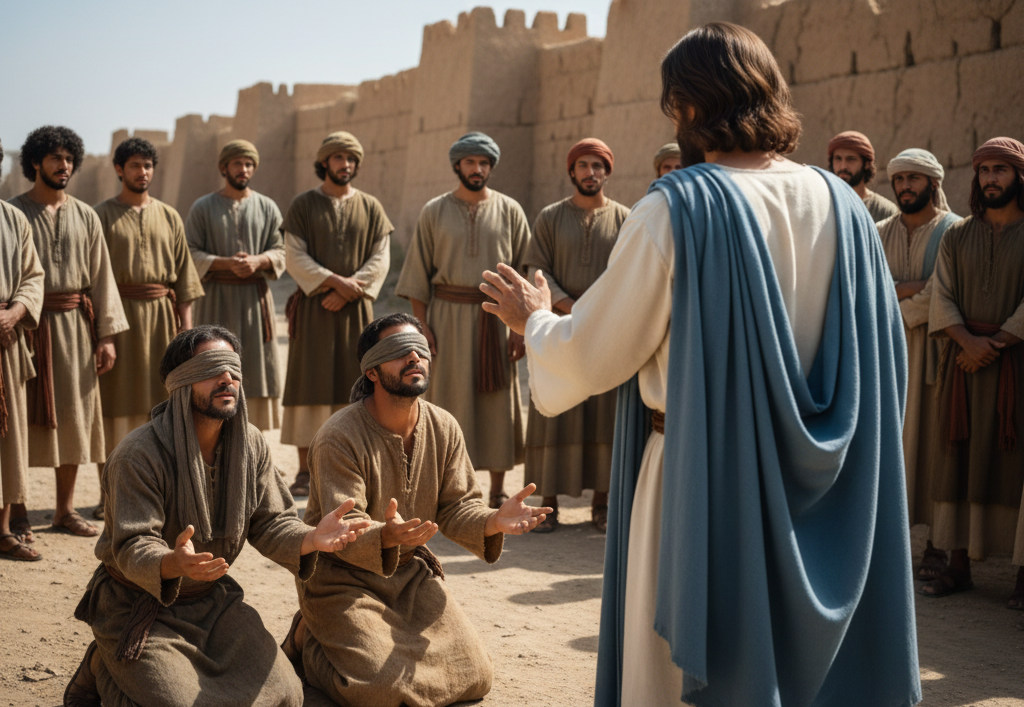
At Jericho, two blind men ask the Messiah Jesus to receive their sight.

Commentary

As the Messiah Jesus approaches Jericho, then passes through the city and out the other side, a great crowd accompanies him. The atmosphere is lively: many want to see him, others hope for a miracle, and some do not yet grasp the significance of this journey to Jerusalem. By the roadside sit one or two blind men, depending on the accounts. One of them is named Bartimaeus, son of Timaeus, a beggar well known to the inhabitants. They sit where travelers pass by, dependent on the compassion of passersby.

Hearing the noise of the crowd, the blind men ask what is happening. They are told that Jesus of Nazareth is passing by. At once they begin to cry out with all their strength: “Son of David, have mercy on us!” Their cry is not only a call for help: it is a confession of faith. They recognize in Jesus the promised Messiah, the one who can open the eyes of the blind and restore what no one else can repair.

The crowd, annoyed by their cries, tries to silence them. They are ordered to calm down and not to cause a disturbance. But the more they are rebuked, the louder they cry out. Their distress and their faith merge into a persistent plea. The Messiah Jesus stops. This simple act brings the whole procession to a halt. He asks that they be brought to him. Of Bartimaeus, it is even reported that the Messiah Jesus calls him personally, and that the blind man, hearing this invitation, throws off his cloak, his only possession, his protection, and leaps up to go to him.

Standing before the Messiah Jesus, the blind men hear this direct question: “What do you want me to do for you?” They answer with simplicity and boldness: they want to regain their sight. The Messiah Jesus, moved by their faith, grants what they ask. He tells them that their trust has not been in vain. At once their eyes are opened. The light they had not seen for a long time, or perhaps never, floods their gaze.

But the miracle does not end with the healing. The men do not go back to their former lives. They begin to follow Jesus along the road. Their first sight of the world is that of the Messiah walking toward Jerusalem, determined to accomplish his work. The crowd, a witness to the scene, gives glory to God, amazed at what it has just seen.


?

Additional note