
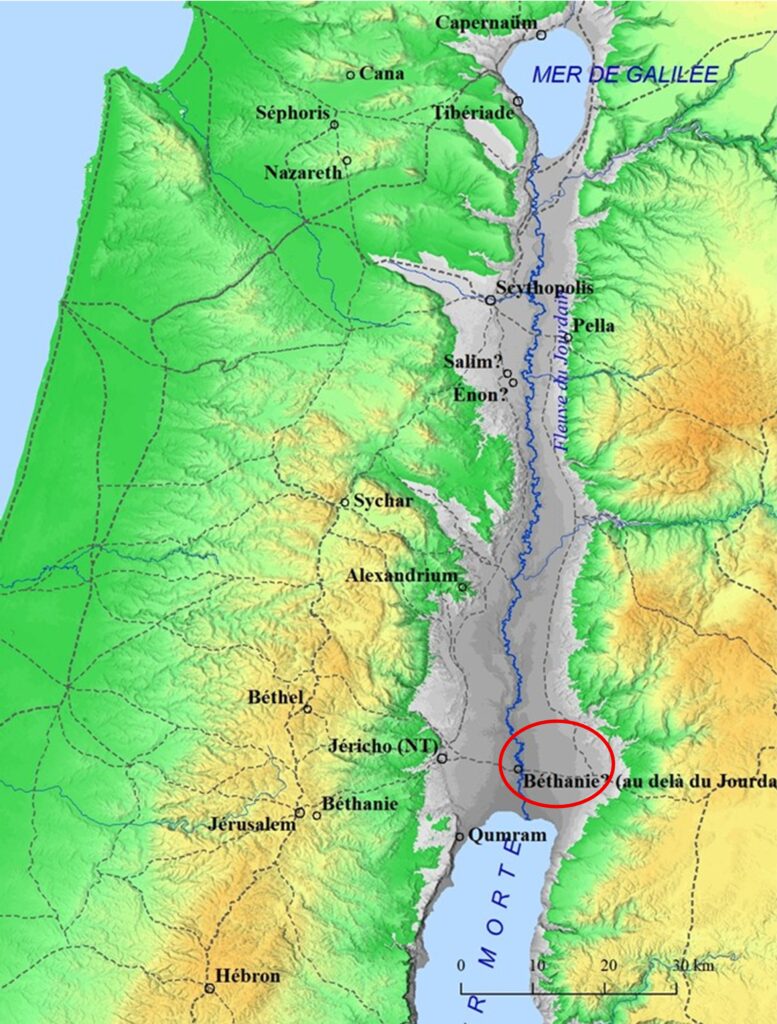
We know that the Messiah Jesus and his disciples withdrew to Bethany beyond the Jordan. It is a secure place, and any aggressive intervention would be quickly noticed; in that case the group would quickly move on to Perea, on the eastern bank of the Jordan, outside the jurisdiction of Pontius Pilate and of the High Priest Caiaphas.
However, we think that small groups of people had resumed contact with the Messiah Jesus. Some among the ruling class were asking questions and made the journey in order to question the Master.
Under these conditions, this passage would therefore take place in Bethany beyond the Jordan, a day's walk from Jerusalem. We must therefore admit that this teacher of the law and his friends traveled about 30 km to question the Master.
This teacher of the law does not appear as sincere as we might have hoped. Indeed, Luke 10.25 specifies that he asked his question to test the Messiah Jesus, yet he calls him "teacher".
The Greek word used here is "didaskalos", which literally means teacher or instructor.
It is a title of respect, often given to rabbis or to religious figures recognized for their authority in the interpretation of the Law.
By using it, the teacher of the law acknowledges the Messiah Jesus as a competent interlocutor in spiritual and legal matters, even if he does so in a context of testing.
asks the expert in the law.
Luke specifies that this question is asked in order to test him, which suggests an intention to test or trap the Messiah Jesus rather than a real desire to learn.
This contrast between the apparent respect of the title and the hidden intention gives a dramatic tension to the exchange.
The Messiah Jesus turns the question around, and rather than answering directly, the Messiah Jesus sends the teacher back to his own expertise:
This reversal shows that the Messiah Jesus does not let himself be confined to a passive role of teacher, but that he masters the art of rabbinic dialogue, often based on questions and answers.
This question about eternal life comes up at various moments in the Gospels, such as: Matthew 19.16-22, Luke 18.18-23, John 3.1-15.
The account could have ended at Luke 10.28, but the man tries to justify himself; he does not want to appear as a pupil taught by the Master (Luke 10.29).
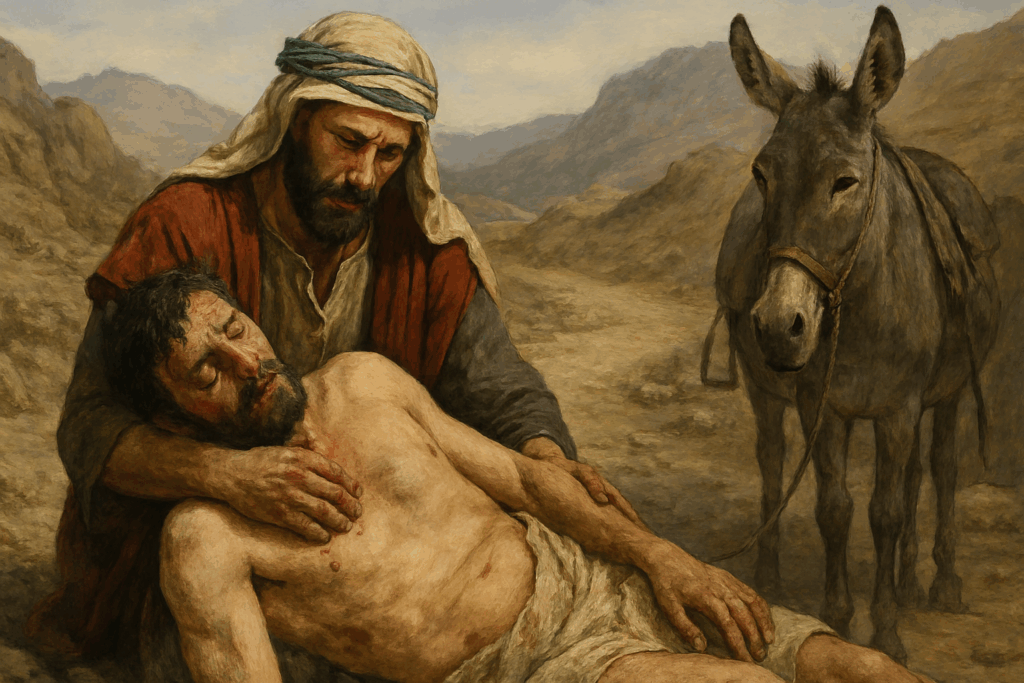
Besides, it is fortunate that he tried to justify himself, for that is how we have this magnificent of the Good .
It is one of the most powerful teachings of the Messiah Jesus on compassion, mercy and love of neighbor.
Context
The Messiah Jesus answers a teacher of the Law who asks him: "Who is my neighbor?" Rather than giving a definition, the Messiah Jesus tells a story to illustrate what it means to be someone's neighbor.
You can consult the detailed study of this : PAR023: The Good
The heart of the message
The priest and the Levite, respected religious figures, see the wounded man but pass by.
The , considered a heretic and despised by the Jews, is the one who acts with compassion.
He tends the man, carries him, pays for his care and promises to return.
The Messiah Jesus overturns expectations: the "neighbor" is not the one who is close to us by religion or culture, but the one who acts with kindness and mercy.
Symbolism and interpretations
The is often seen as a figure of the Messiah Jesus himself, who comes to the rescue of wounded humanity. The oil and the wine symbolize the sacraments, spiritual healing. The inn may represent the Church, a place of care and refuge.
The final call
The Messiah Jesus concludes with a direct command:
It is an invitation to act, not only to believe or to pray. Faith is lived out in concrete deeds toward those who suffer.
The reaction of the teacher of the law remains unknown; while he was trying to put the Master to the test, he found himself confronted with a demanding request that places him in a delicate position. It is suggested to act with discernment in similar situations.
According to our analyses, part of the regarded Jesus as a figure who challenged their status and social position. However, within this group, as already mentioned (PER213), some members were asking questions about him and were sensitive to his words. The influence of the Caiaphas, the High Priest responsible for the , limited contradictory debate, reducing the possibility of expressing divergent opinions. Nicodemus' situation thus seems complex.
It has been established that after their attempt to incite the murder of the Messiah Jesus in Jerusalem (PER219), the changed their strategy and now seek to use legal means to obtain the Master's condemnation.
It is therefore plausible that this Pharisee was sent by the in order to gather incriminating evidence against the Messiah Jesus, with a view to a possible trial before this religious body. It is also possible that this man had personal questions about the Messiah Jesus, which could have made this conversation an instructive moment.