
Matthew and Mark place this event 6 days after Peter's extraordinary declaration: You are the Messiah, the Son of the living God, whereas Luke writes: 8 days! Mark simply copies Matthew; they count the number of days between the two events, while Luke adds the day of the transfiguration and the day of Peter's testimony.
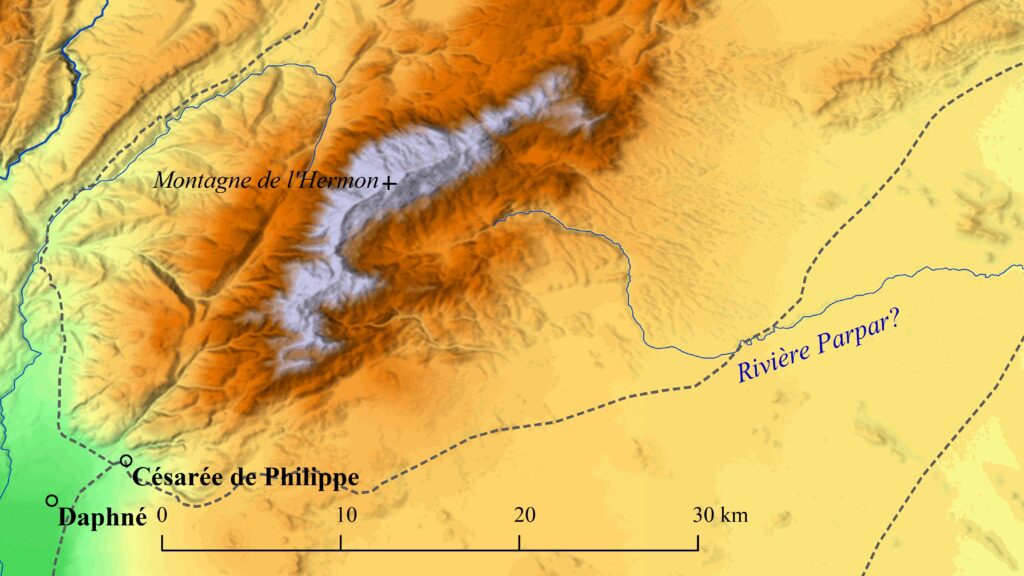
The mountain mentioned in the three texts is probably Mount Hermon, located near Caesarea Philippi. With an altitude of 2,814 meters, Mount Hermon lies in the north-east of Israel. The ridge of the mountain runs along the border between Lebanon and Syria, with the southern part descending onto the Israeli Golan Heights. Caesarea Philippi is home to one of the largest springs feeding the Jordan.
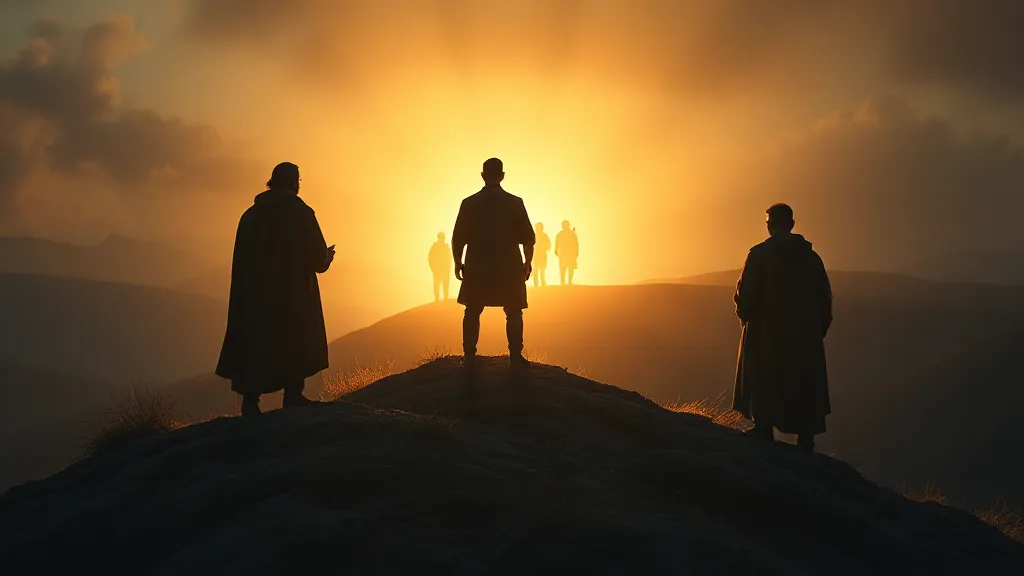
The Messiah Jesus chose three disciples, Peter, James and John, to accompany him up the mountain to pray. Unlike Matthew and Mark, Luke mentions John, the son of Zebedee, before his brother, who had died by the time of writing. The apostle John, author of the fourth Gospel and present at this event, does not consider it necessary to repeat the information already recorded by his colleagues.
The astonishing scene deeply overwhelms the three apostles. Luke reports that as Moses and Elijah are about to leave, Peter intervenes to suggest that they stay, and proposes building a shelter. These details, absent from Matthew and Mark, indicate that Luke probably obtained this information directly from one of the three witnesses. It is more plausible that Luke spoke with Peter or John, given the death of James, beheaded by Herod Antipas.
Peter identifies the two figures appearing beside the Master, probably from their clothing or their words. He names them Moses and Elijah, the first being associated with the law and the second with the prophets. Peter proposes building three shelters, and Luke specifies that the disciples were weighed down with sleep. Peter does not envisage a single shelter for the three figures. Moses, Elijah and Jesus represent respectively the law, the prophets and grace in this chronology.
Peter, in his second epistle, will recall this exceptional moment (2 Peter 1.16-19)
The three passages of Matthew 17.1-13, Mark 9.2-13 and Luke 9.28-36 mentioned deal with the same event known as the Transfiguration of the Messiah Jesus. Here is a comparison of the versions of Matthew, Mark and Luke:
Matthew 17.1-13
- The Messiah Jesus takes Peter, James and John up a high mountain.
- The Messiah Jesus is transfigured before them: his face shines like the sun and his clothes become white as light.
- Moses and Elijah appear and speak with the Messiah Jesus.
- Peter proposes making three tents for the Messiah Jesus, Moses and Elijah.
- A bright cloud envelops them, and a voice says: "This is my beloved Son, with whom I am well pleased; listen to him!"
- The disciples fall on their faces, seized with terror.
- The Messiah Jesus touches them and tells them to get up and not to be afraid.
- As they come down the mountain, the Messiah Jesus orders them not to tell anyone about this vision until he has been raised from the dead.
- The disciples ask why the scribes say that Elijah must come first, and the Messiah Jesus explains to them that Elijah has already come in the person of John the Baptist.
Mark 9.2-13
- The Messiah Jesus takes Peter, James and John up a high mountain.
- The Messiah Jesus is transfigured before them: his clothes become dazzlingly white.
- Moses and Elijah appear and speak with the Messiah Jesus.
- Peter proposes making three tents for the Messiah Jesus, Moses and Elijah.
- A cloud envelops them, and a voice comes out of the cloud: "This is my beloved Son; listen to him!"
- The disciples look around and no longer see anyone but Jesus.
- As they come down the mountain, the Messiah Jesus orders them not to tell anyone what they have seen until he has been raised from the dead.
- The disciples discuss among themselves what "rising from the dead" means.
- They ask Jesus why the scribes say that Elijah must come first, and the Messiah Jesus explains to them that Elijah has already come in the person of John the Baptist.
Luke 9.28-36
- The Messiah Jesus takes Peter, John and James up a mountain to pray.
- While he is praying, the appearance of his face changes and his clothes become dazzlingly white.
- Moses and Elijah appear and speak with the Messiah Jesus about his coming departure in Jerusalem.
- Peter and the other disciples are weighed down with sleep, but they wake up and see the glory of Jesus and the two men.
- Peter proposes making three tents for the Messiah Jesus, Moses and Elijah.
- A cloud envelops them, and a voice comes out of the cloud: "This is my Son, whom I have chosen; listen to him!"
- The disciples keep silent and tell no one what they have seen.
Comparison
- Participants: Peter, James and John are present in all three accounts.
- Place: A high mountain is mentioned in Matthew and Mark, whereas Luke speaks simply of a mountain.
- Transfiguration : All three Gospels describe the transformed appearance of the Messiah Jesus and the presence of Moses and Elijah.
- Reaction of the disciples: Peter proposes making tents in all three accounts. Luke adds that the disciples were weighed down with sleep.
- Voice from the cloud: A heavenly voice identifies the Messiah Jesus as the beloved Son of God in all three accounts.
- Secrecy: The Messiah Jesus orders secrecy until his resurrection in Matthew and Mark, but this is not mentioned in Luke.
- Discussion about Elijah: Matthew and Mark report the discussion between the disciples and Jesus about Elijah, whereas Luke concentrates more on the event of the Transfiguration itself.
This event illustrates the fulfillment of the Master's word mentioned in the previous pericope PER192 : A very strange saying of the Messiah Jesus. This interpretation suggests that the Messiah Jesus knew, six days earlier, of the events that were about to unfold on Mount Hermon.
Not all the apostles were present at this event, which raises questions about the Master's choice. Among the authors of the synoptic Gospels, only Peter, working with Mark, experienced this event. John was also present, but he does not mention it directly and seems to draw on it to write certain passages, such as John 1.14, 1 John 1.5 and 1 John 3.2.
Why this choice of Peter, James and John? Perhaps because they were important members of the group.