
PER101

The Sermon on the Mount (17), do not judge others

This article examines Jesus’ Sermon on the Mount, particularly the prohibition against judging others. Focusing on Matthew 7.1-6 and Luke 6.37-45, it advocates mercy and reciprocity in interpersonal relationships.

8 min judgment mercy justice reflection 9 verses 6 books

See also

Bible texts

Matthew
Matthew 7.1-6 (King James Version)

Judge not, that ye be not judged.

For with what judgment ye judge, ye shall be judged: and with what measure ye mete, it shall be measured to you again.

And why beholdest thou the mote that is in thy brother’s eye, but considerest not the beam that is in thine own eye?

Or how wilt thou say to thy brother, Let me pull out the mote out of thine eye; and, behold, a beam is in thine own eye?

Thou hypocrite, first cast out the beam out of thine own eye; and then shalt thou see clearly to cast out the mote out of thy brother’s eye.

Give not that which is holy unto the dogs, neither cast ye your pearls before swine, lest they trample them under their feet, and turn again and rend you.

Mark
Mark (King James Version) not mentioned in the book
Luke
Luke 6.37-45 (King James Version)

Judge not, and ye shall not be judged: condemn not, and ye shall not be condemned: forgive, and ye shall be forgiven:

Give, and it shall be given unto you; good measure, pressed down, and shaken together, and running over, shall men give into your bosom. For with the same measure that ye mete withal it shall be measured to you again.

And he spake a parable unto them, Can the blind lead the blind? shall they not both fall into the ditch?

The disciple is not above his master: but every one that is perfect shall be as his master.

And why beholdest thou the mote that is in thy brother’s eye, but perceivest not the beam that is in thine own eye?

Either how canst thou say to thy brother, Brother, let me pull out the mote that is in thine eye, when thou thyself beholdest not the beam that is in thine own eye? Thou hypocrite, cast out first the beam out of thine own eye, and then shalt thou see clearly to pull out the mote that is in thy brother’s eye.

For a good tree bringeth not forth corrupt fruit; neither doth a corrupt tree bring forth good fruit.

For every tree is known by his own fruit. For of thorns men do not gather figs, nor of a bramble bush gather they grapes.

A good man out of the good treasure of his heart bringeth forth that which is good; and an evil man out of the evil treasure of his heart bringeth forth that which is evil: for of the abundance of the heart his mouth speaketh.

John
John (King James Version) not mentioned in the book

Technical details

Bar chart for the year 31

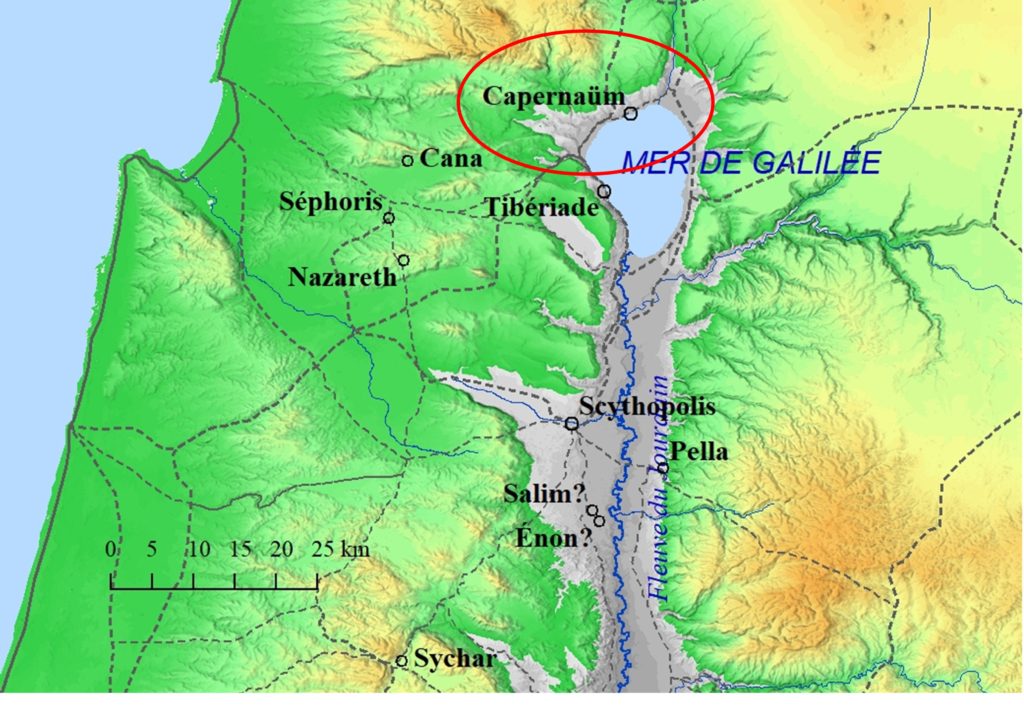
Location: On the plateau below a mountain near Capernaum in Galilee

Date: After the Passover pilgrimage to Jerusalem on April 5, AD 31

Method: We will continue with Matthew, although Luke also addresses this subject

Note on the method: Matthew and Luke describe this passage about judgment, with Luke providing a more detailed account

Capernaum

How the Messiah Jesus addresses judging others.

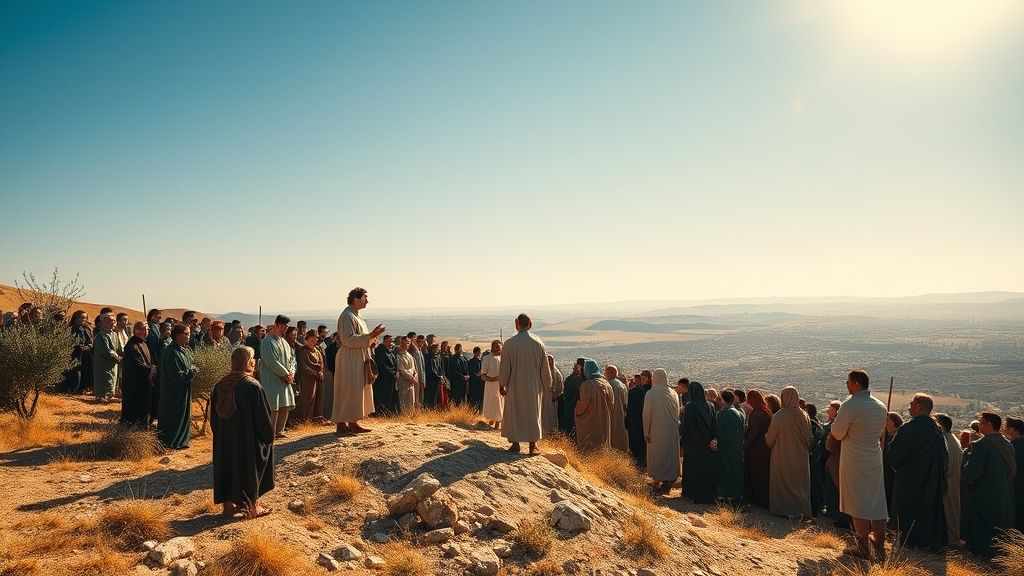
The Sermon on the Mount, not judging others

The crowd

Commentary

We are examining the Sermon on the Mount, divided into 21 sections.

Matthew and Luke begin by addressing the subject of judging others. Although this passage criticizes the behavior of the of the time, it also serves as a warning to all disciples.
We would like to highlight three points:

- The warning against judgment: the Messiah Jesus warns us not to judge others, because in doing so we expose ourselves to the same kind of judgment. This means that if we judge others harshly or unjustly, we will be judged in the same way.

- Reciprocity: the principle of reciprocity lies at the heart of this verse. The way we treat others, including our tendency to judge, will be the way we are treated. This encourages us to be merciful and understanding toward others.

- Humility and self-reflection: this text invites us to adopt a humble attitude and practice self-reflection. Before passing judgment on others, it is crucial to examine our own behavior and attitudes. The Messiah Jesus encourages us to acknowledge our imperfections and treat others with the same kindness.

Matthew recalls the Master’s teaching on judgment through the famous allegory of the speck and the plank. Curiously, he ends this section with a recommendation that seems to depart from the central theme.

The preceding verses reveal a glaring lack of discernment, showing excessive concern for other people’s imperfections, whereas Matthew 7.6 invites us to take the opposite perspective. Thinking that all human beings are good and able to understand spiritual truths would be another kind of error.

Ultimately, the disciple must find a wise balance and cultivate discernment in order to act according to God’s will.

Luke’s treatment seems somewhat different, in that he develops the principle of reciprocity more fully. You will be treated as you have treated others!

He implies the following universal principle: whatever a person sows, they will reap (Galatians 6.7-8, Job 4.8, Hosea 8.7, 2 Corinthians 9.6). These verses illustrate the moral and spiritual principle that our actions have consequences, and we reap the results of what we have sown, whether good or bad.

To grasp these words fully, we must remember the hypocrisy of the who manipulated the people. They considered themselves superior to their fellow citizens, whom they judged to be ignorant (Luke 18.11). From this starting point, Jesus develops the notion of true righteousness that should guide all his disciples.

It is essential to examine every aspect of this discussion and compare it with the actions of the . On one side, we have the righteousness of the , and on the other, God’s righteousness as proclaimed by the Messiah Jesus (Matthew 5.20).

It is therefore crucial to recognize that the Messiah Jesus was not addressing people without spiritual knowledge, but rather individuals deeply influenced by the errors of their religious leaders.