1. Introduction: from the teaching of Jesus to the apostolic proclamation
1.1. A parable that historically precedes the events of the Acts
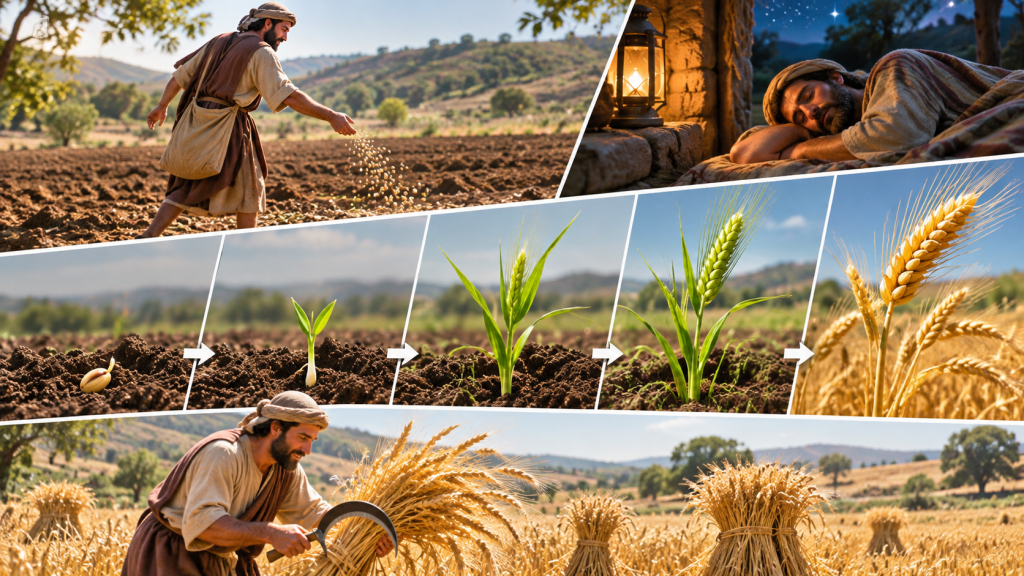
In Mark 4.26-29, Jesus compares God's Kingdom to a seed that germinates, grows and matures.
This parable belongs to his earthly ministry.
The book of Acts then reports the events following his resurrection and ascension.
The apostles proclaim the Gospel, new people become believers and communities are formed.
This progress offers a particularly interesting field of observation to understand certain aspects of Kingdom growth.
1.2. The Difference between the Kingdom of God and the Church
The Kingdom of God and the Church should not be regarded as two strictly synonymous expressions.
The Kingdom basically refers to God's kingdom.
The Church brings together those who recognize Jesus Christ and belong to the community of his disciples.
The expansion of the Church is therefore a historic manifestation of the proclamation and the reception of the Kingdom.
However, God's Kingdom has a wider scope than the only institutional or digital growth of Christian communities.
This distinction must be maintained throughout the study.
1.3. A method based on Luc's data
The book of Acts reports historical events, speeches, movements and situations.
He does not explicitly present his account as a comment by Mark 4.26-29.
The approximations proposed in this annex are therefore theological comparisons.
They allow us to illustrate certain principles of parable, without pretending to identify each event of Acts at a precise stage of seed growth.
2. Acts 1.8: the programme of proclamation
2.1. The promise of the power of the Holy Spirit
Before his ascension, Jesus announces to his disciples that they will receive power when the Holy Spirit comes upon them.
He states that they will be witnesses in Jerusalem, in all Judea, in Samaria, and to the ends of the earth.Acts 1.8
This declaration provides an important geographical perspective.
The testimony must not remain limited to Jerusalem.
It is intended to spread beyond its starting point.
2.2. A mission entrusted to men
Jesus does not present the disciples as mere spectators.
They have to testify.
Their responsibility is to announce what they have seen and heard about Jesus Christ.
This mission corresponds, by analogy, to the initial action of the farmer who spreads the seed.
However, this comparison does not mean that the disciples have the power to produce spiritual growth themselves.
2.3. An increase announced, but not detailed
Acts 1.8 provides a general direction.
The verse does not specify all the circumstances in which the Gospel will spread.
Nor does he announce the exact number of people who will become believers.
The rest of the story shows a progression accompanied by sometimes unexpected events.
This feature allows a first approximation to the growth described in Mark 4.26-29.
3. Acts 2: the first results of the proclamation
3.1. Pentecost
Acts 2 reports the coming of the Holy Spirit upon the disciples gathered in Jerusalem.
This event is accompanied by demonstrations that attract the attention of the crowd.
Peter then spoke to explain the events and to proclaim Jesus Christ.
He presents Jesus as the one whom God raised up and established Lord and Christ.
3.2. Audit response
Acts 2.37 reports that listeners are deeply affected by the message.
They ask Peter and the other apostles what they should do.
Peter calls them to repentance and baptism in the name of Jesus Christ.
Acts 2.41 indicates that about three thousand people welcome the word and are added to the number of disciples.
3.3. Significant growth from the outset
This increase is a remarkable result of the apostolic proclamation.
However, the account does not attribute it solely to Peter's eloquence.
The whole chapter emphasizes the action of the Holy Spirit and the fulfillment of divine promises.
The human proclamation and the action of God thus appear associated.
3.4. Necessary precision
The parable of Mark 4.26-29 insists on progressive growth.
Acts 2 reports a significant increase in one day.
It should therefore not be claimed that the two passages describe exactly the same rhythm.
The rapprochement mainly concerns the distinction between human proclamation and the spiritual fruitfulness of this proclamation.
4. Acts 2.42-47: growth accompanied by community life
4.1. Perseverance of the First Believers
After Pentecost, Luke describes the life of the Jerusalem community.
The believers persisted in the teaching of the apostles, fraternal communion, the breaking of bread and prayers.
The development of the community is therefore not limited to a digital increase.
It is accompanied by an organization of spiritual and fraternal life.
4.2. Daily growth
Acts 2.47 states that the Lord added to the Church daily those who were saved.
This formulation explicitly attributes to the Lord the increase of the community.
It constitutes a particularly significant rapprochement with the teaching of Mark 4.26-29.
The disciples testify and live their faith.
However, Luke presents God as the one who adds new believers.
4.3. A growth that is not limited to the figures
The account combines the increase in the number of disciples with their perseverance in teaching and communion.
This observation calls for a distinction between several dimensions of Christian development.
Digital growth concerns the number of believers.
Spiritual growth concerns their fidelity and transformation.
Community growth concerns organisation and collective life.
These dimensions may be linked, but they are not identical.
5. Acts 4.1-4: growth despite opposition
5.1. The arrest of Peter and John
After the healing of a crippled man, Peter announces Jesus Christ before the crowd.
The religious authorities intervene and arrest Peter and John.
The opposition thus appears from the first stages of the apostolic proclamation.
5.2. Progress despite obstacles
Acts 4.4 states that several listeners become believers and that the number of men reaches about five thousand.
The text does not allow for an accurate total of the entire community, since women and children are not necessarily included in this indication.
It shows, however, that the opposition does not end the progress of the Gospel.
5.3. An illustration of the limitations of human control
The authorities can arrest the messengers.
However, they cannot simply erase the effects of the proclamation already heard.
This situation can be reconciled with parable.
The farmer does not control growth entirely.
Similarly, human actors do not control all the results of the message announcement.
However, this comparison does not mean that every persecution necessarily results in an increase in the number of believers.
6. Acts 6.1-7: growth and internal difficulties
6.1. A larger community
Acts 6.1 indicates that the number of disciples is increasing.
This growth is accompanied by a difficulty in providing assistance to widows.
The widows of the Hellenists are neglected in daily service.
Community development therefore raises new responsibilities.
6.2. Organized response
The Twelve bring together the disciples and propose to entrust this responsibility to seven men recognized for their good reputation and wisdom.
This decision allows the apostles to devote themselves to prayer and the ministry of the Word.
The story shows that growth does not exclude the need for a human organisation.
6.3. The progression of the Word
Acts 6.7 reports that God's Word was spreading and that the number of disciples was increasing considerably in Jerusalem.
Luke adds that a great crowd of priests obeyed the faith.
Growth therefore continues after solving the Community's difficulties.
6.4. An important lesson
Mark's parable should not be interpreted as an invitation to neglect the organization of the Church.
On the contrary, the Acts show that the disciples must make responsible decisions.
However, the organization remains at the service of the mission.
It alone is not the source of spiritual growth.
7. Acts 8.1-8: Dispersal of Believers and Dissemination of the Gospel
7.1. The persecution after the death of Stephen
Acts 7 reports the testimony and death of Stephen.
Acts 8.1 then indicates that a great persecution is erupting against the Church of Jerusalem.
Many believers are scattered in the areas of Judea and Samaria.
This dispersal is an important test for the community.
7.2. Dispersed Believers Announce the Word
Acts 8.4 states that those who had been dispersed went from place to place by announcing the good news.
Persecution thus causes displacements that contribute to the spread of the message.
Philip went to a city of Samaria and proclaimed Christ there.
The account shows that many people pay attention to his preaching.
7.3. A progression that goes beyond human projects
Dispersal is not presented as a missionary strategy initially organized by the apostles.
It is the result of persecution.
However, believers continue to witness in the areas where they go.
This situation shows that the Gospel can be spread in circumstances that the disciples had not chosen.
7.4. A correspondence with the parable
In Mark 4.26-29, the farmer does not direct every stage of development.
In Acts 8, the proclamation spreads through unforeseen events.
The rapprochement highlights the limitations of human planning.
It does not mean that persecution is necessary for any growth of the Church.
8. Acts 9.31: A Period of Peace and Building
8.1. A change in the situation
After the account of Saul's conversion, Acts 9.31 presents a period of peace for the Church in Judea, Galilee and Samaria.
Luke states that she was being edited, walking in the fear of the Lord and progressing through the assistance of the Holy Spirit.
This description is important.
Growth does not occur only in times of persecution.
It can also accompany periods of stability.
8.2. Spiritual and Community Growth
The verse combines several characteristics.
The Church knows peace.
She's sedifying.
She walks in the fear of the Lord.
It's increasing.
These evidences show that Luke does not reduce Christian growth to a purely digital phenomenon.
8.3. The role of the Holy Spirit
Acts 9.31 explicitly mentions the assistance of the Holy Spirit.
The growth of the Church is thus placed within the framework of divine action.
This clarification complements the perspective of Mark 4.26-29, where growth is described without explaining its mechanisms.
9. Acts 10-11: The Gospel Crosses a New Frontier
9.1. The meeting between Peter and Corneille
Acts 10 reports Peter's encounter with Corneille, a centurion Roman.
The account shows how Peter is led to recognize that God also welcomes people from the nations.
Peter announces Jesus Christ to those who are gathered in the house of Cornelius.
The Holy Spirit descends on the listeners.
9.2. An important step in the mission
This event has a special scope.
He confirms that the proclamation of the Gospel should not be limited to Jews alone.
Acts 11.18 reports that the believers in Jerusalem recognize that God has also granted the nations repentance that leads to life.
This recognition is a major step in the history of the early Church.
9.3. A development that exceeds some initial expectations
Pierre himself must understand the scope of the event.
The story shows that the enlargement of the mission is not simply a result of a prior human decision.
It is part of a divine initiative that leads the disciples to reconsider their conceptions.
This situation can be brought closer to the development of the Kingdom beyond human expectations.
9.4. The importance of not confusing images
Mark's parable does not explicitly describe the passage from the Gospel of the Jews to the nations.
It would therefore be unjustified to identify grass, leprosy and ripe grain at specific ethnic groups or geographical stages.
The approximation concerns the general principle of development, the consequences of which go beyond the initial human perspective.
10. Acts 11.19-26: The Birth and Growth of the Church of Antioch
10.1. Post-Persecution message
Acts 11.19 repeated the consequences of the dispersal that occurred after Stephen's death.
Believers go to Phoenicia, Cyprus and Antioch.
Some also proclaim the Lord Jesus to Greeks, according to the readings of many translations of the Bible.Acts 11.20
The message thus crosses new borders.
10.2. The hand of the Lord
Acts 11.21 states that the hand of the Lord was with the preachers and that many believed and converted to the Lord.
This formulation is particularly significant.
Luke mentions the activity of the witnesses.
He also highlights the Lord's action.
The two dimensions appear together.
10.3. The intervention of Barnabas and Saul
Barnabas is sent to Antioch.
He sees God's work and encourages believers to remain attached to the Lord.
He then went to Tarse to look for Saul.
Both teach for a whole year in the Antioch Church.
The story shows that growth is accompanied by teaching and consolidation.
10.4. A community called upon to play a missionary role
Antioch then became an important centre of missionary activity.
Acts 13.1-3 reported the shipment of Barnabas and Saul.
A community born out of the spread of the Gospel is now participating in its own propagation.
This evolution illustrates how a work started in a place can contribute to the emergence of new communities elsewhere.
11. Acts 12.24: A Remarkable Claim by Luke
11.1. The context of the verse
Acts 12 relates in particular to the persecution carried out by Herod Agrippa I.
Jacques, Jean's brother, is killed.
Peter is imprisoned, then delivered.
The chapter also reports the death of Herod.
After these events, Luke made a general comment.
11.2. God's Word Was Growing and Multiplying
Acts 12.24 affirms that God's Word was growing and multiplying.
This formulation uses the language of growth to describe the progress of the Gospel.
The Word is presented as a reality whose dissemination continues despite the obstacles.
11.3. A correspondence with Mark 4.26-29
The rapprochement with parable is particularly interesting.
In Mark, the seed germinates and grows.
In Acts, God's Word grows and multiplys.
Both passages use the language of growth.
However, a distinction must be maintained.
Mark 4.26-29 describes an agricultural comparison concerning the Kingdom.
Acts 12.24 presents a historical observation on the progression of the Word.
It is therefore a thematic correspondence, not a direct quote from parable.
12. Acts 13-14: Growth on the First Missionary Journey
12.1. Sending Barnabas and Saul
Acts 13.1-3 reports that the Holy Spirit asks to set aside Barnabas and Saul for the work to which they were called.
The community of Antioch prays, fasts and imposes their hands before letting them go.
The mission thus combines an initiative attributed to the Holy Spirit and an active participation of the Church.
12.2. Proclamation in different cities
Barnabas and Saul travel to Cyprus and then continue their mission in Asia Minor.
The story mentions among others Antioch of Pisidia, Icona, Lystra and Derbe.
In these cities, they proclaim the Gospel.
The reactions are diverse.
Some people welcome the message.
Others oppose it.
12.3. Different results depending on the location
Acts 13.48 reports that people from the nations are welcoming the Word to Antioch in Pisidia.
Acts 14.1 indicates that a great multitude of Jews and Greeks become believers in Icona.
However, missionaries also encounter opposition and persecution.
These situations show that the proclamation does not produce the same visible results everywhere.
12.4. Community consolidation
Acts 14.21-23 reports that Paul and Barnabas returned to several cities in order to strengthen the disciples.
They exhort them to persevere in the faith and establish elders in the churches.
The mission is therefore not limited to an initial announcement.
It also includes the support of newly formed communities.
12.5. The Relationship with the Parable
The first missionary journey shows a progression of the Gospel accompanied by concrete human actions.
Missionaries travel, announce, teach and encourage.
However, they do not control the reactions of the listeners.
This distinction corresponds to one of the fundamental principles of Mark 4.26-29.
13. Acts 15-18: enlargement of the mission
13.1. The Council of Jerusalem
Acts 15 refers to discussions about the place and obligations of believers from the nations.
This question becomes important as the Gospel spreads.
The growth of the Church therefore leads to new doctrinal and community problems.
Those responsible must examine them in the light of God's action and the Scriptures.
13.2. The Second Missionary Journey
Paul then undertook a new missionary journey.
It crosses several regions and goes to Macedonia in particular.
Acts 16 reports his arrival in Philippi.
Acts 17 presents its activities in Thessaloniki, Berea and Athens.
Acts 18 describes his ministry in Corinth.
13.3. Open doors and obstacles
The account shows that missionary movements do not always follow initial plans.
Acts 16.6-10 reports inter alia obstacles and the vision that leads Paul to Macedonia.
These events are presented in the context of divine direction.
The progress of the Gospel does not depend exclusively on human intentions.
13.4. Growth that requires perseverance
In Philippi Paul and Silas were imprisoned.
In Thessaloniki, they meet with opposition.
In Corinth, Paul remains for an extended period of time to teach the Word.
The development of the missionary work is thus accompanied by difficulties, travel and patient work.
14. Acts 19: The progression of the Word to Ephesus
14.1. An Extended Ministry
Acts 19 reports Paul's activity to Ephesus.
After teaching in synagogue, he continued his teaching in the school of Tyrannus.
Acts 19.10 states that this activity continues for two years.
Luke indicates that the people of the province of Asia, Jews and Greeks, heard the Word of the Lord.
14.2. An influence beyond the original location
The teaching given in Ephesus has a reach that goes beyond the city itself.
The story highlights a regional dissemination of the message.
This growth illustrates how localized activity can contribute to wider expansion.
14.3. Acts 19.20: the power of the Word
Acts 19.20 affirms that the Word of the Lord grew in power and strength.
This wording is in line with the observations of Acts 6.7 and 12.24.
Luke again presents the Word as a reality whose progress is continuing.
14.4. Growth with transformations
Acts 19.18-19 reports that many believers confess their previous practices and that people who have exercised magic publicly renounce their books.
The account thus associates the progression of the Word with changes in behaviour.
This observation points out that spiritual growth is not only measured by the number of people gathered.
It also concerns the transformation of their conduct.
15. Acts 21-28: Proclamation despite imprisonment
15.1. The arrest of Paul
From Acts 21, the account presents the events leading to Paul's arrest in Jerusalem.
The apostle then appeared before various authorities.
He was eventually taken to Rome.
These circumstances seem to limit his freedom of action.
15.2. The testimony before the authorities
Despite his imprisonment, Paul continues to testify.
He presents his defense before the authorities and explains his hope in the resurrection.
Judicial difficulties thus become opportunities for proclamation.
The story does not present imprisonment as the end of his testimony.
15.3. Arrival in Rome
Acts 28 reports Paul's arrival in Rome.
He receives visitors there and announces God's Kingdom to them.
Luke states that he teaches what concerns the Lord Jesus Christ.
15.4. An open conclusion
Acts 28.30-31 presents Paul announcing God's Kingdom and teaching confidently, without hindrance.
The book ends with this proclamation activity.
It does not describe the final fulfillment of the Kingdom.
It shows that the announcement continues despite the obstacles encountered.
15.5. Reconciliation with Mark 4.26-29
The end of the Acts reminds us that the progress of the Gospel does not depend exclusively on the freedom or favourable situation of its messengers.
Paul is a prisoner.
However, he continues to proclaim the Kingdom.
This situation illustrates the limitations of human control over the dissemination of the message.
It does not mean that imprisonment is necessarily a condition for growth.
16. Time and thematic table of growth in the Acts
| Passage | Event | Indicator of growth | Main teaching |
|---|
| Actes 1.8 | Promise of the Holy Spirit | Mission to expand | Divine Power and Witness Responsibility |
| Actes 2.41 | Pentecost | About three thousand people added | Fertility of proclamation |
| Actes 2.47 | Community life | New believers added daily | The Lord's Action |
| Actes 4.4 | Arrest of the Apostles | Increase in the number of believers | Progression despite opposition |
| Actes 6.7 | Community organisation | Multiplication of Disciples | New growth and responsibilities |
| Actes 8.4-8 | Dispersion and mission in Samaria | Dissemination of the Word | Expansion in unforeseen circumstances |
| Actes 9.31 | Peace of the Churches | Construction and increase | Assistance of the Holy Spirit |
| Actes 10-11 | Conversion from Cornelius to Antioche | Welcome of the Gospel by the nations | Enlargement of the mission |
| Actes 12.24 | After Herod's persecution | Growth of the Word | Continuity of the divine work |
| Actes 13-14 | First missionary trip | Formation of new communities | Proclamation and perseverance |
| Actes 16-18 | Second missionary trip | Expansion to Macedonia and Greece | Divine direction and missionary work |
| Actes 19.20 | Ministry in Ephesus | Powerful Progression of the Word | Dissemination and transformation |
| Actes 28.30-31 | Paul in Rome | Proclamation despite captivity | Perseverance of the mission |
17. The Limits of the Reconciliation between Mark 4 and Acts
17.1. Acts are not an official explanation of the parable
Luke never declares that the events he reports represent the stages of Mark 4.26-29.
It would therefore be excessive to present the history of the early Church as a detailed and exclusive realization of this parable.
Reconciliation remains interpretative.
17.2. The Kingdom's growth is not limited to the increase of the disciples
The Kingdom of God has a wider theological significance than the digital growth of the Church.
The Acts describe the expansion of the Christian community.
They also show the transformation of believers and the spread of the Word.
However, they do not claim that the Kingdom is fully accomplished by these events.
17.3. The three agricultural stages do not correspond to three identifiable historical periods
Mark 4.28 mentions grass, leprosy and ripe grain.
It would be tempting to associate these steps with Jerusalem, with the mission among the nations, and with Paul's arrival in Rome.
However, no Bible text establishes such correspondence.
This construction must therefore be avoided.
17.4. The end of Acts does not necessarily correspond to the final harvest
Acts 28 presents the proclamation of the Gospel in Rome.
However, Luke does not declare that this stage represents the harvest of Mark 4.29.
The Kingdom announcement continues.
Eschatological achievement remains a distinct perspective.
18. The main teachings for understanding Kingdom growth
18.1. Human proclamation remains necessary
The Acts show that the disciples are actively proclaiming the Gospel.
They travel, teach, testify and found communities.
Growth therefore does not lead to the removal of their responsibility.
18.2. The results are not fully predictable
Some of the preaching work is very welcome.
Others provoke opposition.
Unforeseen travel leads to new opportunities for testimony.
This diversity reminds us that messengers do not have control over all the consequences of their activity.
18.3. The action of the Holy Spirit accompanies the mission
Luke regularly highlights the Holy Spirit's intervention.
The apostolic proclamation is not based exclusively on human capacities.
This perspective corresponds to the general teaching of the New Testament concerning dependence on God.
18.4. Growth has several dimensions
The Church's development concerns the number of believers, their spiritual formation, their community life and the geographical expansion of the proclamation.
These dimensions do not necessarily progress at the same pace.
They show that growth cannot be reduced to a single indicator.
18.5. Final achievement remains distinct from historical progress
The book of Acts describes a real expansion of the Gospel.
However, he does not present this expansion as the final completion of God's Kingdom.
Historical growth and eschatological achievement must therefore be distinguished.
19. Conclusion of the appendix
The book of Acts provides many examples of how the parable seed that grows itself can be illuminated.
From Jerusalem to Rome, the proclamation of the Gospel is progressing remarkably.
This growth does not always follow human projects.
It develops through preaching, teaching, missionary travel, as well as persecution and imprisonment.
Disciples carry out a real responsibility.
They proclaim Jesus Christ, form new communities and encourage believers to persevere.
However, Luke regularly attributes to God and to the action of the Holy Spirit the fruitfulness of this mission.
The expressions used in Acts 6.7, 12.24 and 19.20 are particularly significant.
They present God's Word as a reality that grows and spreads.
This progression can be reconciled with the seed development described in Mark 4.26-29.
However, the limits of this comparison should be respected.
The Acts do not provide an explicit interpretation of parable.
They do not identify the three agricultural stages at specific historical periods.
Nor do they portray Paul's arrival in Rome as the final fulfillment of the Kingdom.
The main teaching, however, remains clear: the proclamation of the Kingdom involves the responsibility of the disciples, but its growth is beyond their control. The book of Acts shows that God can advance his work through favorable or difficult circumstances, prepared initiatives or unforeseen events. The faithfulness of witnesses and divine action thus appear associated in the historical development of the Gospel, without this progression exhausting the prospect of the final fulfillment of God's Kingdom.