1. The place of the image of the bridegroom in Jesus ' answer
1.1. The Context of the Controversy on Fasting
Matthew 9.14-15 relates a question addressed to Jesus by the disciples of John the Baptist.
They wish to understand why they themselves and Pharisees fast, while Jesus ' disciples do not fast in the same way.
The question concerns a visible difference between several religious groups.
Jesus does not immediately respond with a discussion about the prescriptions of fasting.
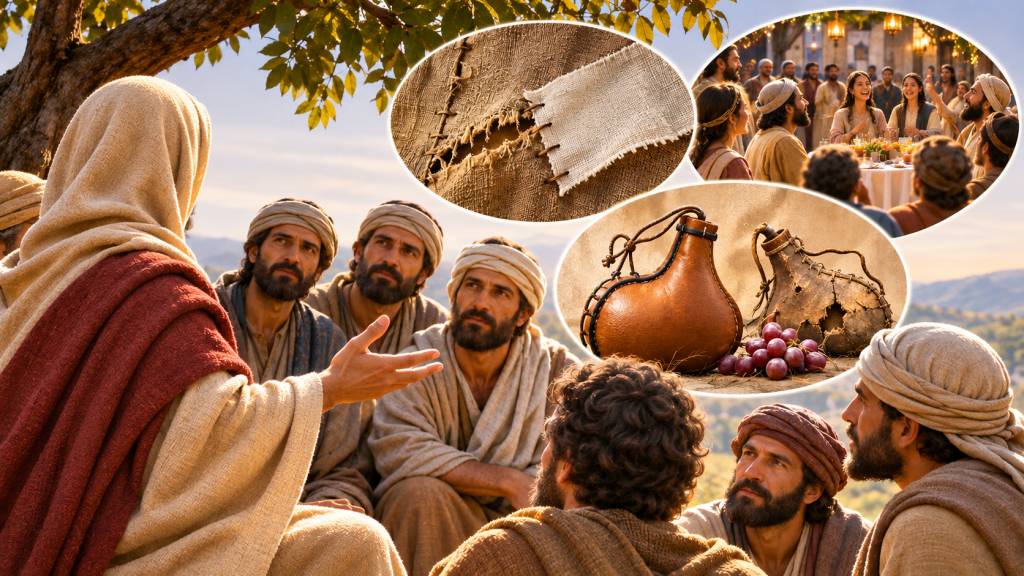
He uses an image taken from the nuptial celebrations.
He asked whether guests to a wedding could be in mourning while the husband was with them.
This answer moves the question.
The main issue is no longer simply the frequency of fasting.
It concerns the meaning of Jesus’ presence with his disciples.
1.2. Spouse's Presence as a Reason for Rejoicing
In ancient Jewish society, weddings were opportunities for joy.
Families and guests gathered to celebrate the union of the spouses.
The festivities could take several days.
Genesis 29.27 evokes a week of wedding celebration.
Judges 14.12 also refers to a seven-day period under Samson's wedding.
These accounts belong to times before Jesus '.
However, they show that the nuptial celebrations have long been an important part of Israeli society.
Jesus ' answer is based on this reality.
A wedding party does not normally correspond to a period of mourning.
The presence of the bridegroom is therefore a reason to rejoice.
1.3. The meaning of the expression "friends of the spouse"
Matthew 9.15 uses a Greek expression that literally means "the sons of the marriage chamber."
This formula refers to persons associated with the celebration of marriage.
It should not be understood as an indication of biological kinship.
In the context, it corresponds to the companions or guests participating in the wedding celebrations.
Mark 2.19-20 and Luke 5.34-35 also use this expression.
Jesus thus compares his disciples to those who accompany the bridegroom during the festivities.
Their conduct must correspond to the situation in which they are in.
The presence of the bridegroom explains why fasting, when it expresses affliction, is not appropriate at this particular time.
2. God presented as the bridegroom of Israel
2.1. Isaiah 54.5: the Creator as Spouse
Isaiah 54.5 declares:
"For your creator is your husband: the the Lord of the armies is his name."
This passage belongs to a restoration announcement.
The prophet addresses Zion using the image of a woman who has experienced abandonment and affliction.
God promises to show him his compassion again.
The conjugal image expresses the special relationship between thethe Lord and its people.
It emphasizes divine fidelity despite periods of judgment.
The text does not describe a marriage in the material sense.
He uses a comparison to present the covenant between God and Israel.
This image is an important background for understanding the nuptial language used in the Gospels.
2.2. Isaiah 62.4-5: Restoration and Joy
Isaiah 62.4-5 announces that Jerusalem will no longer be called "Deadline."
The prophet presents his restoration by means of the language of marriage.
He evokes the joy of the bridegroom for his wife.
This comparison highlights the transformation of the situation of the people.
Afflict and abandonment give way to God's favor.
The announced restoration becomes an opportunity for joy.
This passage allows us to understand why the image of the wedding has a prophetic dimension.
It is not just about a family celebration.
It can also refer to the fulfillment of God's promises.
However, Isaiah 62 should not be considered as a direct quote of Matthew 9.15.
It is a biblical background to illuminate the image.
2.3. Jeremiah 2.2: the memory of the early days of the covenant
Jeremiah 2.2 recalls Israel's attachment to God at the beginning of its history.
The prophet uses the language of engagement love.
This image refers to the relationship between the the Lord and its people after the exit from Egypt.
It highlights Israel's initial fidelity, before denouncing subsequent infidelities.
Marriage thus becomes a representation of the covenant.
Marital fidelity symbolically corresponds to fidelity to God.
Religious infidelity can, conversely, be described as marital infidelity.
This dimension appears particularly in the book of Hosea.
3. The testimony of the prophet Hosea
3.1. Marriage as a Representation of the Covenant
The book of Hosea uses the image of marriage to denounce Israel's infidelity.
Hosea 1-3 presents the prophet's conjugal relationship as a representation of the relationship between God and his people.
The wife's infidelity becomes an image of Israel's religious infidelity.
This comparison does not mean that God would be subject to the same limitations as a human husband.
She uses a human experience to express the gravity of the abandonment of the covenant.
The people turned to other gods.
This conduct is presented as a breach of fidelity to the.the Lord
3.2. Hosea 2.14-20: the promise of a renewed relationship
Hosea 2 announces a future restoration.
God promises to bring his people back to him.
The passage evokes a renewed relationship, based on justice, goodness, compassion and fidelity.
Hosea 2.19-20, according to the numbering of many French translations, contains this promise:
"I will be your fiancé forever."
This statement shows that judgment is not the last word of God's purpose.
God announces a restoration of the covenant relationship.
The image of the engagement expresses a renewed fidelity.
It allows us to understand why nuptial language can be associated with Messianic hope.
The coming of salvation foretold by God becomes an opportunity for joy.
3.3. The scope of this promise
The text of Hosea does not explicitly refer to the parable of the otters.
Nor does he specify that the Messiah will necessarily use the image of the bridegroom.
However, it has an important association between three themes:
- the alliance relationship;
- restoration after infidelity;
- the joy associated with the renewal of this relationship.
These themes constitute a relevant theological background for understanding Jesus' teaching.
They show that the image of the bridegroom has a special depth in the Scriptures.
4. John the Baptist recognizes Jesus as the husband
4.1. The testimony of John 3.28-30
John 3.28-30 reported an important statement by Jean-Baptiste.
He reminds us that he is not Christ.
He says he was sent in front of him.
He then uses the image of the husband:
"The one to whom the bride belongs is the bridegroom."
John presents himself as the husband's friend.
He explains that this friend rejoices when he hears the voice of the husband.
He concludes:
“He must increase, but I must decrease.”
This statement distinguishes between John's preparatory mission and Jesus' mission.
John does not claim the central place.
He recognizes that this place belongs to Christ.
4.2. The Joy of John the Baptist
John 3.29 states that the joy of John the Baptist is complete when he hears the voice of the bridegroom.
This statement is particularly important when approaching Matthew 9.14-15.
John's disciples ask Jesus about fasting.
Now John himself presents the coming of Jesus as a reason for rejoicing.
So there is no fundamental opposition between John's testimony and Jesus' teaching.
John was preparing for the coming of the Messiah.
Jesus fulfills the promised mission.
The difference between the practices of their disciples must be understood from this distinction.
4.3. Complementarity between the two ministries
John the Baptist's ministry calls the people to repentance.
Matthew 3.1-2 presents his preaching in the wilderness of Judea.
Luke 3.3 mentions the baptism of repentance for the forgiveness of sins.
Jesus ' ministry also announces repentance and proximity to the kingdom.
However, his presence is the fulfillment of the expectation prepared by John.
The image of the spouse allows us to understand this progression.
John announces the one who comes.
Jesus is the one whose coming brings joy.
This complementarity prevents the two departments from being presented as contradictory.
5. The bridegroom will be taken away: an announcement of passion
5.1. Unexpected statement
Matthew 9.15 is not limited to explaining the joy of the disciples.
Jesus adds:
"The days will come when the bridegroom will be taken away from them, and then they will fast."
This statement introduces a contrast.
The presence of the bridegroom is a time of joy.
His abduction announces a different period.
The verb used evokes being removed or removed.
In the context of Jesus ' ministry, this word can be understood as an early announcement of his passion.
However, the passage does not yet provide a detailed description of the circumstances of his death.
It is therefore necessary to distinguish the implicit announcement from the event and the more explicit revelations that will then appear.
5.2. Bringing together the passion announcements
Matthew 16.21 reports that Jesus began to show his disciples that he must suffer, be put to death and rise again on the third day.
Mark 8.31 makes a similar announcement.
Luke 9.22 also reports that the Son of man must suffer, be rejected, die and rise again.
These passages provide a retrospective understanding of the declaration of the spouse's abduction.
Jesus announces that he will not remain physically with his disciples under the same conditions.
The separation caused by his death will constitute a period of affliction.
This interpretation corresponds to the subsequent development of the Gospel accounts.
5.3. The pain of the disciples
John 16.20 reported a statement by Jesus concerning the future sadness of his disciples.
He announces that they will cry and lament, while the world will rejoice.
However, their sadness will be turned into joy.
This word corresponds to the events of passion and resurrection.
It shows that the affliction of the disciples will not be definitive.
Jesus ' death will cause a painful separation.
His resurrection will transform their situation.
The announcement of the bridegroom's abduction should therefore not be understood as a permanent disappearance of hope.
It is part of the process of the redemptive work.
6. Fasting after the bridegroom's abduction
6.1. The Declaration of Jesus
Jesus says his disciples will fast when the bridegroom is taken away.
This statement shows that fasting retains a place in the lives of believers.
However, Jesus does not specify a mandatory timetable here.
Nor does it set a universal frequency.
The word emphasizes above all that fasting will correspond to a situation different from that experienced by the disciples during his earthly presence.
It is therefore necessary to avoid deducing from the obligations that the text does not formulate.
6.2. The testimony of the book of Acts
Acts 13.2-3 reports that the leaders of the Church of Antioch fast and pray.
This practice accompanies the sending of Barnabas and Saul.
Acts 14.23 also refers to prayer and fasting when elders are established in the churches.
These passages show that the early Christians did indeed fast after Jesus ' resurrection and ascension.
However, their fastings are not only presented as manifestations of mourning.
They also accompany prayer, consecration and some important decisions.
This observation makes it clear that the Christian practice of fasting can have several dimensions.
6.3. The Fasting and Spiritual Presence of Christ
After his resurrection, Jesus promises to remain with his disciples.
Matthew 28.20 reports this statement:
"And behold, I am with you every day, until the end of the world."
This promise does not contradict the announcement of the bridegroom's abduction.
It concerns another modality of its presence.
During his earthly ministry, the disciples physically accompany Jesus.
After his ascension, they live in communion with the Risen Christ, through the action of the Holy Spirit.
John 14.16-18 announces the coming of the Comforter and affirms that the disciples will not be left orphaned.
This distinction allows us to understand why believers can both rejoice in the presence of the Risen Christ and practice fasting.
Christian joy and fasting are not necessarily incompatible.
Their meaning depends on the circumstances and the spiritual intention.
7. The image of the bridegroom in the teaching of Jesus
7.1. The parable of the ten virgins
Matthew 25.1-13 reported the parable of the ten virgins.
Ten young girls are waiting for the husband to arrive.
Five are cautious and five are insane.
The comparison highlights the need to be ready.
The arrival of the spouse is an event that is expected and the exact time is not known.
In the context of Matthieu 24-25's speech, this parable concerns the vigilance of the disciples before the coming of the Son of Man.
So she uses a nuptial image to evoke eschatological reality.
This use complements that of Matthew 9.15.
In the first passage, the husband is present.
In the second, his arrival is expected.
The two comparisons have different contexts, but they participate in the same Messianic representation.
7.2. The parable of the wedding feast
Matthew 22.1-14 presents a parable in which a king organizes weddings for his son.
The guests initially invited refuse to come.
Other people are then called.
This parable demonstrates the seriousness of the refusal to respond to the Royal Invitation.
It also presents the kingdom of heaven through a wedding celebration.
However, this parable must be distinguished from the controversy over fasting.
Matthew 22 has his own context and accents.
The image of the wedding is used in particular to illustrate the invitation to the kingdom and the responsibility of those who receive it.
Nevertheless, the rapprochement shows that Jesus repeatedly uses the nuptial language to speak of God's kingdom.
7.3. The Joy of the Kingdom
The images of a wedding allow us to associate God's kingdom with joy.
This dimension also appears in Luke 14.15-24, where Jesus presents the parable of the great meal.
Although this parable is not directly based on the image of a marriage, it uses the language of the banquet to evoke the invitation to the kingdom.
These comparisons show that the salvation foretold by Jesus is not limited to a series of religious obligations.
It has a dimension of communion and joy.
The presence of the spouse in Matthew 9.15 belongs to this perspective.
She announces that the messianic expectation is entering a decisive stage.
8. The Church Presented as a Wife
8.1. Ephesians 5.25-32
Paul uses the image of marriage to present the relationship between Christ and the Church.
Ephesians 5.25 declares:
"Christ loved the Church, and gave Himself for her."
The apostle then develops a comparison between the husband's love for his wife and Christ's love for the Church.
He cites Genesis 2.24 and then specifies that this mystery is great and that he speaks of Christ and the Church.
This passage explicitly establishes a conjugal dimension in the representation of the relationship between Jesus and believers.
The image particularly highlights the love of Christ and his sacrifice.
It does not, therefore, only concern the joy of a celebration.
It also highlights self-giving.
8.2. 2 Corinthians 11.2
In 2 Corinthians 11.2 Paul states that he engaged believers to one husband to present them to Christ as a pure virgin.
This comparison underscores the expected fidelity of the Christian community.
It shows that the nuptial language can express the consecration to Christ.
However, the function of each passage must be respected.
In Matthew 9.15, the picture explains why the disciples do not fast during Jesus’ presence.
In 2 Corinthians 11.2 it serves to exhort believers to remain faithful to Christ.
Both texts complement each other without being interchangeable.
8.3. A relationship based on love and loyalty
The nuptial comparisons of the New Testament highlight several aspects of the relationship between Christ and his people.
They evoke love, fidelity, consecration and hope.
However, these images should not be read literally in all their details.
They use human marriage to express spiritual realities.
The relationship between Christ and the Church therefore exceeds the material characteristics of a marriage.
The image retains a theological function.
It highlights the depth of the bond established by salvation.
9. The Marriage of the Lamb in Revelation
9.1. Revelation 19.7-9
Revelation 19.7 announces:
"Let us rejoice and rejoice, and let us give him glory; for the wedding of the Lamb have come, and his wife has prepared herself."
This statement belongs to a vision of heavenly joy.
It presents the fulfilment of wedding of the Lamb.
The image combines divine victory, joy and union between the Lamb and his wife.
It gives an eschatological dimension to the nuptial language.
The announced joy goes beyond the circumstances of Jesus ' earthly ministry.
It concerns the final fulfillment of God's purpose.
9.2. Revelation 21.2
Revelation 21.2 presents the new Jerusalem coming down from heaven, prepared as a bride who has adorned herself for her husband.
The image is shown in Revelation 21.9-10.
The angel announces that he will show the bride, the Lamb's wife, and then present the holy city.
This representation associates the wife with the new Jerusalem.
It emphasizes the fulfilment of the communion between God and his people.
The symbolic language of Revelation must be respected.
The new Jerusalem should not be reduced to mere material construction, nor should it be removed from the real dimension of the hope it represents.
The vision heralds the completion of God's purpose.
9.3. From the presence of the spouse to the performance of the wedding
The Gospels and Revelation make it possible to distinguish several stages in the use of the wedding image.
During his earthly ministry, Jesus presented himself as the bridegroom present to his disciples.
He then announces his abduction.
After his resurrection and ascension, believers live in expectation of the final fulfillment.
The Revelation presents wedding of the Lamb as a manifestation of this accomplishment.
This progression gives a particular depth to Matthew 9.15.
The joy of the disciples during Jesus ' earthly presence heralds a reality whose final fulfillment exceeds this first period.
10. Comparison table of the main domestic references
| Reference | Character or reality represented | Main meaning |
|---|
| Ésaïe 54.5 | God as Spouse of Zion | Divine Faith and Compassion |
| Ésaïe 62.4-5 | God and Jerusalem Restored | Joy of Restoration |
| Jérémie 2.2 | Israel in the early days of the covenant | Remembering the original attachment |
| Osée 2.16-22 | God and His People | Promise of a renewed relationship |
| Matthieu 9.15 | Jesus as a husband | Joy related to his presence and announces his abduction |
| Jean 3.29 | Jesus as a husband; John as a friend of the husband | Recognition of the Messiah and Joy of John the Baptist |
| Matthieu 22.1-14 | The King's son's wedding | Invitation to the Kingdom and Guest Responsibility |
| Matthieu 25.1-13 | Arrival of spouse | Watchfulness in waiting |
| 2 Corinthiens 11.2 | Christ as the husband of believers | Loyalty and consecration |
| Éphésiens 5.25-32 | Christ and the Church | Love of Christ and Gift of His Life |
| Apocalypse 19.7-9 | The Lamb and his wife | Rejoicing in the performance of the wedding |
| Revelation 21:2, 9-10 | New Jerusalem as wife | Fulfillment of communion with God |
This table shows that the nuptial language has several functions in the Scriptures.
He can express the faithfulness of God, the restoration of his people, the presence of the Messiah, Christ's love for the Church or the hope of the final fulfillment.
Each passage must be interpreted according to its context.
11. The Christological Scope of the Spouse's Image
11.1. A designation that goes beyond a simple social comparison
In Matthew 9.15 Jesus could have explained the difference in fasting practices without using the image of the bridegroom.
His choice is significant.
In Israel's Scriptures, this image already has a theological dimension.
God is presented as the bridegroom of his people.
Using this comparison to explain his own presence, Jesus writes his ministry in a language associated with the relationship between God and Israel.
This observation makes it possible to recognize a Christological significance to his statement.
However, we must avoid pretending that Matthew 9.15 alone constitutes an explicit and complete formulation of the divinity of Christ.
The passage presents an image whose meaning can be seen from the entire Scriptures.
11.2. The Presence of Jesus as a Critical Event
Jesus ' answer shows that his presence is changing the situation of his disciples.
They do not simply live under the guidance of an additional religious master.
They accompany the one whose coming is a decisive event in the history of salvation.
This particularity explains why their practices do not necessarily correspond to those of John the Baptist's disciples.
The difference is not based on a disregard for fasting.
It stems from the presence of the Messiah.
The image of the spouse is therefore the key to the reasoning.
Comparisons of clothing and otters then develop the consequences of this novelty.
11.3. A Joy That Is Part of Fulfilling the Promises
The joy associated with the bridegroom is not merely a passing emotion.
It corresponds to the recognition of the fulfillment of God's promises.
John the Baptist rejoices at Jesus' coming.
The disciples know the joy of his presence.
The believers await the final fulfillment announced by the Revelation.
This progression links Christ's earthly ministry with eschatological hope.
It shows that Christian joy has a theological basis.
It is based on the work of God accomplished in Jesus Christ.
12. Limitations of Interpretation
12.1. Do not transform all details into symbols
The comparison of Matthew 9.15 is based on a simple situation.
Guests participate in a wedding celebration.
They rejoice at the presence of the husband.
It would be excessive to attribute a particular doctrinal meaning to every implicit detail of the feast.
The text does not specify the identity of the wife.
It does not describe the complete unfolding of the wedding.
Nor does it provide a detailed schedule of future events.
Therefore, these elements should not be added to the explanation as if they were explicitly taught.
12.2. Distinguish the immediate meaning of subsequent developments
In the immediate context, Jesus answers a question about fasting.
The image of the bridegroom explains why his disciples do not fast during his presence.
The announcement of his abduction indicates that this situation will change.
The other Bible passages allow us to deepen the theological significance of the image.
However, they must not make its primary meaning disappear.
A rigorous interpretation must retain both dimensions.
It must respect the answer given to the initial question.
It can then show how this answer fits into the entire Bible revelation.
13. Conclusion of the appendix
The image of the bridegroom is an essential part of Jesus ' teaching about fasting.
It precedes comparisons of old and new wine.
It allows us to understand the context and scope of the project.
In the Old Testament, God uses marriage language to express his relationship with Israel.
Isaiah, Jeremiah, and Hosea present this relationship in the aspects of fidelity, infidelity, judgment, and restoration.
These passages constitute an important background for understanding the use of the marriage image in the Gospels.
John the Baptist explicitly recognizes Jesus as the bridegroom and presents himself as his friend.
He expresses his joy at the fulfilment of his preparatory mission.
Jesus ' answer in Matthew 9.15 is in this perspective.
The presence of the bridegroom is a time of joy.
His removal heralds a different period, during which the disciples will fast.
The book of Acts confirms that this practice retained a place in the life of the first Christian communities.
The New Testament also develops the nuptial image to present the relationship between Christ and the Church.
The Revelation finally announces wedding of the Lamb and the manifestation of the new Jerusalem.
These passages show that the image of the bridegroom has a scope that goes beyond the question of fasting.
It expresses the presence of the Messiah, his love for his people, and the hope of the final fulfillment.
Jesus' statement thus reveals that the true novelty does not lie first in changing religious practices, but in the presence of the Messiah himself: the expected husband has come, and his coming changes the situation of those who recognize him.