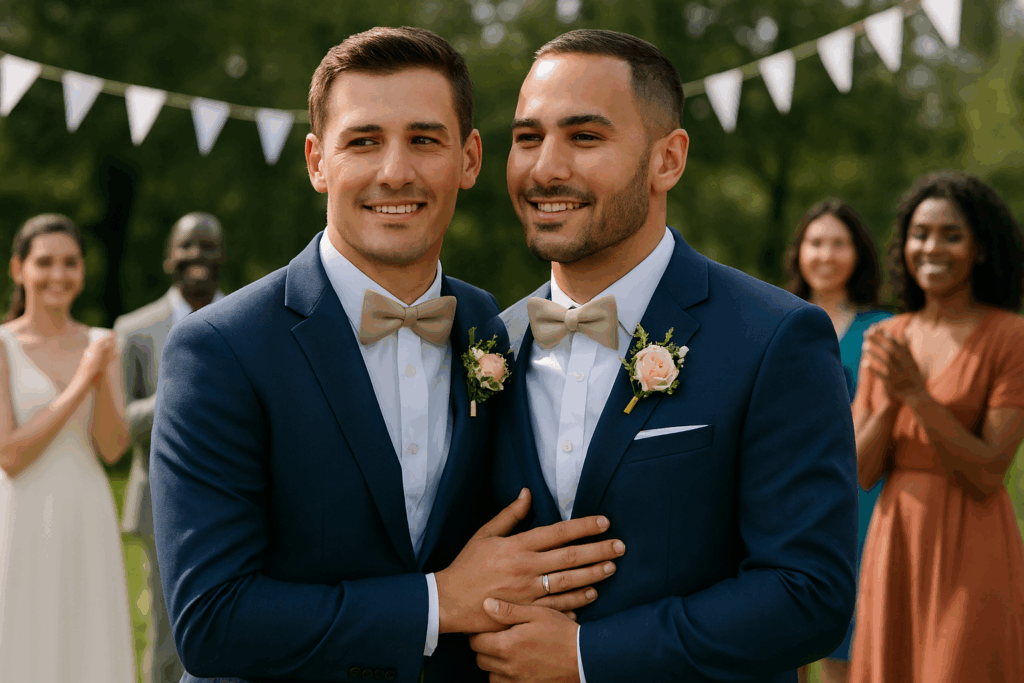
The article explores the legislative developments surrounding same-sex marriage, discussing its legalisation in France and elsewhere, the cultural and religious debates, and the contrasting positions of the Catholic and Protestant Churches. It highlights the importance of equality and respect in these contexts.
15 min
same-sex marriagehomosexualityequalitylawreligion
8 verses
8 books
The evolution of contemporary society has brought legislative changes that are sometimes perceived as hard to accept by certain groups, notably because of age or religious convictions. For example, same-sex marriage is a novelty compared with the social norms of previous decades. It sparks debate about transforming institutional structures that have been established for millennia.
This law is part of the broader liberalisation of morals concerning homosexuality.
Everyone remains free to express an opinion, whether in favour of this law or not; however, that point will not be dealt with here. The aim of this study is to analyse this legislative text in the light of the biblical sources.
The institution of gay marriage
marriage, or marriage for all, refers to the civil union between two people of the same sex. Legally, it grants same-sex couples the same rights and duties as heterosexual couples.
Meaning of the term “”
+
In France
It became legal on 17 May 2013, thanks to the law known as “Marriage for all”.
Same-sex couples have the same rights as heterosexual couples: civil marriage, adoption, inheritance, social security, etc.
This advance was driven by LGBT+ movements and supported by the Ayrault government.
Around the world
Same-sex marriage is legal in more than 39 countries, including:
Netherlands (the first country to legalise it, in 2001)
Canada, Spain, Belgium, Sweden, United States, Germany, Australia, South Africa, Uruguay, Taiwan, etc.
Thailand is the latest country to have legalised it (September 2024, in force since January 2025).
In some countries, marriage is recognised but not yet authorised (e.g. Japan, Brazil, Costa Rica).
Legal implications
Same-sex couples can:
Adopt children
Benefit from the same property and social rights
Have access to social security and medical care
Be protected by human rights laws
Debates and opposition
Some religious or conservative groups oppose marriage for theological or moral reasons.
Others see it as a major step forward for equality, dignity and the recognition of LGBT+ couples.
Political power was strongly influenced by LGBT+ movements in enacting this law on marriage.
+
A mayor in France has no right to refuse to marry a same-sex couple in the name of personal convictions. Since the law of 17 May 2013, marriage has been open to same-sex couples.
Mayors and their deputies are required to respect the law of the Republic and cannot invoke a conscience clause to refuse to celebrate a same-sex marriage.
A refusal based on sexual orientation constitutes discrimination. This exposes the civil registrar to: 5 years' imprisonment and a fine of €75,000, as well as damages payable to the couple wronged.
What is the Church's position?
The position of the Catholic Church on same-sex marriage is clear and rests on a distinction between pastoral welcome and sacramental doctrine:
Official position
The Church holds that marriage is a sacrament reserved for the union of a man and a woman.
Homosexual relationships are seen as contrary to the natural moral law, because they are not open to procreation and are not based on sexual complementarity.
Welcoming homosexual persons
The Catechism of the Catholic Church insists that homosexual persons must be welcomed with respect, compassion and sensitivity, without unjust discrimination.
In December 2023, the Vatican authorised the blessing of same-sex couples, provided it is carried out outside a liturgical setting and without confusion with sacramental marriage.
In summary
No Catholic religious marriage for same-sex couples.
Possibility of a blessing, but outside the official rites.
Respect for persons, but the traditional doctrine is maintained.
The United Protestant Church of France (EPUdF), the main branch of French Protestantism, has adopted an open and inclusive position on same-sex marriage:
A historic decision
In May 2015, at a national synod, the EPUdF voted by an overwhelming majority (94 votes for, 3 against) to authorise the blessing of same-sex couples.
This blessing may be celebrated after the civil marriage, because in Protestantism marriage is not a sacrament but a commitment before God and the community.
Local freedom
Each pastor and each parish remains free to accept or decline to bless these unions.
An internal movement, called the Attestants, formed in reaction to this decision, bringing together about 10 to 15% of EPUdF members who are opposed to this blessing.
Other Protestant branches
The Mission populaire évangélique also permits a liturgical gesture of welcome and prayer for same-sex couples.
By contrast, conservative evangelical Churches and certain Reformed branches remain firmly opposed to any religious recognition of same-sex unions.
The various Christian denominations hold very different positions on same-sex marriage, ranging from strict condemnation to full acceptance. Here is an overview of the main trends:
Denominations opposed to same-sex marriage
These Churches rely on a literal reading of the Bible and regard homosexuality as a sin:
Conservative evangelical Churches: such as the Church of God in Christ or certain Baptist branches, they firmly reject same-sex marriage and homosexuality in general.
Orthodox Church: it considers homosexual acts contrary to divine law and rejects any form of legal or religious recognition.
Certain traditional Protestant Churches: such as certain Reformed or Pentecostal branches, which maintain a traditional view of marriage.
Inclusive and affirming denominations
These Churches adopt a more open and inclusive theology:
United Protestant Church of France (EPUdF): it has authorised the blessing of same-sex couples since 2015.
Anglican Church (depending on the province): certain branches, such as the Episcopal Church in the United States or the Church of Scotland, celebrate same-sex marriages.
Progressive Methodist Churches: some local communities bless same-sex unions, although the overall position remains divided.
Independent and community Churches: such as the Metropolitan Community Church, founded specifically to welcome LGBTQ+ people.
In summary
Catholic Church: marriage refused, blessings possible
Conservative evangelical Churches: total rejection
Orthodox Church: total rejection
United Protestant Church of France: blessing authorised
Anglican Church (depending on the country): marriage authorised in certain provinces
: marriage celebrated and fully recognised.
The
Islam, in its traditional interpretations, rejects homosexuality, which rules out the possibility of same-sex marriage according to a literal reading of the Quran.
However, some contemporary approaches propose a more inclusive interpretation of the texts, stressing that the historical and social context influences the understanding of sacred writings. Moreover, there are LGBTQ+ Muslim communities that strive to reconcile their sexual orientation with their faith, often outside the framework of traditional religious institutions.
What does the Bible say?
The Bible does not explicitly address the question of same-sex marriage as it is defined today. However, many biblical passages are regularly cited in discussions about homosexuality and marriage. For an in-depth analysis of the biblical texts dealing with homosexuality, please refer to the previous article (FDS002: Homosexuality), in which these elements were examined in detail.
According to our understanding of the Scriptures, the biblical position on homosexual practices is unequivocal: they are explicitly described as contrary to the divine will and called sin. In this light, the religious celebration of a marriage between people of the same sex cannot be envisaged without departing from the biblical foundations.
Thus, religious leaders who choose to celebrate these unions in the same way as heterosexual marriages adopt a stance in clear contradiction with the plain teachings of the Word of God.
Reminder of the biblical texts
As we said earlier, the Bible does not speak directly of same-sex marriage as it is understood today, but it contains several passages that are often cited in debates on homosexuality and marriage. Here are the main elements:
Passages often invoked
Genesis 2.24: “A man shall leave his father and his mother and be joined to his wife, and they shall become one flesh.” This verse is often interpreted as defining biblical marriage as a union between a man and a woman.
Matthew 19.4-6: Jesus confirms this view, saying: “Have you not read that the Creator, from the beginning, made them male and female [...] What therefore God has joined together, let not man separate.” This reinforces the idea of heterosexual marriage as the divine model.
Leviticus 18.22: “You shall not lie with a male as with a woman; it is an abomination.” This verse is often cited to condemn homosexual acts.
Romans 1.26-27: Paul speaks of “vile passions” and of homosexual relations as “against nature”.
1 Corinthians 6.9-10: Paul lists those who “will not inherit the kingdom of God”, including the “sexually immoral” and “men who lie with men” according to some translations.
Differing interpretations
Conservative theologians see these verses as a clear condemnation of homosexuality and of marriage.
Progressive theologians stress that these texts must be placed back in their historical and cultural context, and that the central message of the Bible is love, justice and dignity.
It is important to note that God's love for humanity does not imply unconditional acceptance of all human behaviour. The concept of sin is regarded as a factor of separation between human beings and God, and forgiveness, as described by the doctrine concerning the death of the Messiah Jesus, is presented as the way to restore this relationship. Furthermore, it is stated that those who do not subscribe to this principle do not take part in this plan of salvation.
Even though God's love surpasses what we can imagine, it remains true that some will be saved while others will be lost.
Conclusion
Although same-sex marriage is perceived by legislators as a social advance, it represents, according to the teachings of the Messiah Jesus and the Bible, a departure from divine principles. Contrary to the widespread idea that God's laws restrict human freedom, they actually act as protective guideposts, intended to spare people many sufferings and excesses.
This societal “evolution” tends to obscure the spiritual foundations, leading people to believe that what is morally acceptable in the eyes of men is also acceptable before God. Yet the Word clearly affirms that what man considers good may in truth be contrary to the divine will (Isaiah 5.20). And it is not before human institutions that each person will have to give account, but before God himself (Ecclesiastes 11.9).
In this context, the disciple of the Messiah Jesus is called to denounce laws that are contrary to biblical truth, not out of judgment or condemnation, but out of love and truth. His mission is to warn, to accompany, and to bear witness that the Bible offers lasting solutions, approved by God.
“Jesus said to him, ‘If you can!… All things are possible for one who believes.’”, Mark 9.23.
A title, a person, a place, a reference (“Luke 15”)…
opens in a new window
Bible reference
INF137
Information note
INF137 - Influence of LGBT+ groups on laws
Influence of LGBT+ groups on laws
Laws such as marriage for all (2013), the ban on conversion therapies (2022) or the national plans against discrimination were preceded by years of activism.
The National Plan for Equality, against Hatred and Anti-LGBT+ Discrimination (2023–2026) was co-developed with more than a hundred partners, including local and national LGBT+ associations, LGBT+ centers, and public institutions.
These groups proposed more than 300 concrete measures, showing an unprecedented mobilization to change public policy.
A growing political commitment
The French government now regards the fight against LGBT+ discrimination as a political priority.
The shift in public opinion (85% of French people considered homosexuality a normal way of living one’s sexuality in 2019, compared with 24% in 1975) has also strengthened the political legitimacy of these laws.
In sum, gay and LGBT+ groups have played a driving role in the enactment of these laws, by mobilizing, raising awareness, and taking an active part in the political consultation process.
INF136
Information note
INF136 - Meaning of the acronym LGBTQ+
Meaning of the acronym LGBTQ+
The term LGBTQ+ is an acronym that stands for a diversity of gender identities and sexual orientations. Here is what each letter means:
L = Lesbian (a woman attracted to women)
G = Gay (a man attracted to men, sometimes used more broadly to refer to any homosexual person)
B = Bisexual (a person attracted to more than one gender)
T = Transgender (a person whose gender identity does not match the sex assigned at birth)
Q = Queer / Questioning is an inclusive term for identities that do not conform to traditional norms, or for a person who is questioning
+ = Plus: it represents all the other identities: intersex, asexual, pansexual, non-binary, etc.
This acronym evolves over time to better reflect the diversity of human experience. It is often extended to LGBTQIA+, where:
I = Intersex and A = Asexual or Aromantic
INF135
Information note
INF135 - Meaning of the term “gay”
Meaning of the term “gay”
The term "gay" has a fascinating linguistic and cultural history:
Etymological origin
The word "gay" comes from Old French "gai", itself derived from Occitan gai and probably of Germanic origin.
Originally, it meant joyful, carefree, lively. It is found in expressions such as gai savoir (lou gai sabé), which referred to the pleasure of learning among the troubadours.
Evolution of the meaning
17th–19th centuries: in English, "gay" begins to describe a dissolute life or one linked to prostitution. People spoke of a gay life for a life of pleasures that did not conform to moral norms.
1920s–1930s: in the United States, "gay" is used in homosexual circles to express a form of freedom, exuberance or carefreeness.
1940s–1970s: the word becomes a common noun designating homosexual men, notably after the Stonewall riots of 1969, which mark a turning point in the fight for LGBTQ+ rights.
Cultural anecdote: the film Bringing Up Baby (1938) is considered the first to use the word "gay" in reference to homosexuality, in a humorous scene with Cary Grant.
INF138
Information note
INF138 - Inclusive churches
Inclusive churches
Inclusive Churches are Christian communities committed to welcoming everyone, regardless of sexual orientation, gender identity, social status, disability or origin. Their approach rests on a theology of radical welcome, centered on God’s unconditional love.
Principles of Inclusive Churches
Full welcome of LGBTQIA+ people: they can take part fully in the life of the Church, including as ministers or leaders.
Blessing and celebration of same-sex marriages.
Non-gendered liturgical language and practices adapted to people with disabilities.
Social commitment to human rights, justice and the dignity of all people.
Examples of Inclusive Churches
Community of Christ the Liberator: a Christian LGBTQIA+ group that offers worship services and times of prayer open to all.
Metropolitan Community Church (MCC): founded specifically for LGBTQ+ people, present in several countries.
Some Anglican, Protestant or Catholic parishes that practice an inclusive pastoral ministry, as in Strasbourg or Paris.
However, these movements remain very marginal and do not represent the mindset of the traditional churches.