CHR007

The date of birth of Jesus the Messiah

The study explores the date of Jesus’ birth, linking prophecies, Gospel testimonies and historical data to propose a birth around October 12, -2 BC, during the Feast of Tabernacles.

47 min chronology prophecy Jesus birth Tabernacles 57 verses 11 books

Further information

Introduction

This study is one of the elements of our research devoted to establishing a chronology of the life of Jesus the Messiah on the basis of Daniel’s prophecy of the seventy weeks (Daniel 9.24-27). It should be understood in connection with the other studies in this series, each of which contributes complementary historical, calendrical and biblical data. Together, these works form a coherent analysis aimed at reconstructing, as precisely as possible, the sequence of events reported in the Gospels.

Among the many questions raised by biblical research, that of the date of birth of Jesus of Nazareth holds a special place. Although the Gospels give no explicit date, they nevertheless provide several historical, prophetic and chronological landmarks that make it possible to propose a coherent estimate.

This study follows that approach: examining the biblical and historical data in order to determine the most probable period of the birth of Jesus the Messiah.

Our reflection rests mainly on the cross-analysis of three sets of information:

  • the prophecies of Daniel 9.24-27, announcing a period of seventy weeks of years until the coming and then the cutting off of the Messiah;
  • the Gospel testimonies, notably those of Matthew and Luke, which place the events in a precise historical setting (Matthew 2.1; Luke 1.5; Luke 3.1-3);
  • the chronological data drawn from ancient history, such as the reign of Tiberius, the census associated with Quirinius, or the question of the date of the death of Herod the Great.

The aim of this study is to show that a harmonized reading of these different sources allows us to envisage a birth of Jesus around October 12 of the year -2 BC, during the Jewish Feast of Tabernacles ().

This hypothesis does not rest solely on chronological calculations. It also shows strong theological coherence. Indeed, the Feast of Tabernacles celebrates the presence of God in the midst of his people, a theme that the Gospel of John seems to take up when it states:

John 1.14 (King James Version) :
And the Word was made flesh, and dwelt among us, (and we beheld his glory, the glory as of the only begotten of the Father,) full of grace and truth.

The Greek verb used by John can literally evoke the idea of “pitching his tent” among men, directly recalling the symbolism of .

The stakes of this study are therefore twofold:

  • historical, by seeking to reconstruct rigorously the chronology of the events surrounding the birth of the Messiah;
  • theological, by showing the remarkable coherence between biblical prophecies, the feasts of Israel and the fulfillment presented by the Gospels.

By comparing the prophetic data of Daniel, the chronological indications of the Gospels and the information drawn from secular history, we will seek to demonstrate that biblical revelation is rooted in history with a particularly remarkable coherence (Galatians 4.4; John 3.16-17).
I. Methodology of the study

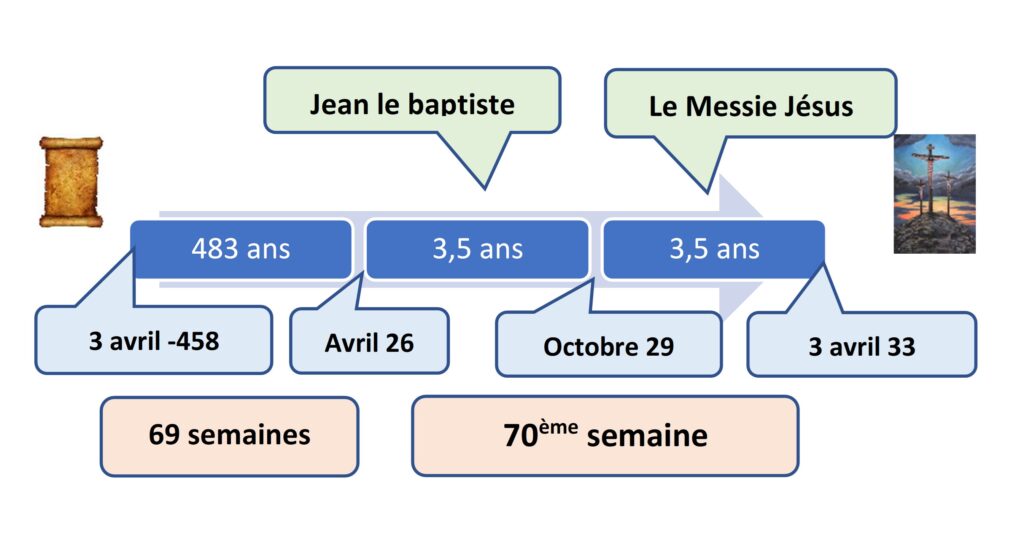
To determine the date of birth of Jesus the Messiah, our approach relies on a rigorous reading of the seventy prophetic weeks announced by Daniel (Daniel 9.24-27). These 490 years form a chronological framework linking the rebuilding of Jerusalem to the coming and rejection of the Messiah.

The starting point retained is the decree of Artaxerxes reported in Ezra 7.1-28, dated to early April 458 BC. Adding 490 years — taking into account the absence of a year zero — brings us to AD 33, generally associated with the crucifixion and resurrection of the Messiah (John 3.16-17, 1 Corinthians 15.3-4). This correspondence underscores the remarkable precision of the text of Daniel.

Going back three and a half years (1,260 days, Revelation 11.3), we place the baptism of Jesus around October AD 29 (Tishri 3790), in the middle of the seventieth week, marking the beginning of his public ministry. Now, Luke 3.23 indicates that he was “about thirty years old” at that time, which leads to a birth around October –2 BC.

This dating nevertheless raises a difficulty: Matthew places the birth “in the days of King Herod” (Matthew 2.1), traditionally said to have died in –4 BC according to Flavius Josephus. However, the sequence of events described between the eclipse and the Passover (illness, executions, funeral, political transition) fits better with the eclipse of January 9, –1 BC, leaving a sufficient interval. Thus, a death of Herod in –1 appears more coherent (cf. Appendix ANN011).

This hypothesis makes it possible to harmonize the Gospel accounts, Herod’s actual reign at the time of Jesus’ birth, and the chronology leading to AD 33. Henceforth, a birth in October –2 BC becomes compatible with Luke 1.5 and with the political context under Archelaus.

Moreover, the reliability of Luke is reinforced by his method (Luke 1.3) and his precise historical anchoring (Luke 3.1-2), as well as by his status as a well-informed witness (Colossians 4.14, 2 Timothy 4.11).

In the light of these data, the birth of the Messiah can be placed with a high probability around October –2, possibly during the Feast of Tabernacles (Leviticus 23.34-43), echoing John 1.14. Thus, the chronology derived from Daniel, confirmed by the Gospels, manifests the coherence of the divine plan: “But when the fullness of time had come, God sent forth his Son” (Galatians 4.4).

II. The prophecy of Daniel’s seventy weeks

The book of Daniel announces that, starting from a decree authorizing the rebuilding of Jerusalem, a period of seventy weeks of years — that is, 490 years — will elapse until the coming of the Messiah and his cutting off (Daniel 9.24-27).

In our study, we take as the starting point the decree of Artaxerxes reported in Ezra 7.1-28, generally placed in the spring of the year -458 BC. Adding 490 years to this date, while taking into account the absence of a year zero in our calendar, we arrive at AD 33, a date compatible with the Gospel chronology of the crucifixion and resurrection of Jesus the Messiah (Matthew 27.45-54).

This correspondence appears particularly remarkable and constitutes, according to our analysis, an important argument in favor of the chronological coherence of the Scriptures. Several researchers have proposed different methods of calculation concerning this prophecy; however, all the data seem to converge toward the beginning of the first century and the events surrounding the death of Christ.

We develop this study in more detail in the chapter devoted to the prophet Daniel as well as in the study CHR002 on the seventy weeks.

Timeline of Daniel’s 70 weeks

III. The Messiah’s ministry in the prophetic chronology

Daniel specifies that “in the middle of the week” the sacrifice and the offering will cease (Daniel 9.27). In our interpretation, this expression corresponds to the moment when the Messiah fully accomplishes his redemptive mission.

We propose the following chronological structure:

  • first half of the seventieth week: ministry of John the Baptist, preparing the way of the Messiah (Luke 1.16-17);
  • second half: public ministry of Jesus the Messiah until his death and resurrection.

This reading leads us to envisage a public ministry of about three and a half years for Jesus, a duration that seems to be confirmed by the various Passovers mentioned in the Gospel of John (John 2.13; John 6.4; John 11.55).

Some authors have also noted a possible parallel between this duration and the symbolic period of 1,260 days mentioned in Revelation (Revelation 11.3). Even if this comparison must be handled with caution, it remains interesting within a global prophetic reading of the Scriptures.

IV. Luke’s chronological landmarks

From the introduction of his work, the evangelist Luke insists on the seriousness of his historical approach (Luke 1.1-4). He places the beginning of the ministry of John the Baptist “in the fifteenth year of the reign of Tiberius Caesar” (Luke 3.1-2).

Two methods of calculation are generally proposed:

  • either from the death of Augustus in AD 14, which leads to around 28-29;
  • or by taking into account the co-regency of Tiberius with Augustus from the years AD 11-12, a hypothesis compatible with ancient political practices.

Under this second hypothesis, the fifteenth year of Tiberius would correspond to AD 26-27, which would make it possible to place:

  • the beginning of John’s ministry around 26;
  • the baptism of Jesus in the autumn of 29;
  • then the crucifixion in the spring of 33.

This reconstruction shows a remarkable coherence with Daniel’s prophecy as well as with the approximate duration of Jesus’ public ministry.

V. The Messiah’s birth during the Feast of Tabernacles

Luke specifies that Jesus was “about thirty years old” when he began his ministry (Luke 3.23). If we accept a baptism in the autumn of AD 29 and a ministry of about three and a half years, the birth of Jesus the Messiah can be placed around the autumn of the year -2 BC.

This period would correspond to the Feast of Tabernacles, also called , celebrated from the 15th to the 22nd of Tishri (Leviticus 23.34-43). This feast was one of the three great annual pilgrimages required of the Israelites, along with Pesach and Shavuot. Jerusalem and its surroundings then welcomed a large crowd of pilgrims from all over the country and even from the diaspora.

In this context, Luke’s remark that “there was no room for them in the inn” (Luke 2.7) becomes particularly understandable. The lack of lodging seems more naturally explained by the massive influx of pilgrims during a great religious feast than by the mere effect of an administrative census.

This hypothesis also has an important theological interest. The Feast of Tabernacles commemorated the presence of God in the midst of his people during the crossing of the wilderness. Now, John uses particularly evocative vocabulary when he writes:

John 1.14

“The Word became flesh and dwelt among us.”

The Greek verb used can be translated literally as “to pitch one’s tent” or “to tabernacle.” Several researchers see in this expression a possible allusion to and to the theme of the divine presence coming to dwell among men.

Thus, the birth of the Messiah during this feast would present a strong symbolic coherence:

  • celebrated the presence of God with Israel;
  • the incarnation of Christ shows God coming to dwell among men (Matthew 1.23).

This reading is obviously not an absolute proof, but it offers a particularly coherent harmonization between:

  • the chronological data;
  • Jewish practices of the first century;
  • and the theology developed in the Gospels.

In this hypothesis, the birth of Jesus could be placed around October 12 of the year -2 BC, during the Feast of Tabernacles.

VI. The testimony of Zechariah and the priestly division of Abijah

The Gospel of Luke also provides another important chronological clue by specifying that Zechariah, the father of John the Baptist, belonged to the priestly division of Abijah (Luke 1.5).

The twenty-four priestly divisions had been organized in the time of King David (1 Chronicles 24.1-19). The division of Abijah occupied the eighth position (1 Chronicles 24.10).

Several researchers have tried to reconstruct the calendar of priestly rotations until the destruction of the Temple in AD 70. According to some of these reconstructions, Zechariah’s service could be placed around the summer of the year -3 BC.

Luke reports that John the Baptist was conceived shortly after this period (Luke 1.23-24). A few months later, the angel Gabriel announces to Mary that Elizabeth is then “in her sixth month” (Luke 1.36). By adding six months to the probable birth of John, several researchers thus arrive at a birth of Jesus around the autumn of the year -2 BC.

It should nevertheless be emphasized that this reconstruction remains partly hypothetical. The data concerning the priestly rotations of the first century are not perfectly preserved, and certain historical interruptions may have altered their regularity.

Nevertheless, this hypothesis shows an interesting coherence with:

  • Luke’s chronological indications;
  • the birth of Jesus during ;
  • and the general chronology proposed in this study.

Thus, even if these calculations do not allow absolute certainty, they reinforce the idea that a birth of the Messiah in the autumn of the year -2 BC remains historically and biblically plausible.

VII. The question of the death of Herod the Great

One of the main debates surrounding the chronology of Jesus’ birth concerns the date of the death of King Herod the Great. Matthew explicitly places the birth of the Messiah during the reign of this ruler (Matthew 2.1) and then reports the visit of the Magi, the massacre of the children of Bethlehem and the flight to Egypt (Matthew 2.13-18).

Now, the majority of modern historians today place the death of Herod in the year -4 BC, mainly following the work of Emil Schürer in the nineteenth century. This dating rests on the interpretation of the indications provided by Flavius Josephus, notably the identification of a lunar eclipse preceding the king’s death.

However, this reconstruction is not unanimously accepted. Several researchers consider that another eclipse, that of January 10, -1 BC, fits better with Josephus’ account and with the events he describes between this eclipse and the Feast of Passover.

Under this hypothesis:

  • Herod would die at the beginning of the year -1;
  • Jesus could therefore have been born in the autumn of the year -2 while still being truly born “in the days of King Herod” (Matthew 2.1);
  • the visit of the Magi and the events reported by Matthew would have a more coherent chronological timeframe.

It is important to emphasize that the writings of Flavius Josephus provide no absolute date according to our modern calendar. The reconstructions proposed by historians therefore rest on chronological calculations and interpretations that are sometimes complex:

  • length of reigns;
  • possible co-regencies;
  • identification of eclipses;
  • ancient methods of counting years.

Under these conditions, the date of -4 BC should not be presented as an absolute historical certainty, but as the dominant historiographical hypothesis among other possibilities.

Luke indirectly confirms Matthew’s testimony when he writes:

Luke 1.5

“In the days of Herod, king of Judea, there was a priest named Zechariah…”

Thus, Matthew as well as Luke clearly place the events surrounding the birth of the Messiah under the reign of Herod the Great.

Moreover, several ancient Christian authors as well as certain Church Fathers seem to have envisaged a birth of Jesus around the years -3 to -2 BC. This chronology was therefore not foreign to the first centuries of Christianity.

The debate remains open today in certain specialized circles. Our aim is not to claim to settle this complex question definitively, but to show that a death of Herod in the year -1 BC remains historically plausible and compatible with all the biblical and chronological data studied in this research.

VIII. Coherence between the major stages of the Messiah’s life and the feasts of Israel

Another remarkable element of this chronology lies in the possible correspondence between the major stages of the life of Jesus the Messiah and the main feasts of the biblical calendar.

According to our reconstruction:

  • the birth of Jesus would take place during the Feast of Tabernacles (), celebrating the presence of God in the midst of his people;
  • his baptism and the beginning of his public ministry would be situated at the time of Yom Kippur, the feast of forgiveness and reconciliation;
  • his crucifixion would occur during the feast of Pesach, in direct connection with the symbolism of the Passover lamb (1 Corinthians 5.7);
  • his resurrection would correspond to the feast of firstfruits, announcing the first harvest offered to God (1 Corinthians 15.20).

This coherence should not be understood as an absolute mathematical proof, but it shows a strong symbolic and theological unity.

The feasts of Israel already announced, in figurative form, several aspects of the work of the Messiah:

  • Pesach announced the redemptive sacrifice;
  • the firstfruits announced the resurrection;
  • evoked the divine presence among men.

From this perspective, Jesus appears as the fulfillment of the figures and symbols of the Law (Matthew 5.17).

This harmonization between:

  • the biblical calendar,
  • the events of the life of Christ,
  • the prophecies of the Old Testament,
  • and the Gospel accounts,

reinforces the impression of a particularly remarkable overall coherence among the different parts of the Scriptures.

Conclusion

The cross-study of the prophetic, Gospel and historical data allows us to seriously envisage a birth of Jesus the Messiah in the autumn of the year -2 BC, probably during the Feast of Tabernacles.

This reconstruction rests on several converging elements:

  • the chronology of Daniel’s seventy weeks (Daniel 9.24-27);
  • Luke’s precise indications concerning the age of Jesus and the political context at the beginning of his ministry (Luke 3.1-23);
  • the various feasts mentioned in the Gospel of John;
  • the historical data relating to the reign of Herod and to the time of Tiberius;
  • as well as the theological symbols associated with the great feasts of Israel.

From this perspective, the birth of the Messiah during shows a particularly remarkable coherence. Israel was then celebrating the presence of God in the midst of his people, while the Gospel of John affirms:

John 1.14

“The Word became flesh and dwelt among us.”

This convergence between chronology, biblical symbolism and theological fulfillment gives a particular depth to the Gospel accounts.

We are aware that several points addressed in this study remain debated among historians and specialists in ancient chronologies. The questions relating to the death of Herod, to the census associated with Quirinius, or to the exact calculation of the years of reign cannot be considered definitively closed.

Our aim is therefore not to artificially impose an absolute dating, but to show that a birth of Jesus in the year -2 BC remains historically plausible and that it fits coherently with all the biblical data examined.

This approach also invites us to consider the Gospels not as accounts detached from history, but as testimonies deeply rooted in the political, religious and chronological context of the first century. Luke himself stresses that he undertook careful investigations before writing his account (Luke 1.1-4), while Matthew explicitly places the birth of the Messiah under the reign of Herod (Matthew 2.1).

Thus, far from weakening the credibility of the biblical texts, the careful study of the historical and prophetic data tends on the contrary to reveal a particularly remarkable overall coherence. The prophecies of the Old Testament, the feasts of Israel and the events of the life of the Messiah seem to fit together according to a logic that runs through the whole of the Scriptures.

As the apostle Paul writes:

Galatians 4.4

“But when the fullness of time had come, God sent forth his Son…”

The coming of Jesus the Messiah then appears not as an isolated or imprecise event, but as the progressive fulfillment of a plan announced long ago in the Scriptures and inscribed in the very course of history.