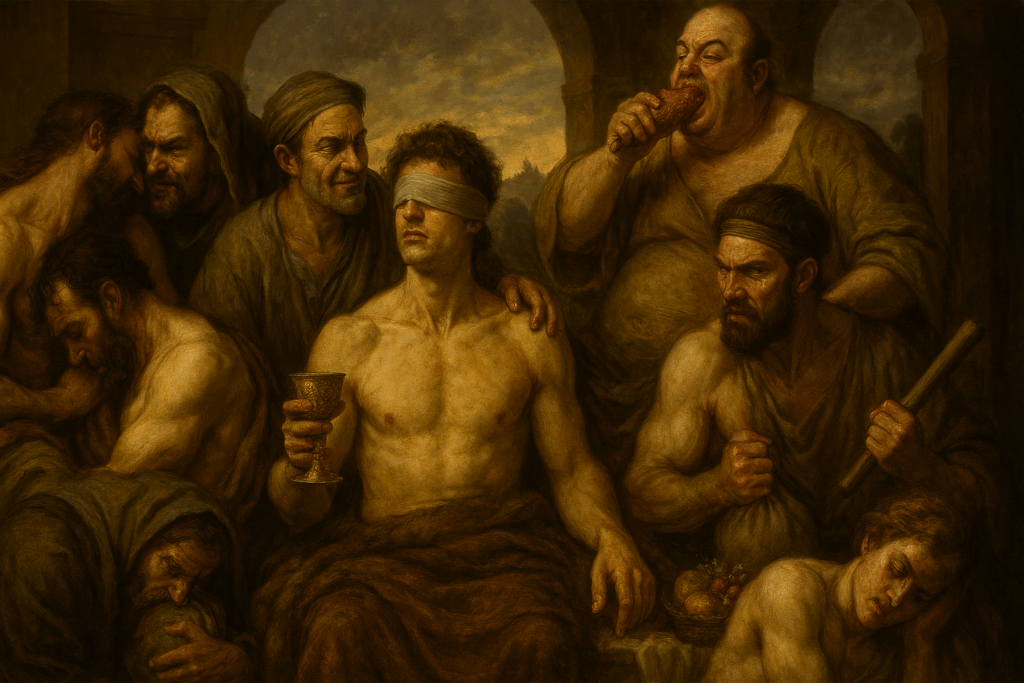
Capital and venial sins are discussed by several major figures of the Christian tradition, notably Evagrius Ponticus, John Cassian, Gregory the Great and Saint Thomas Aquinas. These authors contributed to their definition, their classification and their spiritual scope.
1 - Genesis of the capital sins
1. Evagrius Ponticus (4th century)
A desert monk, he developed a spiritual psychology based on eight evil thoughts (logismoí) that trouble the soul.
These thoughts were not yet called “sins”, but they were seen as fundamental temptations: gluttony, lust, avarice, sadness, anger, acedia (sloth), vainglory, pride.
They form the ascetic basis of what would become the capital sins.
2. John Cassian
He transmitted Evagrius’s ideas to the Latin West, adapting them to monastic life. He speaks of principal vices that must be fought through prayer, discipline and virtue.
He initiates a moral classification of faults, in connection with the inner life.
3. Gregory the Great (6th century)
Pope and doctor of the Church, he reduced the list to seven capital sins, removing sadness and merging vainglory and pride.
To each capital sin corresponds a Christian virtue directly opposed to it, like a spiritual remedy intended to purify the soul and orient the believer toward the good. This opposition makes it possible to better understand man’s inner struggles and the means of overcoming them.
To pride, which drives man to believe himself superior to others and to God, is opposed humility, which consists in recognizing one’s condition as a creature and submitting with trust to the divine will.
To avarice, which is excessive attachment to material goods, is opposed generosity, a virtue that leads one to share with others, particularly the most deprived, in a spirit of detachment.
To lust, which is the disordered pursuit of sexual pleasure, is opposed chastity, understood as self-mastery and respect for the dignity of the body and of love.
To envy, which is sadness at another’s good and the desire to possess it, is opposed charity, which rejoices in the happiness of others and seeks their good.
To anger, which is a violent and disordered reaction to an annoyance, is opposed patience, which makes it possible to bear trials and offenses with peace and gentleness.
To gluttony, which is excess in food or drink, is opposed temperance, a virtue of moderation that regulates desires and pleasures.
To sloth (or acedia), which is the refusal of spiritual and moral effort, is opposed zeal (or perseverance), which drives one to fulfill with ardor one’s duties toward God and others.
This moral structure profoundly influenced Christian spirituality, preaching, religious education and even medieval iconography, where these virtues and sins are often depicted in opposition in frescoes, stained-glass windows or illuminated manuscripts.
Pope Gregory the Great thus created a pedagogical structure for preaching and confession. His classification became canonical in the Catholic Church.
2 - Emergence of the venial sins
4. Saint Thomas Aquinas (13th century)
In his major work, the Summa Theologica, he distinguishes three types of sins:
Mortal: grave, destroying charity in the soul.
Venial: light, weakening the relationship with God.
Capital: roots of vices, which engender other sins.
He gives a rational structure to Christian morality, based on gravity, intention, and the freedom of the subject.
The development of the notions of capital and venial sins was built up gradually over the centuries, through the reflections of several major figures of the Christian tradition.
In the 4th century, Evagrius Ponticus, a monk and ascetic theologian, identified eight evil thoughts (logismoí) that trouble the soul: gluttony, lust, avarice, sadness, anger, acedia (sloth), vainglory and pride. These thoughts form the basis of what would later become the capital sins.
In the 5th century, John Cassian, a disciple of Evagrius, adapted this classification to the Latin West. He then speaks of principal vices, linking them to monastic life and the daily spiritual struggle, thus laying the foundations of a structured Christian morality.
In the 6th century, Gregory the Great, pope and doctor of the Church, reduced the list to seven capital sins by merging certain categories and removing sadness. He associated with each of these sins an opposing virtue, creating a moral and spiritual framework that was widely disseminated in the Catholic Church.
Finally, in the 13th century, Thomas Aquinas, in his Summa Theologica, systematized these teachings. He clearly distinguishes mortal sins, which destroy charity in the soul, from venial sins, which weaken it, and from capital sins, which he regards as roots generating other faults.
This gradual evolution testifies to a constant effort by the Church to understand, name and combat the different forms of moral evil in human life.