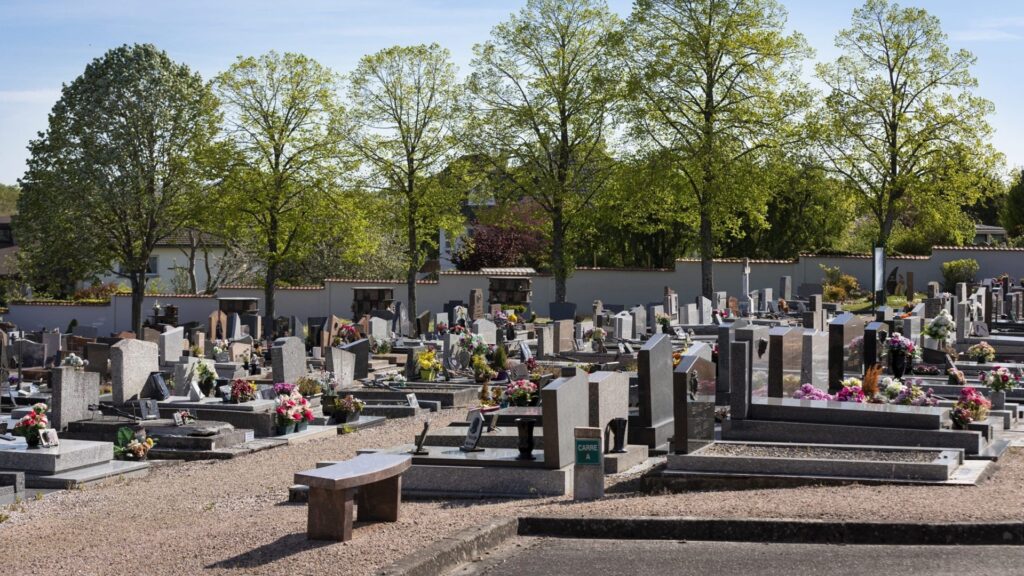
This article explores the biblical perspectives on the fate of the dead, whether unconscious sleep until the resurrection or an intermediate consciousness. It analyzes key texts, stressing the resurrection and the coming divine judgment, as well as the eternal distinction between the righteous and the wicked.
79 min
deathresurrectionjudgmentdormition
113 verses
22 books
At Christian funerals, it is not unusual to hear words such as: “He is with the Lord,” “He is in paradise,” or “He is in heaven.” These expressions, often spoken with compassion, seek to comfort the family and friends by presenting a peaceful picture of the fate of the departed. Yet behind these statements lie sometimes very different ideas of what really becomes of the dead.
Some imagine that the departed still watch over the living or observe their loved ones from heaven. Others think that access to paradise is immediate from the last breath. Conversely, several Christian currents defend the idea of an unconscious sleep of the dead until the final resurrection.
Despite these differences, a certain consensus exists in Christianity concerning the final destiny of the human being. The Bible teaches that the body returns to dust while the spirit or soul survives physical death (Genesis 3.19 ; Ecclesiastes 12.7). The Scriptures also announce a future resurrection of the dead and a divine judgment meant to reveal definitively the eternal destiny of each person (Daniel 12.2 ; John 5.28-29 ; Revelation 20.11-15).
The main Christian currents also acknowledge the existence of a distinct eternal destiny for the righteous and for the wicked: salvation and eternal life for those who have placed their faith in God, and condemnation for those who have rejected Him (John 3.16-17 ; Matthew 25.46).
However, an important divergence remains concerning the state of the dead between physical death and the final resurrection. Two main conceptions are opposed in Protestantism and evangelical Christianity:
the unconscious sleep of the dead until the resurrection (Ecclesiastes 9.5 ; John 11.11-14);
or a conscious intermediate state, either in the presence of God or in a state of separation (Luke 16.19-31 ; Luke 23.43 ; Philippians 1.23 ; 2 Corinthians 5.8).
The Catholic Church has also developed the doctrine of purgatory, presented as a temporary state of purification before final entry into the presence of God. We will not address this doctrine here, because, according to our analysis, it does not rest on an explicit teaching of the Scriptures. A specific study has nevertheless been devoted to it in appendix ANN115: Purgatory.
It must also be acknowledged that the biblical texts describe this intermediate period relatively little. The main emphasis of the Scriptures is above all on:
the final victory over death;
the resurrection of the bodies;
the judgment;
and the definitive establishment of the Kingdom of God (1 Corinthians 15.50-57 ; Revelation 21.1-5).
We will also look at the famous passage in which the Messiah Jesus says to the repentant thief:
Luke 23.43 (King James Version) :
And Jesus said unto him, Verily I say unto thee, To day shalt thou be with me in paradise.
King James Version (1769), domaine public — texte : eBible.org
This text, often invoked to defend immediate consciousness after death, seems to be in tension with other biblical passages. We will therefore offer a careful analysis of this verse by setting it back within the whole of the scriptural testimony.
Finally, this study continues our previous work (ANN123), devoted to Sheol, Hades, hell and paradise. Our aim will be to examine the various biblical data in order to try to answer this essential question:
What really becomes of the deceased between physical death and the resurrection?
I. The thesis of unconscious sleep
This position teaches that the dead remain in an unconscious sleep until the resurrection and the final judgment. It relies on the many texts describing death as “sleep” (John 11.11 ; Daniel 12.2) and stating that the dead know nothing (Ecclesiastes 9.5). According to this understanding, reward and judgment come only after the resurrection (John 5.28-29 ; Revelation 20.12).
Here is a reasoned defense of the position of soul sleep, as it is held notably by Seventh-day Adventists, certain Anabaptists, and historically by reformers such as Martin Luther (in some of his writings).
The scheme defended
Death → Unconscious sleep → Resurrection → Judgment → Paradise or Hell
According to this view, at death:
The human being ceases to exist consciously.
There is neither reward nor punishment before the resurrection.
Only the resurrection restores consciousness, followed by the judgment that determines the final destiny.
Biblical arguments in favor of soul sleep
1. Death is systematically called “sleep”
The metaphor of sleep is omnipresent in the Scriptures to describe death:
John 11.11 (King James Version) :
These things said he: and after that he saith unto them, Our friend Lazarus sleepeth; but I go, that I may awake him out of sleep.
King James Version (1769), domaine public — texte : eBible.org
John 11.14 (King James Version) :
Then said Jesus unto them plainly, Lazarus is dead.
King James Version (1769), domaine public — texte : eBible.org
Jesus himself uses “to sleep” as a synonym of “to die.” If the dead were conscious in paradise, why speak of “awakening”?
Acts 13.36 (King James Version) :
For David, after he had served his own generation by the will of God, fell on sleep, and was laid unto his fathers, and saw corruption:
King James Version (1769), domaine public — texte : eBible.org
Daniel 12.2 (King James Version) :
And many of them that sleep in the dust of the earth shall awake, some to everlasting life, and some to shame and everlasting contempt.
King James Version (1769), domaine public — texte : eBible.org
1 Thessalonians 4.13 (King James Version) :
But I would not have you to be ignorant, brethren, concerning them which are asleep, that ye sorrow not, even as others which have no hope.
King James Version (1769), domaine public — texte : eBible.org
Argument: If death were a conscious existence in paradise or in hell, the image of “sleep” would be misleading. Sleep implies the absence of consciousness.
2. The dead have neither consciousness, nor thought, nor activity
The Old Testament explicitly affirms the absence of consciousness of the dead:
Ecclesiastes 9.5 (King James Version) :
For the living know that they shall die: but the dead know not any thing, neither have they any more a reward; for the memory of them is forgotten.
King James Version (1769), domaine public — texte : eBible.org
Ecclesiastes 9.10 (King James Version) :
Whatsoever thy hand findeth to do, do it with thy might; for there is no work, nor device, nor knowledge, nor wisdom, in the grave, whither thou goest.
King James Version (1769), domaine public — texte : eBible.org
Isaiah 38.18 (King James Version) :
For the grave cannot praise thee, death can not celebrate thee: they that go down into the pit cannot hope for thy truth.
King James Version (1769), domaine public — texte : eBible.org
Psalms 115.17 (King James Version) :
The dead praise not the LORD, neither any that go down into silence.
King James Version (1769), domaine public — texte : eBible.org
Psalms 146.4 (King James Version) :
His breath goeth forth, he returneth to his earth; in that very day his thoughts perish.
King James Version (1769), domaine public — texte : eBible.org
Argument: These texts do not simply describe an earthly perspective, but the real state of the dead: they do not think, do not praise, know nothing.
3. The reward comes at the resurrection, not at death
Jesus and the apostles place the reward at the time of the resurrection, not at death:
Luke 14.14 (King James Version) :
And thou shalt be blessed; for they cannot recompense thee: for thou shalt be recompensed at the resurrection of the just.
King James Version (1769), domaine public — texte : eBible.org
John 5.28-29 (King James Version) :
Marvel not at this: for the hour is coming, in the which all that are in the graves shall hear his voice,And shall come forth; they that have done good, unto the resurrection of life; and they that have done evil, unto the resurrection of damnation.
King James Version (1769), domaine public — texte : eBible.org
“I charge you [...] to keep the commandment [...] until the appearing of our Lord Jesus Christ.” (1 Timothy 6.13-14)
Argument: If the righteous were already in paradise at their death, why insist on the resurrection as the moment of reward?
4. Paul awaits the resurrection, not an intermediate state
Paul places his hope in the bodily resurrection, not in a disembodied state:
1 Corinthians 15.13-14 (King James Version) :
But if there be no resurrection of the dead, then is Christ not risen:And if Christ be not risen, then is our preaching vain, and your faith is also vain.
King James Version (1769), domaine public — texte : eBible.org
1 Corinthians 15.53 (King James Version) :
For this corruptible must put on incorruption, and this mortal must put on immortality.
King James Version (1769), domaine public — texte : eBible.org
“We groan [...] longing to put on our heavenly dwelling [...] so that what is mortal may be swallowed up by life.” (2 Corinthians 5.2,4)
Argument: For Paul, salvation involves a body, not a floating soul. Without the resurrection, everything is vain — which would make no sense if souls were already in paradise.
5. David has not ascended to heaven
Peter explicitly states that David — yet “a man after God’s own heart” — is not in heaven:
Acts 2.34 (King James Version) :
For David is not ascended into the heavens: but he saith himself, The LORD said unto my Lord, Sit thou on my right hand,
King James Version (1769), domaine public — texte : eBible.org
Acts 2.29 (King James Version) :
Men and brethren, let me freely speak unto you of the patriarch David, that he is both dead and buried, and his sepulchre is with us unto this day.
King James Version (1769), domaine public — texte : eBible.org
Argument: If David, a model of faith, is not in heaven but in his tomb, this suggests that the dead await the resurrection.
6. The judgment is future, not already accomplished
The Bible presents the judgment as a future and unique event:
Hebrews 9.27 (King James Version) :
And as it is appointed unto men once to die, but after this the judgment:
King James Version (1769), domaine public — texte : eBible.org
Acts 17.31 (King James Version) :
Because he hath appointed a day, in the which he will judge the world in righteousness by that man whom he hath ordained; whereof he hath given assurance unto all men, in that he hath raised him from the dead.
King James Version (1769), domaine public — texte : eBible.org
Revelation 20.12 (King James Version) :
And I saw the dead, small and great, stand before God; and the books were opened: and another book was opened, which is the book of life: and the dead were judged out of those things which were written in the books, according to their works.
King James Version (1769), domaine public — texte : eBible.org
Argument: If the dead go immediately to paradise or to hell, the last judgment becomes a formality with nothing at stake. Why “judge” people whose fate has been sealed for centuries?
7. The soul is not naturally immortal
Unlike Greek philosophy (Plato), the Bible does not present the soul as intrinsically immortal:
Ezekiel 18.4 (King James Version) :
Behold, all souls are mine; as the soul of the father, so also the soul of the son is mine: the soul that sinneth, it shall die.
King James Version (1769), domaine public — texte : eBible.org
1 Timothy 6.16 (King James Version) :
Who only hath immortality, dwelling in the light which no man can approach unto; whom no man hath seen, nor can see: to whom be honour and power everlasting. Amen.
King James Version (1769), domaine public — texte : eBible.org
Romans 6.23 (King James Version) :
For the wages of sin is death; but the gift of God is eternal life through Jesus Christ our Lord.
King James Version (1769), domaine public — texte : eBible.org
Argument: Immortality is a gift granted at the resurrection, not a natural property of the human soul. Without this gift, the dead do not exist consciously.
Response to common objections
Objection 1: “Today you will be with me in paradise” (Luke 23.43)
Response: Ancient Greek has no punctuation. One can read:
“I tell you, today you will be with me in paradise” (traditional meaning)
“I tell you today: you will be with me in paradise” (promise made that day, fulfillment in the future)
This second reading is consistent with the fact that Jesus himself did not go to paradise that day — he was in the tomb for three days.
Objection 2: The rich man and Lazarus (Luke 16.19-31)
Response: It is a , not a doctrinal teaching about the afterlife.
Jesus uses popular Jewish images of his time to teach a moral lesson (the urgency of repentance, the authority of the Scriptures).
If it were literal, paradise and hell would be within earshot — which contradicts other texts.
Abraham is not God; why would he be the judge of the dead?
Objection 3: “To be away from the body and at home with the Lord” (2 Corinthians 5.8)
Response: Paul expresses a preference, not a chronology. In the immediate context:
“We groan [...] longing to put on our heavenly dwelling.” (2 Corinthians 5.2)
Paul longs for the resurrection (putting on a heavenly body), not for a disembodied state. From the subjective viewpoint of the dead person, the resurrection is instantaneous — there is no perception of time in sleep.
Objection 4: Moses and Elijah at the transfiguration (Matthew 17.3)
Response :
Elijah never died — he was taken up alive (2 Kings 2.11).
Moses is a special case: one text suggests an early resurrection (“Michael [...] contended with the devil and disputed about the body of Moses” — Jude 1.9).
They do not represent the normal state of the dead.
Objection 5: The souls under the altar (Revelation 6.9-10)
Response: Revelation is a symbolic book.
The blood of Abel also “cries out” to God (Genesis 4.10) — this does not mean that Abel is conscious.
The souls “under the altar” symbolically represent the martyrs whose sacrifice calls for justice, not literally conscious persons.
Synthesis: why this position is coherent
Element
Position of soul sleep
Nature of man
Man is a body-soul unity, not an immortal soul in a temporary body
State at death
Total unconsciousness (“sleep”)
Resurrection
Necessary to restore conscious life
Judgment
Future, unique, decisive for all
Reward/punishment
Only after the judgment
God’s justice
No one is punished or rewarded before being judged
Theological advantage of this position
This view preserves the coherence of the judgment: it would be unjust for people to suffer in hell for millennia before being judged. The scheme sleep → resurrection → judgment → destiny respects the logical order of divine justice.
It also takes biblical anthropology seriously: man is not a soul imprisoned in a body (the Greek view), but a living unity that only God can raise.
II. The thesis of immediate consciousness
Commentators agree on the general course of events after death, but differ on the intermediate state of the deceased. Two positions exist:
The sleep of the dead, which sees the intermediate state as total unconsciousness until the resurrection.
Immediate consciousness, according to which the dead experience, from the moment of their death, the consolation or the torment linked to their destiny.
This study will present the biblical arguments supporting each of these two interpretations.
Most evangelicals and Reformed Protestants defend the thesis of immediate consciousness after death, also called the conscious intermediate state. Here is this position in detail.
Death → Conscious intermediate state → Bodily resurrection → Judgment → Paradise or Hell
According to this view:
At death, the soul separates from the body but remains conscious.
Believers immediately enter the presence of Christ (intermediate paradise).
Unbelievers enter a place of torment (Hades).
The resurrection brings a glorified body to believers and a body for judgment to unbelievers.
The final judgment confirms and publicly manifests what was already spiritually true.
Biblical foundations of the evangelical position
1. The soul survives the death of the body
The Bible distinguishes the body and the soul/spirit, which can exist separately:
Matthew 10.28 (King James Version) :
And fear not them which kill the body, but are not able to kill the soul: but rather fear him which is able to destroy both soul and body in hell.
King James Version (1769), domaine public — texte : eBible.org
Argument: If the soul could be killed by those who kill the body, this distinction would make no sense. The soul therefore survives physical death.
Ecclesiastes 12.7 (King James Version) :
Then shall the dust return to the earth as it was: and the spirit shall return unto God who gave it.
King James Version (1769), domaine public — texte : eBible.org
2. Immediate presence with Christ at death
Paul clearly expresses the expectation of immediate communion with Christ:
Philippians 1.23 (King James Version) :
For I am in a strait betwixt two, having a desire to depart, and to be with Christ; which is far better:
King James Version (1769), domaine public — texte : eBible.org
Argument: If death were an unconscious sleep, Paul would not say that dying is “far better.” A sleep without consciousness is neither better nor worse than earthly life — it is simply nothing.
2 Corinthians 5.8 (King James Version) :
We are confident, I say, and willing rather to be absent from the body, and to be present with the Lord.
King James Version (1769), domaine public — texte : eBible.org
Argument: Paul contrasts “being in the body” and “being with the Lord” as two immediate alternative states, not as “being in the body” vs. “sleeping for millennia and then being with the Lord.”
3. The good thief: a promise for “today”
Luke 23.43 (King James Version) :
And Jesus said unto him, Verily I say unto thee, To day shalt thou be with me in paradise.
King James Version (1769), domaine public — texte : eBible.org
Argument: The natural position of “today” (σήμερον) in the Greek sentence is with “you will be,” not with “I tell you.” Throughout the New Testament, when Jesus says “truly I tell you,” he never adds “today” — it is redundant. The natural meaning is therefore: that very day, the thief would be in paradise.
4. The rich man and Lazarus: consciousness after death
Luke 16.22-23 (King James Version) :
And it came to pass, that the beggar died, and was carried by the angels into Abraham’s bosom: the rich man also died, and was buried;And in hell he lift up his eyes, being in torments, and seeth Abraham afar off, and Lazarus in his bosom.
King James Version (1769), domaine public — texte : eBible.org
Evangelical argument: Even if it is a , Jesus would not teach a false doctrine about the afterlife to illustrate a moral point. The details of the story presuppose real consciousness: the rich man sees, speaks, suffers, remembers, pleads. This would make no sense if the dead were unconscious.
5. Moses and Elijah at the transfiguration
Matthew 17.3 (King James Version) :
And, behold, there appeared unto them Moses and Elias talking with him.
King James Version (1769), domaine public — texte : eBible.org
Argument: Moses had been dead for more than 1,400 years, yet he appears and converses with Jesus. This demonstrates a conscious existence after death. The argument that Moses would be a special case (early resurrection) is not based on any explicit text.
6. The souls of the martyrs cry out to God
Revelation 6.9-10 (King James Version) :
And when he had opened the fifth seal, I saw under the altar the souls of them that were slain for the word of God, and for the testimony which they held:And they cried with a loud voice, saying, How long, O Lord, holy and true, dost thou not judge and avenge our blood on them that dwell on the earth?
King James Version (1769), domaine public — texte : eBible.org
Argument: These souls are conscious, speak, remember their martyrdom, and actively await the judgment. Even in a symbolic book, this image presupposes that the dead are conscious.
7. Stephen sees Jesus and commits his spirit to him
Acts 7.55-59 (King James Version) :
But he, being full of the Holy Ghost, looked up stedfastly into heaven, and saw the glory of God, and Jesus standing on the right hand of God,And said, Behold, I see the heavens opened, and the Son of man standing on the right hand of God.Then they cried out with a loud voice, and stopped their ears, and ran upon him with one accord,And cast him out of the city, and stoned him: and the witnesses laid down their clothes at a young man’s feet, whose name was Saul.And they stoned Stephen, calling upon God, and saying, Lord Jesus, receive my spirit.
King James Version (1769), domaine public — texte : eBible.org
Argument: Stephen expects his spirit to be received by Jesus immediately — not to cease to exist until the resurrection.
8. “Away from the body, at home with the Lord” — without delay
Likewise for Jesus:
Luke 23.46 (King James Version) :
And when Jesus had cried with a loud voice, he said, Father, into thy hands I commend my spirit: and having said thus, he gave up the ghost.
King James Version (1769), domaine public — texte : eBible.org
Paul’s reasoning in 2 Corinthians 5 is structured as follows:
2 Corinthians 5.1 (King James Version) :
For we know that if our earthly house of this tabernacle were dissolved, we have a building of God, an house not made with hands, eternal in the heavens.
King James Version (1769), domaine public — texte : eBible.org
2 Corinthians 5.2 (King James Version) :
For in this we groan, earnestly desiring to be clothed upon with our house which is from heaven:
King James Version (1769), domaine public — texte : eBible.org
2 Corinthians 5.4 (King James Version) :
For we that are in this tabernacle do groan, being burdened: not for that we would be unclothed, but clothed upon, that mortality might be swallowed up of life.
King James Version (1769), domaine public — texte : eBible.org
Argument: Paul does not want to be “naked” (disembodied) but “clothed.” However, even in this imperfect intermediate state, he prefers to be with the Lord rather than here below. The intermediate state is conscious and preferable, even if it is not the final state.
Response to the arguments of soul sleep
Evangelical response :
Ecclesiastes speaks from a perspective “under the sun” — earthly life seen by the human observer.
“They have no more reward” means that they can no longer gain anything on earth, not that they do not exist.
Ecclesiastes is a book of skeptical wisdom that explores the limits of human knowledge, not a treatise of systematic theology.
On “sleep” as a metaphor
Evangelical response :
“Sleep” describes the outward appearance of death (the inert body), not the state of the soul.
We still say today that someone “rests” in the cemetery — this does not mean that he is unconscious.
Sleep is a metaphor of hope: as one wakes from sleep, we will rise again.
On David who “has not ascended to heaven” (Acts 2.34)
Evangelical response :
Peter speaks of David’s body (“his tomb is with us to this day”), not of his soul.
Peter’s argument is that Psalm 16 cannot be speaking of David himself (whose body saw corruption), but of Christ (whose body did not see corruption).
This says nothing about the state of David’s soul.
On the future judgment
Evangelical response :
The intermediate state is provisional, not final.
The final judgment publicly confirms and finalizes what was already spiritually true.
For believers, the judgment concerns rewards (1 Corinthians 3.12-15), not the question of salvation.
For unbelievers, the judgment manifests the justice of their condemnation.
Synthesis: the majority evangelical/Protestant position
Element
Evangelical position
Nature of man
Body-soul unity, but the soul can exist temporarily without the body
State at death
Immediate consciousness — presence with Christ (believers) or torment (unbelievers)
Resurrection
Necessary for fullness — reunion of the soul with a glorified body
Judgment
Confirms and publicly manifests the verdict already in effect
Intermediate state
Real but incomplete — the soul without a body awaits the resurrection
Why this position is the majority one among evangelicals
1- A natural reading of the texts: The passages on consciousness after death (Luke 16.1-31, Luke 23.43, Philippians 1.23, Revelation 6.9-10) seem to indicate real consciousness more naturally than a metaphor.
2- Consistency with Christian hope: To die is “gain” (Philippians 1.21) because one is immediately with Christ, which motivates confidence in the face of death.
3- Continuity with tradition: This position is that of the great majority of the Church Fathers, of the reformers (Calvin in particular), and of the historic Protestant confessions of faith.
4- Pastoral consolation: Telling the bereaved that their believing loved one is “now with the Lord” is a source of comfort grounded in these texts.
Evangelicals acknowledge that the intermediate state remains mysterious and that the Bible focuses more on the final resurrection. But they consider that the textual clues point clearly toward immediate consciousness after death, in anticipation of the fullness of the resurrection.
III. So, which solution is the most probable?
The hypothesis of the “sleep” of the dead teaches that the deceased are totally unconscious until the resurrection, without perception or experience. It relies on several texts speaking of death as a “sleep” (John 11.11-14 ; Daniel 12.2 ; Ecclesiastes 9.5-6 ; Psalms 6.5 ; Acts 7.60 ; 1 Thessalonians 4.13-15).
This position, a minority one, is nevertheless difficult to reconcile with other passages that describe consciousness after death (Revelation 6.9-11 ; Luke 16.19-31 ; Philippians 1.23 ; 2 Corinthians 5.8).
From a strictly biblical point of view, both positions have serious arguments. However, if we consider all the texts without philosophical or religious presupposition, the solution that seems to account best for the biblical data is probably a form of conscious waiting, yet still incomplete, centered on the hope of the future resurrection.
Why this conclusion?
The strongest point of the “unconscious sleep” thesis lies in the fact that the Bible constantly insists on:
the future resurrection;
the return of the Messiah;
the awakening of the dead;
the coming judgment.
For example:
“Many of those who sleep in the dust of the earth shall awake” (Daniel 12.2);
“Lazarus, our friend, has fallen asleep” (John 11.11);
“Those who have fallen asleep in Christ” (1 Thessalonians 4.13-16).
The dominant language used by the Scriptures to speak of death is therefore indeed that of sleep.
Moreover, the main Christian hope is never presented as a simple immediate departure to heaven after death, but as:
the resurrection;
the Kingdom of God;
the new creation;
and the final restoration of all things (1 Corinthians 15 ; Revelation 21.1-5).
On this point, the doctrine of the sleep of the dead recalls an essential truth: the Bible gives central importance to the bodily resurrection.
However, several passages remain difficult to reconcile with the idea of total unconsciousness after death.
The main texts often invoked are:
“Today you will be with me in paradise” (Luke 23.43);
“To be away from the body and at home with the Lord” (2 Corinthians 5.8);
“My desire is to depart and be with Christ” (Philippians 1.23);
the account of the rich man and Lazarus (Luke 16.19-31);
the souls of the martyrs under the altar (Revelation 6.9-11).
These texts genuinely give the impression of a personal, conscious continuity after physical death.
The difficulty probably comes from the fact that the Scriptures seem to describe two realities at once:
1- a personal continuity after death;
2- a waiting still unfinished until the final resurrection.
In other words:
the dead do not seem to be annihilated;
but they do not yet seem to have reached the definitive state intended by God.
Even in Revelation, the martyrs are still waiting for:
final justice;
the resurrection;
and the complete fulfillment of the Kingdom (Revelation 6.10-11).
This also echoes Paul’s thought:
he prefers to be with Christ;
but he is still awaiting the glorious transformation of the body (2 Corinthians 5.1-4 ; 1 Corinthians 15.51-54).
It is therefore appropriate to distinguish the intermediate state referred to in certain passages of the New Testament from the definitive state that will follow the resurrection and the last judgment (Revelation 20.11-15 ; Revelation 21.1-5).
Thus, the most balanced biblical solution could be:
a real but partial consciousness;
a provisional intermediate state;
and an active waiting for the final resurrection.
This understanding seems to account for all the texts better than absolute unconsciousness.
On the other hand, the popular idea that believers would already be fully in their definitive state immediately after death seems harder to reconcile with:
the future resurrection;
the last judgment;
the expectation of Christ’s return;
and the final restoration of creation.
Indeed, if believers already fully enjoyed their eternal destiny after death, the central importance given by the New Testament to the bodily resurrection would become harder to explain (1 Corinthians 15.16-19).
Thus, even if certain passages seem to indicate a conscious continuity after death, the center of Christian hope remains above all:
the resurrection of the dead;
the definitive victory over death;
and the establishment of the Kingdom of God (1 Corinthians 15.50-57 ; Revelation 21.1-5).
IV. Do the conscious dead see the living?
Summary of the paragraph:
If we adopt the second thesis, that of the conscious dead, several questions arise.
Do the dead see the living?
Will we recognize our loved ones?
Do the dead influence the world of the living?
Can there be a link between a living person and a dead one?
Full text:
If we adopt the second thesis, that of the conscious dead, several questions arise.
We are obliged to answer these various questions with great caution, because these subjects are not always treated directly in the Bible. In these conditions, we must rely on various texts to provide an answer, hence our reserve.
Conclusion
The study of the biblical texts devoted to the state of the dead shows that this question remains complex and at times mysterious. The Scriptures never develop a detailed doctrine of the intermediate state; they direct the believer’s hope above all toward the resurrection, the return of the Messiah, and the definitive establishment of the Kingdom of God.
Two major conceptions appear in the history of Christianity: that of the unconscious sleep of the dead until the resurrection and that of a conscious waiting in an intermediate state. Each has serious biblical arguments and certain difficulties of interpretation.
The many passages speaking of the “sleep” of the dead strongly remind us that death is presented as a provisional state from which God will finally awaken humanity (Daniel 12.2 ; John 11.11-14 ; 1 Thessalonians 4.13-17). The Bible constantly insists on the future resurrection and not on a fulfillment already fully realized immediately after death.
However, several New Testament texts also seem to suggest a conscious personal continuity after physical death (Luke 23.43 ; Philippians 1.23 ; 2 Corinthians 5.8). This tension probably explains why many believers consider that there is a real but still incomplete intermediate state, awaiting the final resurrection.
We should nevertheless avoid certain popular representations that are sometimes far from the biblical data. The Scriptures never describe deceased believers as having already fully attained their definitive eternal condition. Even the righteous are still waiting for:
the resurrection of the body;
the final judgment;
the definitive destruction of death;
and the complete restoration of creation (Romans 8.19-23 ; 1 Corinthians 15.51-57 ; Revelation 21.1-5).
Thus, the true center of Christian hope lies not in the intermediate state itself, but in God’s final victory over death. The heart of the biblical message remains the promise that God will raise the dead, judge the world with justice, and definitively establish his Kingdom (John 5.28-29 ; Revelation 20.11-15).
A title, a person, a place, a reference (“Luke 15”)…
opens in a new window
Bible reference
INF291
Information note
INF291 - Do the dead influence the world of the living?
Do the dead influence the world of the living?
In the classical biblical perspective, the dead have no active, autonomous influence on the world of the living. Several points must be distinguished.
God alone directs history, not the dead
The Bible presents:
God as sovereign over history,
the risen Christ as living and active Lord,
the angels as servants sent by God.
But it never presents the dead (even believers) as actors who:
protect,
guide,
or influence events on earth.
In other words: no “management of the world” entrusted to the departed.
Prohibition of seeking the influence or the word of the dead
A very clear point:
Deuteronomy 18.10‑12 condemns necromancy, consulting the dead, and so on.
The very idea of wanting to obtain influence or information from the dead is presented as a forbidden path.
If God forbade these practices so firmly, it is not so that he might then tell us elsewhere that the dead continue to intervene normally in our daily life.
Special and misunderstood cases
1 Samuel 28 (Saul and “Samuel”):
An exceptional episode, in a context of Saul’s total disobedience.
Even there, Samuel does not “do” anything; he only announces God’s judgment.
This account is never given as a model, but as a warning.
“They watch over us from heaven”:
It is a poetic way of speaking, but biblically, the true watching over us is:
God the Father,
Christ who intercedes,
the Spirit who dwells in us,
possibly the angels sent by God.
The Bible does not speak of the dead as “guardians” acting on their own initiative.
What we can say positively
Holding the texts together:
Departed believers are conscious, in the presence of God, in peace.
They worship, they await the resurrection, they are at rest.
Their life of faith and their witness continue to influence us here below, but:
through the example they left in history (Hebrews 11–12),
not through direct action from heaven.
We could say:
they influence our lives through the trace they have left, not through interventions from the beyond.
Summary
No, the dead are not presented as exercising an autonomous active influence on the living.
Yes, God alone keeps, leads and speaks, sometimes through his angels, always through his Word and his Spirit.
Wanting to address the dead or to count on their action turns us away from simple trust in God and in the risen Christ.
INF292
Information note
INF292 - Can there be a link between a living person and a dead one?
Can there be a link between a living person and a dead one?
Starting from the Bible, we can answer in two steps:
No, there is no “direct” link between the living and the dead (communication, exchanges, voluntary influence).
Yes, a real link “in Christ”, but of a different order than what we often imagine.
What is clearly excluded
The Bible is very clear:
No seeking contact with the dead
Deuteronomy 18.10‑12 condemns every form of consulting the dead, spiritism, and so on.
This prohibition points in this direction: do not seek a direct spiritual link with a deceased person.
No mediating role for the dead
1 Timothy 2.5: “There is one mediator between God and men, the man Christ Jesus.”
Access to God passes neither through the departed nor through their supposed action, but through Christ alone.
So:
there is no link of the type of dialogue, guidance, protection or voluntary influence between a living person and a dead one, according to the biblical perspective.
What really exists as a “link”
There are, however, links of another kind, quite real:
The link of memory and love
Our dead go on living in our memory, our history, our choices.
Their example, their words, their faith can mark us deeply (Hebrews 11 shows this kind of “link” with the believers of earlier times).
The “communion of saints” in Christ
Through faith, all who belong to Christ (living and dead) are part of one people, the body of Christ.
They are already “with the Lord,” we are still on the way, but it is the same Lord, the same spiritual family.
It is a real link, but not a dialogue: we do not speak to them, we speak to God, with them, in a way.
A link in the same hope
1 Thessalonians 4.13‑18: together we await the resurrection.
They are in the presence of God, we are still on earth; but one and the same future, one and the same hope.
Beware of false spiritual links
There is another danger, biblically speaking:
What presents itself as “contact with a deceased person” may in reality come from:
self‑suggestion, from the psychological,
or, in more serious cases, from an evil spiritual influence passing itself off as a dead person (hence the very strong prohibition of necromancy).
From a biblical point of view, seeking a spiritual link with the dead opens a door that is better left closed. Every spiritual relationship must be directed:
toward God the Father,
through Jesus Christ,
in the power of the Holy Spirit.
In summary
Direct link between living and dead (communication, protection, spiritual influence): no, the Bible refuses it.
Real link in Christ (same people of God, same hope, memory of love and of example): yes, but without dialogue or mediation.
God wants our heart to turn toward him, not toward the dead, however loved, to seek comfort, direction or security.
INF290
Information note
INF290 - Will we recognize our loved ones?
Will we recognize our loved ones?
The biblical texts do not answer in a “technical” way, but everything points toward a true personal recognition.
Continuity of identity
The Bible never presents the life to come as the disappearance of our person, but as a transfigured continuity:
Jesus speaks of Abraham, Isaac and Jacob as people who are alive to God (Matthew 22.31‑32).
Paul says that we will be ourselves, but glorified (1 Cor 15).
If we truly remain ourselves, it is logical that the bonds of love, too, will not be erased, but purified.
Examples of recognition
Several scenes clearly suggest mutual recognition:
The transfiguration: the disciples recognize Moses and Elijah (Luke 9.30‑33), though they had never seen them on earth. This shows that in heaven, identity remains recognizable.
Luke 16.19‑31: the rich man recognizes Lazarus and Abraham after death.
Even if the passage is in part a parable, it assumes that people keep their identity.
1 Thessalonians 4.13‑18: Paul comforts by saying that we will be “together with them” forever with the Lord. The comfort would make little sense if we were together… without recognizing one another.
All this strongly supports the idea that we will know who is who, and therefore that we will recognize those we have loved.
What changes all the same
Jesus says that there will no longer be marriage as we know it (Matthew 22.30).
This does not mean that the bonds disappear, but that they will be reconfigured in a greater love, centered perfectly on God.
Our relationships will no longer be marked by:
jealousy,
wounds,
inner distances.
Love will be without fear, without lack, without rivalry.
So yes, from the classic biblical perspective:
we will recognize those we have loved, but within an entirely renewed setting, where love is deeper and purer than anything we have known here below.
INF289
Information note
INF289 - Do the dead see the living?
Do the dead see the living?
Staying within the hypothesis of conscious dead: the Bible never says clearly that the dead “see” the living continuously, as if they were watching our life live. We can only draw out a few clues, with caution.
Texts that show a certain awareness of earthly realities
There are passages where the dead seem at least to know what is happening on earth:
Luke 16.19‑31 (the rich man and Lazarus)
The rich man remembers his brothers who are still alive.
But the text does not say that he sees them, only that he knows they exist and that they risk coming “to this place of torment”.
Revelation 6.9‑10
The souls under the altar cry out to God about what is happening on the earth (“how long… until you avenge our blood on those who dwell on the earth?”).
Here again, they are aware of the situation, but we do not know how they receive this information (direct sight? revelation from God?).
These texts show an awareness of earthly realities, but do not prove that the dead constantly watch what the living do as individuals.
Texts often invoked, but to be interpreted with caution
Hebrews 12.1: “so great a cloud of witnesses”
Many imagine the departed believers as spectators in a stadium watching us run the “race”.
But the text insists above all on their role as “witnesses” by their example of faith (chapter 11), not on the fact that they observe our actions in the present.
1 Samuel 28 (Saul and Samuel through the medium)
Samuel, already dead, speaks to Saul and seems to be aware of the spiritual and political situation.
But this is a very particular text, on forbidden ground (necromancy), and it does not serve as a basis for a “normal theology” of the relationship between the dead and the living.
What the Bible does not say (and what is better not to invent)
No clear indication that:
the dead “watch us live” continuously,
they can enter into communication with us on their own initiative,
we should invoke them or seek their gaze or approval.
On the contrary, the Bible:
forbids any attempt to contact the dead (Deut 18.10‑12),
directs us to God alone and to Christ as the only mediator (1 Tim 2.5).
So even if the conscious dead may have some knowledge of what happens on earth (through God’s revelation, for example), the Bible never makes this an important element of our faith or of our Christian life.
A cautious position
We can say, staying as close as possible to the text:
The departed believers are with Christ, in the light, in peace.
They are conscious, they worship, they await the resurrection.
They probably have a deeper understanding of God’s work than we do.
But the Bible does not teach us that they follow the details of our lives live, nor that this should play a role in our piety.
In other words: God knows everything about us, Christ intercedes for us, the Holy Spirit dwells in us. It is on this relationship that Scripture invites us to concentrate, not on a possible gaze of the dead.
INF181
Information note
INF181 - Parable or metaphor
Parable or metaphor
The number of parables in the Gospels varies considerably depending on the scholars. Some are defined directly in the text, where we find that Jesus the Messiah announces a parable. However, many others are harder to classify.
Here, then, is a clear summary of the differences between parable, metaphor and image, and allegory, with biblical examples to illustrate:
Parable: a symbolic story with a moral or spiritual aim
Definition: A parable is a short, narrative story, often fictional, that illustrates a moral, spiritual or theological truth.
Structure: It features characters, a plot, and sometimes a twist or a reversal.
Function : It invites interpretation, often indirect, and provokes reflection or conversion.
Examples: The Sower (Matthew 13.1-23), The Good Samaritan (Luke 10.25-37), The Prodigal Son (Luke 15.11-32)
A parable is a narrative device that both hides and reveals; it demands active listening and interpretation.
Metaphor: a figure of speech based on an implicit analogy
Definition: A metaphor is the transfer of a term into another semantic field, without any word of comparison.
Structure: It is brief, often contained in a single sentence or expression.
Function: It sheds light on an abstract reality through a concrete image, but without a story.
Examples: “I am the light of the world” (John 8.12), “You are the salt of the earth” (Matthew 5.13)
A metaphor condenses a truth into a striking image, but does not tell a story.
Image: a generic term for any figurative representation
Definition: The image is an encompassing term that designates any figurative representation, whether narrative (parable), stylistic (metaphor), or visual.
Function: It serves to make the invisible visible, to embody the abstract.
Examples: The lamb (symbol of Christ), The rock (symbol of God in the Psalms).
The image is the common ground of parables and metaphors; it is their raw material.
In summary:
A parable is a symbolic story, generally long, which aims to teach or provoke reflection. It takes the form of a story, often with characters and a plot. An emblematic biblical example is that of the prodigal son (Luke 15.11-32).
A metaphor is a brief figure of speech based on an implicit analogy. It serves to shed light on a reality or strike the mind with a powerful image, without going through a story. For example: “I am the vine” (John 15.1 and John 15.5).
The image, for its part, is a more general concept. Its length varies and its function is to represent or embody an abstract reality. It can be visual, poetic or symbolic. Here we think of figures such as the lamb or the rock, frequently used in the Scriptures.
INF038
Information note
INF038 - YHWH
YHWH
The tetragrammaton YHWH is the proper name of God used in the Hebrew Bible. Here is some key information:
Meaning and origin
Name of God:YHWH is regarded as the most sacred name of God in Judaism. It is often rendered "the LORD" or "Jehovah" in English.
Origin: The term "tetragrammaton" means "four letters" in Greek, referring to the four Hebrew letters יהוה (yod, heh, waw, heh).
Pronunciation
Unknown: The exact pronunciation of the tetragrammaton is unknown because, in Jewish tradition, it was forbidden to pronounce this name in order to avoid profaning it.
Substitutes: In its place, substitutes such as "Adonai" (Lord) or "HaShem" (The Name) are used.
Usage
Sacred text:The tetragrammaton appears frequently in the Torah and other writings of the Hebrew Bible. Ritual and prayers: In prayers and rituals, Jews generally use "Adonai" to replace YHWH when they read the sacred texts aloud.
Theological importance
Monotheism:YHWH underscores the uniqueness and exclusivity of God in the Jewish faith. Divine relationship:It expresses the personal relationship between God and the people of Israel, marking a divine revelation and a covenant.
The tetragrammaton is therefore a central and sacred element in Jewish theology and religious practice.