
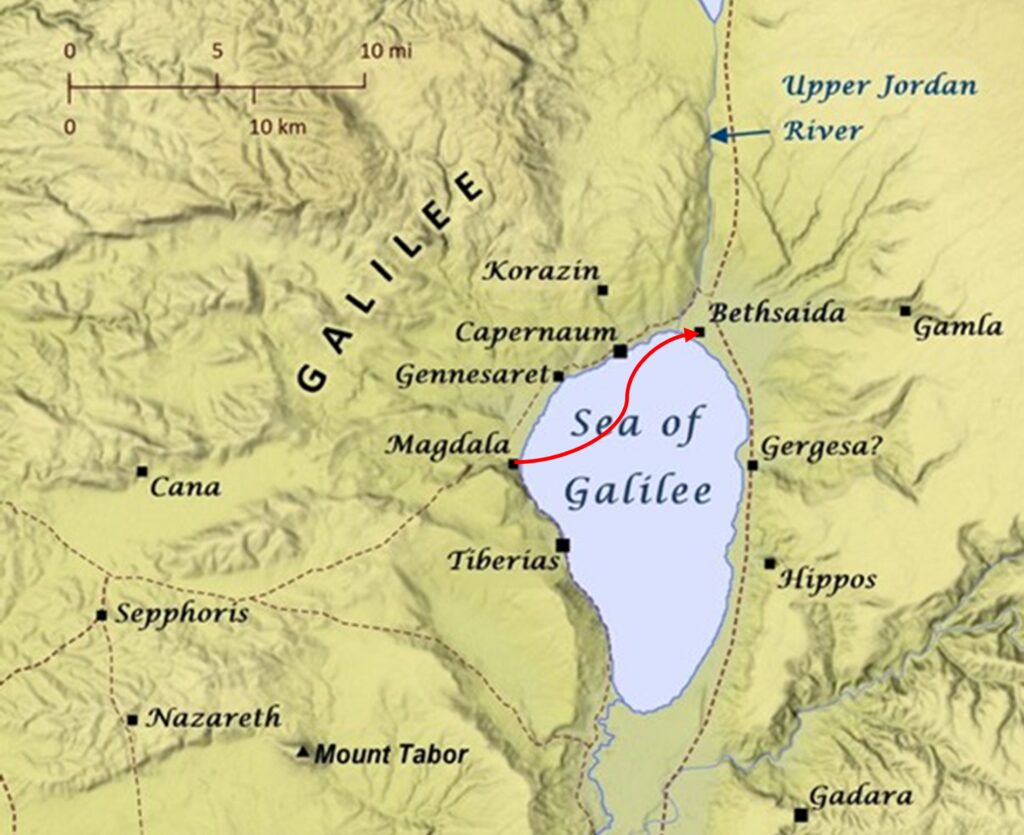
The shore mentioned by Matthew 16.5 refers to the eastern bank of the Jordan, where is located, within the Decapolis. It should be noted that at that time another part of this city was situated in Galilee, on the western bank of the Jordan River.
According to our analyses, the Messiah Jesus and his apostles returned to the Decapolis in October AD 32, six months after the first (April AD 32). Consequently they will not be able to go to Jerusalem for the feast of at the beginning of October, but they will make the journey at the in December (Matthew 19.1-2 and Mark 10.1).
Thus, after the fruitless confrontation with the and the , the Messiah Jesus, accompanied by his disciples, quickly sets off again. He evidently does not wish to waste precious time discussing with people who do not want to know anything.
We could consider that the Master is acting in accordance with the instructions he had given to his apostles in case of a poor reception (Matthew 10.14, Mark 6.11, Luke 9.5). He shakes the dust off his garment and heads for another place.
We have no information on the precise reasons that lead Jesus to go to certain places. We believe that it is under the influence of the Holy Spirit that he decides to set out on a journey. The apostles usually follow him without asking questions, except when it will be a matter of returning to Jerusalem shortly before the crucifixion.
Is the Messiah Jesus seeking to find again the people who were present at the and fish (PER182 : Second multiplication of the loaves for 4000 people)? In any case, the reception in this region was very favorable. It is in fact the and the who regularly come to disrupt the teaching of the Messiah Jesus.
These discussions with these religious leaders are far from encouraging people's faith, which is the main purpose of the Messiah Jesus.
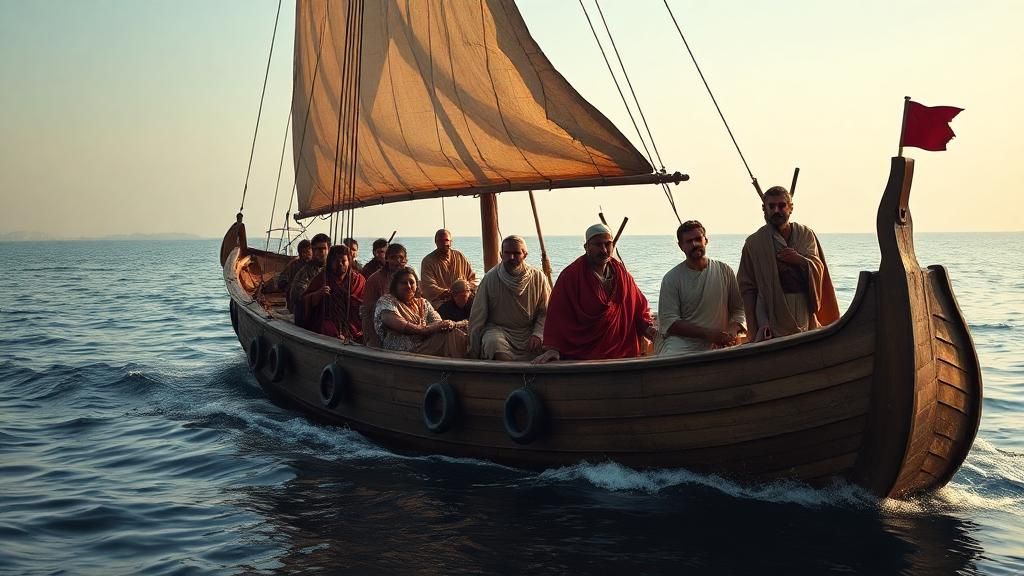
The boat crossing offers a period of rest and tranquility after the many attacks of the , and before the various demands of the crowds.