APO010

The Second Seal, the Second Horseman

The article APO010 analyzes the second seal of Revelation (Rev 6.3-4): a red horse whose rider receives a great sword and the power to take peace from the earth. Through four symbols — the red horse, the rider, the sword and the peace taken away — the study explores the reality of war as divine judgment and human responsibility, stressing that only Christ can bring true and lasting peace.

36 min second seal red horseman Revelation war sword 29 verses 12 books

Further information

Introduction

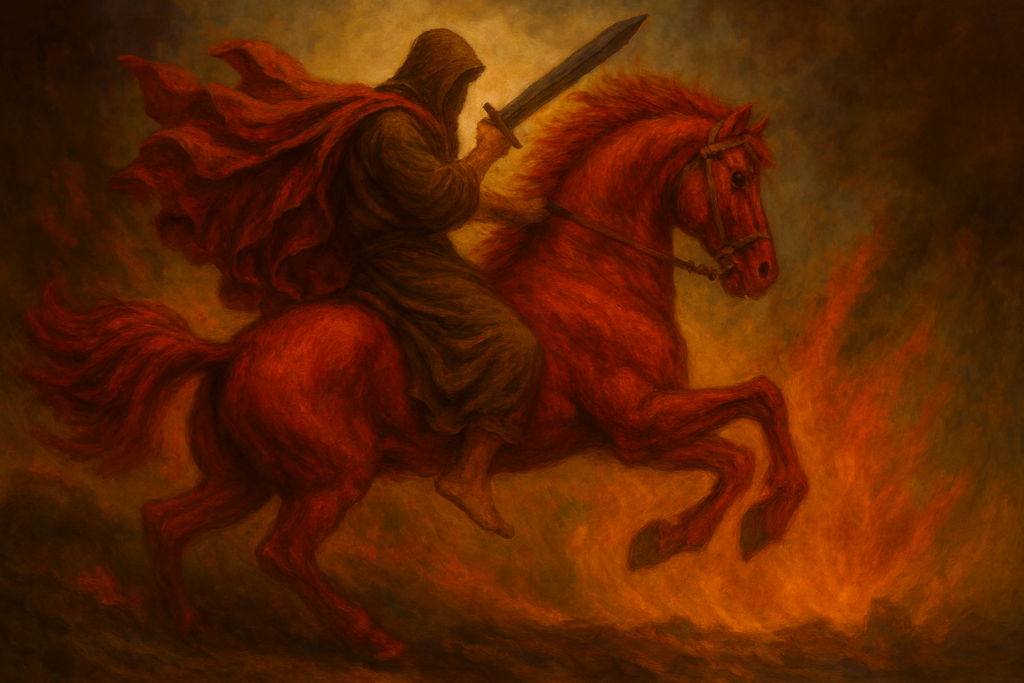
The second seal (Revelation 6.3-4) reveals a fiery red horse whose rider receives a sword and the power to take peace from the earth. This vision symbolizes the outbreak of war, conflict and hatred among men.

It fits into the progression of the seals: after the conquest of the white horseman comes the division brought by the red horseman, recalling the fragility of human peace and the reality of the struggles that run through history.

In the analysis of chapter 6 of Revelation, attention turns to the opening of the second seal by the Messiah Jesus. Once opened, this seal brings forth a second horse of a fiery red color.

The text gives no precise description of the horseman, except that he holds a sword and receives a specific power: that of taking peace from the earth. This power, far from being trivial, brings upon the world a climate of discord and hatred, plunging humanity into chaos and violence.

Through the successive opening of the seals, Revelation presents a series of visions that disclose the divine judgments as well as the spiritual realities running through human history. More precisely, the opening of the second seal (Revelation 6.3-4) brings onto the scene a blazing red horse.

His rider is entrusted with the mission of removing peace from the earth, thus driving men to slay one another. The sword given to him becomes the symbol of the war and violence that fall upon the peoples.

This depiction, at once brief and powerful, belongs to the continuity of the sequence of the seals. After the passage of the white horseman, bearer of an initial conquest, comes the red horseman, bearer of division and conflict. The account thus insists on the intrinsic fragility of peace among men and highlights the omnipresence of the struggles that mark human history.

The analysis that follows sets out to explore this passage in depth, by examining the symbols used, the context in which it is set and its spiritual significance. This introduction aims to place the second seal back within the dynamic whole of Revelation and to open the reflection on the meaning of this striking vision.

We have reached the fourth section of the book, entitled “The things which shall be hereafter,” and we are now dealing with the second subject: the opening of the seven seals.

The outline of the book, Chapter IV B

SectionSubsectionDescriptionReferences
I—IntroductionRevelation 1.1-3
II—The things past: “what you have seen”Revelation 1.4-20
III—The things present: “what is,” message to the seven ChurchesRevelation 2.1 à Revelation 3.22
IVAThe throne of Christ; the sealed bookRevelation 4.1 à Revelation 5.14
BOpening of the 7 sealsRevelation 6.1 à Revelation 8.1
CParenthesis: Jews and Gentiles saved during the tribulationRevelation 7.1-17
DJudgment announced by the seven trumpetsRevelation 8.2 to Revelation 9.21 and Revelation 11.15-19
EParenthesis: prelude to the seventh trumpetRevelation 10.1 à Revelation 11.14
FDominant figuresRevelation 12.1-18
GAdvent and reign of the Beast and the false prophetRevelation 13.1-18
HParenthesis: prophetic visionsRevelation 14.1-20
IJudgments announced by the seven bowls of the wrath of GodRevelation 15.1 à Revelation 16.21
JCondemnation of Babylon the GreatRevelation 17.1 à Revelation 19.6
KPreparations for Armageddon and the thousand-year reignRevelation 19.7 à Revelation 20.6
LLast Judgment; description of the holy cityRevelation 20.7 à Revelation 22.5
V—Conclusion: the last message of the BibleRevelation 22.6-21

This outline comes from Scofield’s commentaries.

I. The text

Revelation 6.3-4 (King James Version) :
And when he had opened the second seal, I heard the second beast say, Come and see.And there went out another horse that was red: and power was given to him that sat thereon to take peace from the earth, and that they should kill one another: and there was given unto him a great sword.

John witnesses the opening of the second seal by the Lamb. One of the four living creatures then cries out with a loud voice: "Come." A red horse appears, ridden by a horseman armed with a sword, to whom God entrusts the mission of taking peace from the earth. The horseman goes forth to carry out this task.

The symbolic elements of the second seal

1. The red horse

II. The symbolic elements

Red color: a symbol of blood, war and violence. In the Bible, red is often associated with judgment and carnage (cf. Nahum 2.3; Isaiah 1.18).

Horse: a figure of military power, speed and terror. Horses evoke armies on the march and war (Judges 5.22; Jeremiah 4.13).

Overall meaning: the red horse embodies the rise of armed conflicts and collective violence, in contrast to the white horse of the first seal (conquest).

2. The rider

Unnamed: he represents an impersonal force, a principle of war rather than an individual.

Mission received: to take peace from the earth. This is not an isolated human initiative, but an action permitted by God as part of His judgment.

Effect: men slay one another, which underscores human responsibility for violence and division.

3. The great sword

Sword (machaira megale): a symbol of open war, of slaughter and of judicial authority. In the world, the sword represented the power of life and death.

Great: underscores the scale of the conflict, not limited to one region but worldwide.

Biblical link: the sword is often associated with divine judgments (Ezekiel 14.21, Leviticus 26.17).

4. The peace taken away

Peace withdrawn: shows that human peace is fragile and dependent on the divine will. The peace of the white horseman was only a lure.

Consequence: wars, revolts, social and family divisions. It is not only a war between nations, but a widespread hostility between individuals.

Parallel: Jesus announces in Matthew 24.6-7 "wars and rumors of wars" as signs of the times.

Theological and pedagogical significance

Sovereignty of Christ: only the Lamb opens the seals, showing that even wars are under divine control.

Judgment and call to repentance: war is a consequence of sin and a warning.

Human frailty: peace is not lasting without God; alliances and treaties are precarious.

Spiritual message: believers are called to seek the peace of Christ (John 14.27), which remains even when earthly peace is taken away.

The second seal reveals war and division as divine judgments, through three major symbols:

The red horse (violence and blood),

The horseman (impersonal force of conflict),

The great sword (instrument of world war),

The peace taken away (fragility of the human order).

These images teach that true peace can come only from the reign of Christ, and that the wars of history are so many reminders of the human condition without God

III. The living creature?

Summary of the paragraph:

Les quatre êtres vivants entourent le trône de Dieu et se distinguent par leurs formes symboliques (lion, veau, homme, aigle). Leur rôle principal est d’adorer Dieu et de proclamer sa sainteté. Le , semblable à un veau, symbole de force, de service et de sacrifice, introduit l’ouverture du deuxième sceau en appelant Jean à regarder.

In this way it links the heavenly liturgy to earthly judgments. Its intervention underscores that even war and bloodshed, represented by the red horse, are part of God's sovereign purpose.

Full text:

The four living creatures (Revelation 4.6-8)

They are placed around the throne of God.

They are described as each having a different appearance:

The first is like a lion.

The second is like a calf (or a young bull).

The third has a face like that of a man.

The fourth is like a flying eagle.

They are full of eyes, in front and behind, and each has six wings.

Their main function: to worship God unceasingly and proclaim His holiness ("Holy, holy, holy, Lord God Almighty").

▸ The second living creature

Identity: he is the one who is "like a calf" (Revelation 4.7).

Symbolism : the calf or bull is a sacrificial animal, associated with strength and service. It can symbolize power in obedience, submission in the service of God, and sacrifice.

Role in Revelation 6.3: he introduces the second seal by saying to John: "Come." Through his intervention, he links the heavenly vision (the throne and the worshipers) to the earthly manifestation (the red horse and war). He acts as a liturgical mediator: he announces what the Lamb reveals, and he invites the seer to behold.

▸ Spiritual significance

Le fait que ce soit le qui parle n’est pas anodin : chaque sceau est introduit par un des quatre êtres vivants, dans l’ordre.

The choice of the calf to introduce the seal of war can be interpreted as follows:

Sacrifice: war brings bloodshed, recalling sacrifice.

Brute force: the bull evokes unleashed power, like the violence of conflicts.

Divine service: even terrible judgments are under God's control and serve His purpose.

▸ Summary

L’être vivant qui parle lors de l’ouverture du deuxième sceau est le , semblable à un veau.

It represents strength in obedience and sacrifice.

It introduces the vision of the red horse, a symbol of war and bloodshed.

Its role is to link the heavenly liturgy to the unfolding of earthly judgments, showing that everything is orchestrated under God's authority.


IV. The horseman

  • Red: the color of blood, war, fire and wrath.
  • Symbolic function: to announce immediately a climate of violence and widespread conflict.
  • Contrast: it stands opposed to the white of the first horse, marking a shift from conquest to open war.

2. The rider

  • Unnamed: he does not represent a historical individual, but an impersonal principle of war.
  • Role: to carry out a permitted judgment — his action is "given," not initiated by himself.
  • Effect: he causes the collapse of social, political and interpersonal peace.

3. The peace taken away

  • Meaning: the breakdown of the social order; hostility between nations, groups and individuals.
  • Scope: violence spreads "over the earth," going beyond a single battlefield.
  • Observation: war is not merely endured; it reveals human responsibility in mutual destruction.

4. The great sword

  • Symbol: direct war, slaughter, authority to put to death.
  • "Great": indicates the scale of the conflict, not a localized clash.
  • Contrast: compared with the bow of the first horseman, the sword signals the entry into open violence.

5. Theological meaning of the horseman

  • Divine sovereignty: the horseman acts within a framework where "it was given to him," recalling that nothing escapes the authority of the Lamb.
  • Judgment: it unveils the fragility of human peace and the depth of divisions.
  • Humanity laid bare: "that they should kill one another" underscores that war reveals the as much as it destroys it.

The second horseman, mounted on a fiery red horse, embodies open war and widespread violence. He receives the power to take peace away, drawing men into mutual destruction. His great sword symbolizes the scale of the conflict. This horseman reveals at once the sovereignty of God, the fragility of human peace and the responsibility of men in the violence that ravages the earth.

  • Red: evokes shed blood, war, fire and wrath.
  • Fire-red: intensifies the idea of conflagration, like a land set ablaze by conflicts.
  • Visual impact: the color immediately announces a climate of widespread violence.

2. Its symbolic function

  • The horse is a vehicle of power, of movement and of sudden eruption.
  • Here, it becomes the bearer of war, the animal that carries and manifests the dynamic of conflict.
  • It represents the rapid spread of violence: war does not stay static, it spreads.

3. Its contrast with the first horse

  • The white of the first horse evoked the initial conquest.
  • The fire-red marks a turning point: conquest is transformed into open war.
  • This visual contrast structures the progression of the judgments.

4. Its symbolic significance

  • The fire-red horse is not mere decoration: it embodies the very nature of the judgment.
  • It represents a world set ablaze by conflicts, where peace is taken away.
  • It is the animal symbol of collective violence unleashed.

The fire-red horse symbolizes the war that sets the earth ablaze: its color evokes blood, fire and violence, while its nature as a horse expresses the power and rapid spread of the conflict. By its contrast with the white horse, it marks the passage from conquest to open war and becomes the very image of a world from which peace has been removed.

VI. The great sword

The fiery red horse of the second seal (Revelation 6.3-4) is an image extremely rich in symbols. Here is a detailed and structured analysis:

1. Its color: fire-red

1. Nature of the object: a "great sword"

  • The sword is a classic symbol of war, of close combat and of putting to death.
  • The text stresses its greatness, which gives it a particular weight: it is not a mere accessory, but a major instrument of judgment.

2. Its symbolic function

  • It represents direct violence, open conflict, confrontation without mediation.
  • Unlike the bow of the first horseman (conquest from a distance), the sword evokes manifest war, visible and bloody.
  • It embodies the idea of an acknowledged conflict, not concealed, that erupts in broad daylight.

3. Its scope: a conflict of great scale

  • The qualifier "great" suggests a widespread war, not limited to one region or one group.
  • It symbolizes the intensity and the scale of the judgment: the violence is not marginal, it becomes structural.
  • The sword thus becomes the emblem of a world where peace is withdrawn and violence dominates.

4. Its role in the scene

  • The sword is not wielded on personal initiative: it is given to the horseman.
  • This underscores that the sword is an entrusted instrument, not an autonomous power.
  • It embodies the divine permission for a judgment unfolding on the earth.

5. Its theological significance

  • The sword is a reminder that war, in this seal, is not uncontrolled chaos but a permitted judgment.
  • It unveils the fragility of human peace: a single instrument is enough for everything to tip over.
  • It highlights human responsibility: the sword is given, but it is men who slay one another.

The great sword of the second seal symbolizes open and massive war. By its size, it expresses the scale of the conflict; by its nature, it embodies direct and bloody violence. Given to the horseman, it manifests a judgment permitted by God, revealing at once the fragility of human peace and the responsibility of men in mutual destruction.

Summary of the paragraph:

The second horseman, who takes peace from the earth and brings about war, corresponds directly to Jesus' announcements in the discourse on the , where He speaks of "wars," "rumors of wars" and nations clashing with one another.

The two passages describe the same reality: a period of conflicts, betrayals and widespread violence, presented as a sign of the times.

Thus the red horseman of Revelation stages what Jesus had already announced: the breaking of human peace and the unveiling of divine judgments in history.

Full text:

The link between the second horseman and the Mount of Olives discourse

The second horseman, the one on the fiery red horse, receives the power to take peace from the earth and to drive men to slay one another (Revelation 6.3-4). Now this theme corresponds exactly to what Jesus announces in the discourse on the .

According to the synoptic Gospels, the Messiah Jesus warns His disciples:

  • "You will hear of wars and rumors of wars" (Matthew 24.6)
  • "Nation will rise against nation, and kingdom against kingdom" (Matthew 24.7)

These announcements are explicitly presented as signs of the times, that is, realities that will mark history before the end.

A comparative study confirms that the themes of Jesus' discourse and those of the seals of Revelation are parallel: "To clearly show the link that exists between the discourse that Jesus gave on the and John's prophecy on the opening of the six seals…".

Precise correspondence

Revelation 6 Discourse on the
The red horseman takes away peace and causes war "Wars and rumors of wars"; "nation against nation"
Widespread violence "Many will betray one another and hate one another" (Matthew 24.10)
Judgment permitted by God "All these things must come to pass" (Matthew 24.6)

Synthesis

The second horseman fulfills in John's vision what Jesus had announced on the : a period of wars, divisions and widespread violence, a sign that human peace is breaking and that God's judgments are being unveiled in history.

Daniel describes the succession of kingdoms and their violence, while Revelation reveals the spiritual forces behind these events, notably with the fiery red horse.

Points of convergence between Daniel and Revelation

1. The kingdoms and the conflicts

VIII. Is there a connection with the information given by Daniel?

Daniel 2 and 7: Daniel sees the great powers of the world in the form of statues or beasts (lion, bear, leopard, terrible beast).

Revelation 6 (horsemen): the horses symbolize impersonal forces (conquest, war, famine, death) that run through the history of kingdoms.

Link : Daniel announces the succession of empires and their violence; Revelation shows the spiritual dynamic behind these conflicts (judgments permitted by God).

2. War and the peace taken away

Daniel 7.21-25: the little horn makes war against the saints and oppresses them.

Revelation 6.4: the red horseman takes away peace and drives men to slay one another.

Link: both texts stress war as an instrument of domination and judgment, revealing the fragility of human alliances.

3. The instruments of judgment

Daniel 9.26-27: announcement of wars, desolations and broken alliances.

Revelation 6.4: the great sword symbolizes open war.

Link: Daniel describes historical conflicts; Revelation transposes them into a cosmic and eschatological perspective.

4. Divine sovereignty

Daniel 2.44: "The God of heaven will set up a kingdom that shall never be destroyed."

Revelation 6: each horseman acts because "it was given to him" → God remains in control.

Link: both books affirm that despite wars and judgments, God directs history toward the establishment of His kingdom.

Differences of perspective

Daniel: emphasizes the succession of earthly kingdoms and their fall.

Revelation: stresses the spiritual forces and divine judgments that run through history.

Complementarity: Daniel gives the historical structure, Revelation unveils its spiritual and eschatological meaning.

The fiery red horse and its horseman find an echo in the visions of Daniel: the wars and violence announced by Daniel are taken up in Revelation as symbolic judgments.

Both books show that human peace is fragile and that conflicts are permitted within the framework of the divine plan.

Together, Daniel and Revelation offer a coherent reading: the history of kingdoms is marked by war, but God leads everything toward His final reign.

IX. Commentary

Summary of the paragraph:

The passage of Revelation 6.3-4 describes symbolically war and the peace taken away, not as a dated prediction, but as a revelation about human frailty and the judgments permitted by God.

The realities of the 21st century, wars, terrorism, geopolitical tensions, resonate with this image. The fiery red horse can thus be understood as a timeless prophecy describing the violence that runs through history.

Current conflicts remind us that earthly peace is precarious and that God remains sovereign over their course. When God so decides, this stage of conflict could reach a scale exceeding present confrontations.

Full text:

The biblical text (Revelation 6.3-4) describes a symbolic reality: war and the peace taken away from the earth. It is not a dated prediction, but a revelation about human frailty and the judgments permitted by God.

The 21st century already knows phenomena that resonate with this image:

Regional and world wars (Ukraine, Middle East, Africa).

Terrorism, civil violence, ethnic conflicts.

Rising geopolitical tensions (nuclear weapons, economic rivalries).

Potential for fulfillment: it is not extravagant to see in the fiery red horse an image that can manifest itself in our time. Wars and divisions are constant realities of human history, and the 21st century is no exception.

The fiery red horse can quite readily be read as a realistic prophecy for the 21st century, not in the sense of a dated prediction, but as a timeless image of the wars and violence that run through human history. This seal reminds us that current conflicts are not outside the divine plan, but that they announce the fragility of earthly peace and the need to seek true peace in Christ.

Observation of contemporary facts indicates that, in our view, the prophecy could be fulfilled when God determines it. This stage of conflict, as evoked in John's prophecy, would exceed present confrontations by its widespread character.

Conclusion

Summary of the paragraph

The first horseman of Revelation 6.1-2 does not represent Christ, but the , who imitates the symbols of the Messiah in order to deceive. Mounted on a white horse and crowned with a temporary power, he advances with the appearance of victory and authority, but is only a seductive counterfeit.

This false peace opens the way for the three following horsemen, who pour out the divine judgments. Thus the initial seduction of the first horseman prepares the gradual entry of chaos.

Full text

We have just analyzed the passage of Revelation 6.1-2, and according to the hypothesis we hold, this first horseman does not evoke the Messiah Jesus, but the , the one who presents himself as a savior while usurping the symbols of Christ. He appears mounted on a white horse, a color that normally evokes purity and victory, but which he uses here as a mask, an imitation meant to deceive. Even though the text does not mention his robe, we can imagine that it too is white, reinforcing this illusion of legitimacy.

He goes out "conquering and to conquer," displaying total assurance, as if he possessed unquestionable authority. His crown, which is given to him, symbolizes a power granted for a time, not a true kingship. It is not the glorified Christ returning to complete His work: it is a strong man, a seductive leader, a false king who advances under the appearance of triumph.

The honor with which he seems to be surrounded in this vision has nothing to do with the heavenly worship reserved for the true Lamb. No king, even the most powerful, has ever received such respect on earth — and yet this horseman is only a counterfeit.

After this first scene, three other horsemen will appear, each linked to the opening of a seal. The order is precise and intentional: the first horseman opens the way, and the following ones pour out on the earth the plagues that manifest the wrath of God. We will see in the following chapters how this sequence unfolds and how the initial seduction of the first horseman gradually leads to chaos.