The Presence of the Living One in the Midst of the Churches
The first chapter of a study of Revelation, this article presents the dating of the book (around AD 95 under Domitian), the identity of John as its author and his exile on Patmos. The exegetical analysis of Revelation 1 unveils a glorious, sovereign Christ present in the midst of his Churches, calling believers to faithfulness in persecution.
33 min
RevelationJohn the apostlePatmosDomitianrevelation
30 verses
5 books
This chapter 1 opens a demanding but deeply encouraging book. It presents a revelation intended for real communities facing pressure and uncertainty, and shows them Jesus the Messiah alive, close, speaking, walking in their midst.
Far from being an esoteric puzzle, this text lays the meaning bare: to listen, to keep, and to see reality as God shows it, with Jesus the Messiah at the center, sovereign and faithful.
The outline of the book, chapter I
Section
Subsection
Description
References
I
—
Introduction
Revelation 1.1-3
II
—
The things past: “what you have seen”
Revelation 1.4-20
III
—
The things present: “what is,” message to the seven Churches
Revelation 2.1 à Revelation 3.22
IV
A
The throne of Christ; the sealed book
Revelation 4.1 à Revelation 5.14
B
Opening of the 7 seals
Revelation 6.1 à Revelation 8.1
C
Parenthesis: Jews and Gentiles saved during the tribulation
Revelation 7.1-17
D
Judgment announced by the seven trumpets
Revelation 8.2 to Revelation 9.21 and Revelation 11.15-19
E
Parenthesis: prelude to the seventh trumpet
Revelation 10.1 à Revelation 11.14
F
Dominant figures
Revelation 12.1-18
G
Advent and reign of the Beast and the false prophet
Revelation 13.1-18
H
Parenthesis: prophetic visions
Revelation 14.1-20
I
Judgments announced by the seven bowls of the wrath of God
Revelation 15.1 à Revelation 16.21
J
Condemnation of Babylon the Great
Revelation 17.1 à Revelation 19.6
K
Preparations for Armageddon and the thousand-year reign
Revelation 19.7 à Revelation 20.6
L
Last Judgment; description of the holy city
Revelation 20.7 à Revelation 22.5
V
—
Conclusion: the last message of the Bible
Revelation 22.6-21
This outline comes from Scofield’s commentaries.
I. Dates
Summary of the chapter :
The book of Revelation is said to have been written around the year 95, under the emperor Domitian, in a context of persecution. Tradition attributes the work to the apostle John, then about 85 to 90 years old, exiled on the .
Although some scholars propose an earlier date (68–70 under Nero), this hypothesis remains a minority view. The identity of the author is debated, but the apostolic tradition remains the most widely held. The book presents itself as a call to faithfulness and a revelation of the glorious Christ.
Full text :
The book of Revelation was probably written around the year 95, during the reign of the emperor Domitian. If the author is the apostle John, as we believe, he would have been about 85 to 90 years old at that time.
Date of writing
Most scholars place the writing of Revelation around AD 95, at the end of the reign of the emperor Domitian (81–96). This dating rests on several elements:
The context of persecution described in the text corresponds to the one experienced under Domitian.
Irenaeus of Lyon, in the 2nd century, states that John received the vision on Patmos at the end of Domitian’s reign.
Some scholars propose an earlier date, around the year 68–70, under Nero, but this hypothesis is a minority view.
John’s age
The exact identity of the author remains debated:
Traditionally, he is identified with John, son of Zebedee, one of the twelve apostles. We hold to this hypothesis.
If John was a teenager (say 15–20 years old) at the time of the ministry of Jesus the Messiah (around the year 30), he would have been about 85 to 90 years old in the year 95.
Some Church Fathers, such as Justin Martyr and Irenaeus, state that John lived until the beginning of Trajan’s reign (around 98), which confirms an exceptional longevity.
Other hypotheses mention John the Presbyter, an elder of the community of Ephesus, which makes the age less certain.
In summary
Probable date of writing: around AD 95.
Place: , in forced exile
Author: John, probably aged 85 to 90 if we follow the apostolic tradition
Context: persecution, a call to faithfulness, a revelation of the glorious Christ
The
The
Summary :
This passage offers a continuous reading of Revelation 1, showing that the revelation is first of all that of Jesus Christ, faithfully transmitted and intended to enlighten believers. John testifies to what he has seen, inviting the Churches to read, listen to and keep this message, which brings grace and peace.
Christ appears there in the midst of his communities, majestic, pure, sovereign and close, revealing his victory over death and his authority. John, standing with believers in their trial, receives the mission to write for the Churches. The vision emphasizes that each community is precious and accompanied, and that in their midst is the key to the whole book of Revelation.
Full text :
Verse-by-verse analysis
Revelation 1.1 (King James Version) :
The Revelation of Jesus Christ, which God gave unto him, to shew unto his servants things which must shortly come to pass; and he sent and signified it by his angel unto his servant John:
King James Version (1769), domaine public — texte : eBible.org
Starting point: This is not first of all a revelation “about” the end, but “of” Jesus Christ: his person sheds light on everything.
Purpose: It is about showing, and thus opening believers’ eyes to what is coming, so as to live with clear sight.
Simple transmission: God → Jesus → angel → John → Churches: a reliable chain, which guarantees that the message does not come from imagination.
Revelation 1.2 (King James Version) :
Who bare record of the word of God, and of the testimony of Jesus Christ, and of all things that he saw.
King James Version (1769), domaine public — texte : eBible.org
Credibility: John does not invent; he attests to what he has seen, as an eyewitness.
Double anchoring: The word of God and the testimony of Jesus the Messiah: the voice of God and the life of Jesus the Messiah converge.
Vision and faithfulness: “What he saw” underlines that the revelation is given in images, to touch both the mind and the imagination.
Revelation 1.3 (King James Version) :
Blessed is he that readeth, and they that hear the words of this prophecy, and keep those things which are written therein: for the time is at hand.
King James Version (1769), domaine public — texte : eBible.org
Promise of happiness: Read, listen, keep: three concrete actions for an aligned life.
Nearness of the moment: The urgency is not anxiety-provoking; it prompts attention and faithfulness today.
Communal: “He who reads… those who hear” suggests a public, shared reading.
Revelation 1.4 (King James Version) :
John to the seven churches which are in Asia: Grace be unto you, and peace, from him which is, and which was, and which is to come; and from the seven Spirits which are before his throne;
King James Version (1769), domaine public — texte : eBible.org
Concrete recipients: Seven real communities: the text speaks to people in a particular place.
Central blessing: Grace and peace: this gift comes before any correction or appeal.
He who is, was, and is to come: God is present throughout all time; no period escapes his faithfulness.
Revelation 1.5 (King James Version) :
And from Jesus Christ, who is the faithful witness, and the first begotten of the dead, and the prince of the kings of the earth. Unto him that loved us, and washed us from our sins in his own blood,
King James Version (1769), domaine public — texte : eBible.org
Portrait in three strokes: Faithfulness, victory over death, universal authority.
Present love: “Who loves us” in the present tense: his love is not a thing of the past.
Real liberation: “Washed” evokes purification and a new identity.
Revelation 1.6 (King James Version) :
And hath made us kings and priests unto God and his Father; to him be glory and dominion for ever and ever. Amen.
King James Version (1769), domaine public — texte : eBible.org
New calling: A royal and priestly people: access to God and responsibility for the world.
Adoration: The right response to this gift is praise.
Endless duration: Christ’s dominion is not temporary; it endures.
Revelation 1.7 (King James Version) :
Behold, he cometh with clouds; and every eye shall see him, and they also which pierced him: and all kindreds of the earth shall wail because of him. Even so, Amen.
King James Version (1769), domaine public — texte : eBible.org
Universal visibility: No hidden appearance; his coming touches the whole world.
Memory of the wound: “Those who pierced him” recalls that the story of the cross remains decisive.
Clear-eyed sorrow: The mourning expresses an awakening: what the world did to the Righteous One.
Revelation 1.8 (King James Version) :
I am Alpha and Omega, the beginning and the ending, saith the Lord, which is, and which was, and which is to come, the Almighty.
King James Version (1769), domaine public — texte : eBible.org
Origin and fulfillment: From beginning to end, God embraces the whole.
Sovereign presence: The “Almighty” reassures: nothing escapes his hand.
Constancy of being: The same refrain as in verse 4: divine stability as a foundation.
Revelation 1.9 (King James Version) :
I John, who also am your brother, and companion in tribulation, and in the kingdom and patience of Jesus Christ, was in the isle that is called Patmos, for the word of God, and for the testimony of Jesus Christ.
King James Version (1769), domaine public — texte : eBible.org
Solidarity: John calls himself “brother” and “partner”: he shares the trial, the kingdom and the endurance.
Patmos: A place of exile and faithfulness: the word can lead to marginalization.
Clear cause: He is there “because of” his public attachment to Jesus the Messiah.
Revelation 1.10 (King James Version) :
I was in the Spirit on the Lord’s day, and heard behind me a great voice, as of a trumpet,
King James Version (1769), domaine public — texte : eBible.org
Liturgical moment: “The Lord’s Day” suggests a time of shared worship.
Divine initiative: It is the Spirit who takes the initiative; the revelation is not forced by man.
A voice that awakens: The trumpet calls for attention and gathering.
Revelation 1.11 (King James Version) :
Saying, I am Alpha and Omega, the first and the last: and, What thou seest, write in a book, and send it unto the seven churches which are in Asia; unto Ephesus, and unto Smyrna, and unto Pergamos, and unto Thyatira, and unto Sardis, and unto Philadelphia, and unto Laodicea.
King James Version (1769), domaine public — texte : eBible.org
See, then write: The vision is turned into a lasting word.
Precise destinations: Seven cities; the message is contextualized and circulating.
Author’s responsibility: John receives an editorial mission for the good of the communities.
Revelation 1.12 (King James Version) :
And I turned to see the voice that spake with me. And being turned, I saw seven golden candlesticks;
King James Version (1769), domaine public — texte : eBible.org
From sound to sight: To turn around is to move from the call to the reality.
Golden lampstands: Symbols of communities called to shine: the value of the Church is precious.
Seven as fullness: All the Churches are in view, not an elite.
Revelation 1.13 (King James Version) :
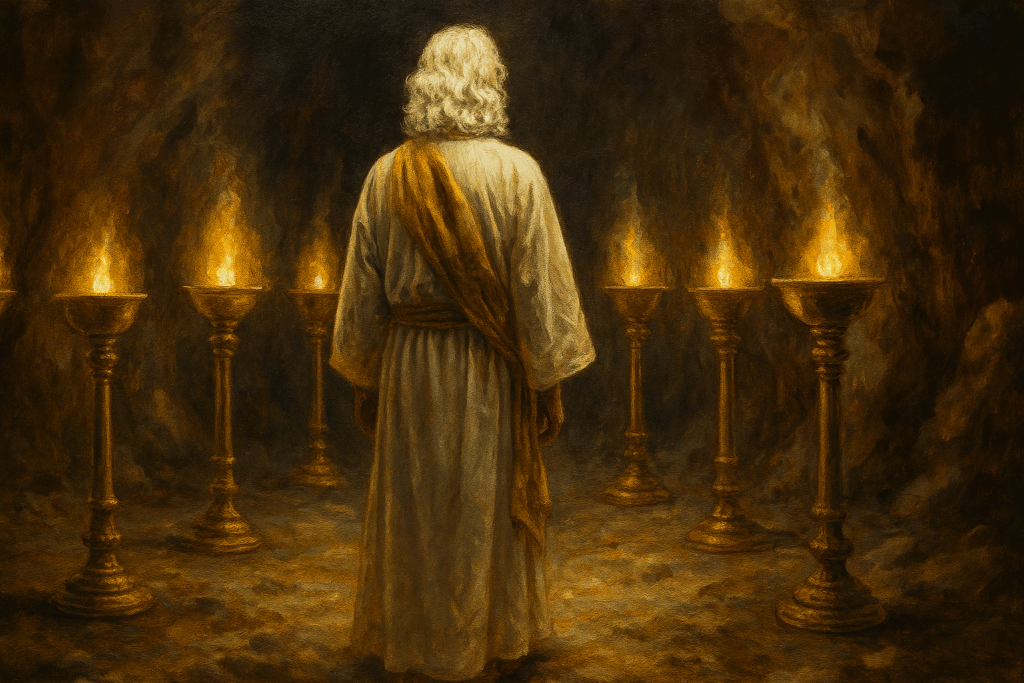
And in the midst of the seven candlesticks one like unto the Son of man, clothed with a garment down to the foot, and girt about the paps with a golden girdle.
King James Version (1769), domaine public — texte : eBible.org
In the midst: Jesus the Messiah is not far away; he is present at the heart of the communities.
Son of Man: A human figure, close, yet majestic.
Robe and sash: Dignity and authority; he is qualified to speak and to judge with equity.
Revelation 1.14 (King James Version) :
His head and his hairs were white like wool, as white as snow; and his eyes were as a flame of fire;
King James Version (1769), domaine public — texte : eBible.org
Whiteness: Wisdom and purity; experience and moral clarity.
Eyes of fire: A gaze that sees everything, that awakens and purifies.
No dark corner: Nothing escapes his discernment.
Revelation 1.15 (King James Version) :
And his feet like unto fine brass, as if they burned in a furnace; and his voice as the sound of many waters.
King James Version (1769), domaine public — texte : eBible.org
Firm feet: Stability and strength; he holds the ground firmly.
Warmth of bronze: Trial passed through and power proven.
Voice like waters: A broad authority that carries and envelops.
Revelation 1.16 (King James Version) :
And he had in his right hand seven stars: and out of his mouth went a sharp twoedged sword: and his countenance was as the sun shineth in his strength.
King James Version (1769), domaine public — texte : eBible.org
Right hand: Protection and mastery: the “stars” are kept safe.
Sword from the mouth: His word separates true from false and sets free.
Face like the sun: A brilliance that illuminates, warms and sometimes dazzles.
Revelation 1.17 (King James Version) :
And when I saw him, I fell at his feet as dead. And he laid his right hand upon me, saying unto me, Fear not; I am the first and the last:
King James Version (1769), domaine public — texte : eBible.org
Human reaction: Before the holy, John collapses; it is normal to be overwhelmed.
Soothing gesture: The hand upon him: closeness, not rejection.
First word: “Do not be afraid”: the revelation begins with consolation.
Revelation 1.18 (King James Version) :
I am he that liveth, and was dead; and, behold, I am alive for evermore, Amen; and have the keys of hell and of death.
King James Version (1769), domaine public — texte : eBible.org
Clear identity: The Living One has passed through death and rules over it.
Keys in hand: He opens and closes what terrifies us; nothing is fatalism.
Strong hope: Death no longer has the last word.
Revelation 1.19 (King James Version) :
Write the things which thou hast seen, and the things which are, and the things which shall be hereafter;
King James Version (1769), domaine public — texte : eBible.org
Triptych of time: Past seen, present lived, future to come: everything is taken into account.
Duty to write: The vision must become memory and a landmark for others.
Simple order: No needless complexity: see, write, pass on.
Revelation 1.20 (King James Version) :
The mystery of the seven stars which thou sawest in my right hand, and the seven golden candlesticks. The seven stars are the angels of the seven churches: and the seven candlesticks which thou sawest are the seven churches.
King James Version (1769), domaine public — texte : eBible.org
Interpretation given: Jesus the Messiah explains, to avoid confusion.
Angels and Churches: Each community is accompanied; it matters and is seen.
In the midst of the lampstands: at the heart of the Churches is the key to reading the whole book.
?
The
whom?
What is the origin of the expression “7 spirits”?
The
Chapter 1 of Revelation presents the revelation given by God to Jesus the Messiah and transmitted to John, intended for the seven Churches of Asia. John recalls the grace and peace coming from the God, from the Spirit and from Christ, who loves, frees and makes his people a kingdom of priests. He announces the visible return of Christ.
Exiled on Patmos, John receives a vision of the glorified Son of Man, in the midst of the lampstands representing the Churches: a majestic, sovereign and living figure, who holds the keys of death.
Christ reassures John, entrusts him with writing what he sees, and reveals that each Church is precious and accompanied. At the center of the chapter stands the presence of the living Christ, who enlightens, protects and calls to faithfulness.
Here is a detailed synthesis of chapter 1 of Revelation, respecting the narrative structure, the theological elements and the key symbols:
Synthesis of chapter 1 of Revelation
Origin of the revelation: It comes from God, transmitted to Jesus the Messiah, then to his servant John by means of an angel.
Subject : The events that must soon take place.
Prophetic character: John bears witness to the word of God and the testimony of Jesus Christ the Messiah.
Beatitude: Blessed is the one who reads and those who hear the words of this prophecy, and who keep what is written in it.
2. Address to the seven Churches (Revelation 1.4-6)
Sender : John addresses the seven Churches of Asia.
Trinitarian greeting :
From him who is, who was and who is to come (God the Father).
From the before his throne (interpreted as the fullness of the Holy Spirit).
From Jesus Christ, the faithful witness, the firstborn from the dead, the ruler of the kings of the earth.
Doxology (praise to God) :
Jesus loves us and has washed us from our sins by his blood.
He has made us a kingdom, priests to God his Father.
3. Announcement of Christ’s return (Revelation 1.7-8)
Eschatological vision: He comes with the clouds, every eye will see him, even those who pierced him.
Universal reaction: All the tribes of the earth will mourn because of him.
Divine declaration: “I am the Alpha and the Omega,” says the Lord God, “who is, and who was, and who is to come, the Almighty.”
4. Context of the vision (Revelation 1.9-11)
Identity of John: Brother and partner in the tribulation, the kingdom and the perseverance in Jesus.
Place: , because of the word of God and the testimony of Jesus.
Moment: On a Lord’s Day (Sunday), John is caught up in the Spirit.
Powerful voice: Like the sound of a trumpet, it commands him to write in a book what he sees and to send it to the seven Churches: Ephesus, Smyrna, Pergamum, Thyatira, Sardis, Philadelphia and Laodicea.
5. Vision of the Son of Man (Revelation 1.12-16)
Place of the vision: John turns around and sees seven golden lampstands.
Central figure: One like a Son of Man, in the midst of the lampstands.
Symbolic description :
Long robe and golden sash.
Hair white as wool, eyes like a flame of fire.
Feet like burnished bronze, voice like the sound of many waters.
In his right hand: seven stars.
From his mouth: a sharp two-edged sword.
His face: like the sun shining in its strength.
6. John’s reaction and the revelation of Christ (Revelation 1.17-20)
John’s terror: He falls as though dead.
Christ’s comfort: “Do not be afraid. I am the first and the last, and the living one. I was dead, and behold, I am alive forevermore.”
Keys of death and of Hades: Jesus holds them.
John’s mission: To write what he has seen, what is, and what is to take place afterward.
Interpretation of the symbols :
The seven stars: the angels of the seven Churches.
The seven lampstands: the seven Churches themselves.
At the heart of the first chapter of Revelation, the living Christ is revealed, wise and sovereign, standing “in the midst” of the Churches. His word enlightens, corrects and protects, inviting believers to become faithful reader-listeners, keeping the message and living in grace and peace with courage.
The hope is concrete: the Living One holds the keys of death, and history is not abandoned to chaos but held by the one who is, who was and who is to come. The mission remains current: to see what God shows, to write and share faithfully, and to walk as a royal and priestly people, assured that Jesus the Messiah accompanies each community.
The over human history
Summary :
The first chapter of Revelation presents a divine message addressed to the seven Churches, representing the universal Church. John appears there as a faithful messenger and prophet, charged with transmitting a revelation intended for all generations. The text affirms the sovereign presence of Jesus the Messiah, victor over death, who sustains and encourages believers.
It also recalls that history remains under God’s control, despite human appearances. Finally, the vision transforms John’s relationship with Christ : l: the friendof former daysisnow revealedas the glorified God, majestic and almighty.
Full text :
The first chapter of the Revelation of John gives us particularly precise information. It presents a message, coming directly from God, addressed to the seven Churches. These symbolize, at bottom, the whole universal Church, in all its forms and expressions.
This divine message, transmitted by John, is meant to be understood and proclaimed to all. John thus acts as a faithful messenger, transcribing the word of God for the Churches, so that its content may be heard and announced to all people. The importance of this information lies in its universal scope: it must be proclaimed so that everyone may become aware of it.
Through this function of transmission, the apostle John proves to be a prophet for future generations. This prophetic role, inscribed in the text, allows the message to remain alive and relevant for the Church, from its founding in the first century until today.
The affirmations of this chapter prove to be a constant reality in the life of the Church. , victor over death and almighty, remains a powerful encouragement for the faith of believers. His victory and his power are assurances that sustain the Church throughout time.
Moreover, it is affirmed that the world is not abandoned to fate or chance, but is under the sovereign control of God. This conviction echoes Daniel’s declaration before King Nebuchadnezzar (Daniel 2.21), while offering particular encouragement to those who suffer persecution because of their faith.
Thus, even if men appear to rule the world, it is God who sets the limits, saying: “Thus far and no farther” (Job 38.11, Mark 4.39, Revelation 1.18).
This reality remains, even today, a of encouragement for all Christians, reminding them of God’s sovereignty at the heart of history.
The text highlights a fundamental change in the relationship between John and Jesus the Messiah. Whereas in the past John could live a closeness with Jesus during his earthly ministry, marked by friendship and familiarity, this relationship evolves profoundly after the resurrection and glorification of Christ.
From now on, John no longer perceives Jesus as the friend, but as God himself, manifesting his power and majesty. This transformation in John’s perception underlines the distance established by the divine revelation, while affirming the sovereignty of the risen and glorified Messiah, at the center of history and of the life of the Church.
Conclusion
Summaryof the chapter:
The first chapter of Revelation reveals the risen Jesus the Messiah as the living center of history and of the Church, present in the midst of his communities to enlighten, correct and protect them. His victory over death grounds a solid hope : c: it is he who holdshistory in his hands.
The mission entrustedto John: to see, to write and to pass on, becomes that of all disciples,called to live as a royal and priestly people. Each Church can thus move forward with assurance, sustained by the faithful presence of Christ until the end of time.
Full text :
The first chapter of Revelation places the risen Jesus the Messiah right at the center of history and of the life of the Church. He stands “in the midst” of the lampstands, close to his communities, and manifests his wisdom, his power and his glory. His word enlightens, corrects and protects, so that believers become faithful listeners, rooted in grace and peace.
This revelation is far from theoretical: it brings a true hope. The One who is alive holds authority over death and the realm of the dead; he controls history, which is not left to chance, but guided by the one who exists, who existed and who will come.
The mission entrusted to John becomes that of every disciple: to see what God shows, to write and share faithfully, to walk as a royal and priestly people. Thus each community can move forward with courage, knowing that Jesus the Messiah accompanies and sustains his Church until the end of time.
Matthew 28.20 (King James Version) :
Teaching them to observe all things whatsoever I have commanded you: and, lo, I am with you alway, even unto the end of the world. Amen.
King James Version (1769), domaine public — texte : eBible.org
.
A title, a person, a place, a reference (“Luke 15”)…
Bible reference
INF227
Information note
INF227 - Localisation de l’île de Patmos
Location of the island of Patmos
L’île de Patmos se trouve en Grèce, dans l’archipel du Dodécanèse, au cœur de la mer Égée. Elle est située à environ 20 km au nord-ouest de l’île de Léros et à 13 km à l’ouest de Lipsi.
Localisation géographique
Pays : Grèce
Archipel : Dodécanèse
Mer : Égée (partie de la Méditerranée)
Coordonnées : environ 37° 19′ N, 26° 33′ E
Superficie : 34,5 km²
Point culminant : Mont Profitis Ilias (269 m)
Importance historique et spirituelle
Patmos est célèbre comme lieu d’exil de l’apôtre Jean, où selon la tradition chrétienne il reçut la vision relatée dans l’Apocalypse.
La grotte de l’Apocalypse, classée au patrimoine mondial de l’UNESCO, est considérée comme l’endroit où Jean aurait écrit ce texte fondateur.
Le monastère de Saint-Jean-le-Théologien, fondé au XIᵉ siècle, est un haut lieu de pèlerinage orthodoxe.
Accès à l’île
Patmos n’a pas d’aéroport : on y accède uniquement par bateau.
Des ferries relient l’île à Athènes (Le Pirée), Samos, Rhodes et d’autres îles voisines.
Le port principal est Skala, qui est aussi la plus grande localité de l’île.
In summary
Patmos est une petite île grecque, isolée mais hautement symbolique, connue pour son rôle dans l’histoire chrétienne comme lieu de révélation de l’Apocalypse. Aujourd’hui, elle est à la fois un site de pèlerinage et une destination touristique, où se mêlent spiritualité, histoire et beauté méditerranéenne.
INF228
Information note
INF228 - Les déportations de Daniel et Jean
Les déportations de Daniel et Jean
Le fait que Daniel et Jean aient reçu leurs révélations en situation de contrainte ou de déportation n’est pas un détail secondaire : c’est un élément clé qui relie les deux livres et leur donne une force particulière.
Daniel en déportation
Daniel est emmené à Babylone après la chute de Jérusalem (vers 595 av. J.-C.).
Il vit en exil forcé, loin de son pays, soumis à une culture et un pouvoir, étrangers.
Ses visions (statues, bêtes, fils de l’homme) naissent dans ce contexte de domination impériale.
Le message : même si Israël est déporté et semble écrasé, Dieu reste souverain et prépare un royaume qui ne sera jamais détruit Daniel 2.44.
Jean en exil
Jean est envoyé sur l’île de Patmos, probablement par décision impériale, à cause de son témoignage Revelation 1.9.
Il est isolé, marginalisé, coupé de sa communauté.
Ses visions (le Messie Jésus au milieu des Eglises, bêtes, nouvelle Jérusalem) naissent dans ce contexte de persécution et de fragilité.
Le message : même si l’empire romain semble tout contrôler, le Messie Jésus est vivant, présent et son règne est assuré Revelation 1.18.
Lien entre les deux révélations
Lieu de faiblesse → lieu de révélation : Daniel à Babylone, Jean à Patmos. Tous deux reçoivent une vision non pas dans la gloire, mais dans l’exil.
Pouvoirs impériaux → royaumes limités : Babylone et Rome apparaissent puissants, mais leurs empires sont décrits comme passagers.
Espérance universelle : Daniel annonce un royaume éternel confié au “fils de l’homme” Daniel 7.14. Jean voit ce même “fils de l’homme” glorieux au milieu des Églises Revelation 1.13.
Résistance et fidélité : Les deux livres encouragent à tenir bon, à rester fidèles malgré la pression.
Vision de l’avenir : Les deux montrent que l’histoire humaine est agitée, mais qu’elle est connue et tenue par Dieu.
Conclusion
La déportation de Daniel et l’exil de Jean ne sont pas des obstacles à la révélation, mais le cadre même où Dieu parle. Cela souligne que la parole divine surgit dans les lieux de fragilité, pour donner espérance et courage. Les deux livres se répondent :
Daniel annonce le royaume éternel.
L’Apocalypse montre ce royaume réalisé en Christ.
Ensemble, ils forment une grande fresque de résistance et d’espérance, où l’exil devient le lieu de la vision et la faiblesse le lieu de la force.
INF234
Information note
INF234 - La souveraineté absolue de Dieu
La souveraineté absolue de Dieu sur l’histoire humaine
Il y a un lien très fort entre ces deux affirmations, Revelation 1.18 et Daniel 2.21, et c’est même l’un des fils rouges qui relie l’Apocalypse et Daniel : la souveraineté absolue de Dieu sur l’histoire humaine.
Points de convergence entre Apocalypse 1 et Daniel
Dieu comme maître du temps et de l’histoire
Apocalypse 1 : Dieu est « celui qui est, qui était et qui vient » (Revelation 1.4 et Revelation 1.8). Cela exprime sa maîtrise du passé, du présent et de l’avenir. Rien n’échappe à son contrôle, même la mort (Revelation 1.18).
Daniel : Dieu « change les temps et les circonstances, il renverse et établit les rois » (Daniel 2.21). L’histoire des empires est sous sa main, même quand les puissances semblent autonomes.
Le Christ / le Fils de l’homme comme figure centrale
Revelation 1.13-16 : Le Christ apparaît « au milieu » des Églises, souverain, lumineux, tenant les clés de la mort.
Daniel 7.13-14 : Le « Fils de l’homme » reçoit de l’Ancien des jours la domination, la gloire et le royaume, que nul ne peut lui ravir. → Dans les deux cas, la figure messianique est placée au centre de l’histoire, garantissant que le chaos des nations est limité par la souveraineté divine.
La pédagogie de la révélation
Apocalypse : Le but est de former des lecteurs-auditeurs courageux et fidèles, conscients que l’histoire est tenue par Dieu.
Daniel : Les visions (statue, bêtes, succession des royaumes) enseignent que les empires passent, mais que Dieu établit son royaume éternel. → Les deux livres veulent donner assurance et espérance à des communautés fragilisées par la persécution ou l’incertitude.
Clé théologique commune
Dieu contrôle tout (Apocalypse) et Dieu place les rois (Daniel) sont deux facettes d’une même conviction : l’histoire humaine, avec ses puissances et ses crises, n’est pas livrée au hasard. Elle est orientée par la volonté divine, qui prépare le règne définitif du Christ.
En résumé, l’Apocalypse reprend et amplifie le message de Daniel : les royaumes terrestres sont provisoires, mais Dieu est souverain et son Messie détient l’autorité ultime.
INF229
Information note
INF229 - Pourquoi aux sept Eglises ?
Pourquoi aux sept Eglises ?
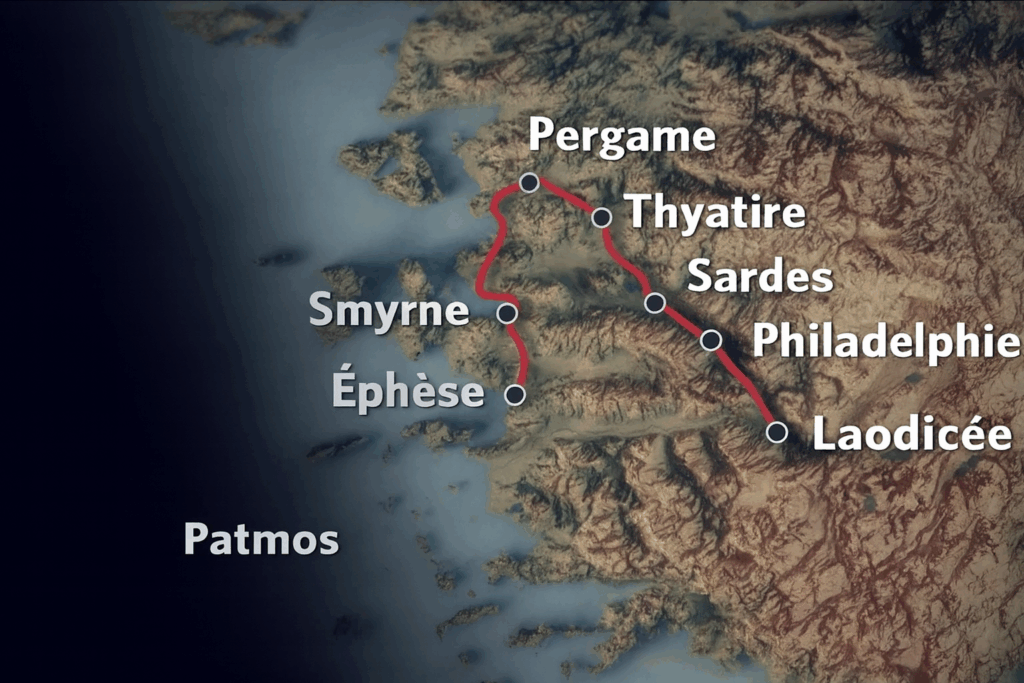
Jean 1.4(/b) précise que son message est adressé aux sept Eglises, et nous avons la liste de ces Eglises : à Éphèse, à Smyrne, à Pergame, à Thyatire, à Sardes, à Philadelphie et à Laodicée.
Doit-on conclure que ce message est ciblé et concerne uniquement ces Eglises, leur localisation ? Ont-elles une valeur symbolique qui pourrait laisser penser qu’il est question de l’Eglise en Général ? Alors dans ces conditions n’était-il pas plus simple de stipuler l’Eglise. Pourquoi ces détails ?
Nous remarquons que géographiquement elles sont toutes situées au même endroit, en Asie Mineure et plus précisément à l’endroit qui correspond aujourd’hui à la Turquie.
Ce sont des communautés chrétiennes locales auxquelles Jean adresse son livre depuis l’île de Patmos. Voici leur particularité :
Ephèse : grande cité portuaire, centre commercial et religieux important.
Smyrne (aujourd’hui Izmir) : ville prospère, connue pour sa fidélité à Rome.
Pergame : capitale régionale, réputée pour ses temples et son culte impérial.
Thyatire : ville industrielle, spécialisée dans les teintures et le commerce.
Sardes : ancienne capitale de Lydie, riche mais déclinante.
Philadelphie : petite ville, mais reconnue pour sa persévérance.
Laodicée : centre bancaire et médical, prospère mais critiqué pour sa tiédeur.
Ces sept villes formaient un cercle géographique en Asie Mineure, correspondant à un itinéraire logique pour un messager qui aurait porté la lettre de Jean
INF235
Information note
INF235 - La présence du Messie Jésus
La présence du Messie Jésus
Le Nouveau Testament affirme que le Messie Jésus est toujours présent auprès des croyants, les accompagnant et les soutenant. Cette proximité est illustrée par l’image de Jésus « au milieu des sept chandeliers » (Revelation 1.13), symbolisant sa présence permanente avec les communautés croyantes.
Voici une sélection représentative :
Versets du Nouveau Testament sur la présence de Jésus
Promesse permanente : « Et voici, je suis avec vous tous les jours, jusqu’à la fin du monde. » Matthew 28.20
Présence dans la communauté : « Car là où deux ou trois sont assemblés en mon nom, je suis au milieu d’eux. » Matthew 18.20
Assurance personnelle : « Je ne vous laisserai pas orphelins, je viendrai à vous. » John 14.18
Union intime : « Ce n’est plus moi qui vis, c’est Christ qui vit en moi. » Galatians 2.20
Force dans la faiblesse : « Le Seigneur se tint près de moi et me fortifia. » 2 Timothy 4.17
Assurance de fidélité : « Je ne te délaisserai point, et je ne t’abandonnerai point. » Hebrews 13.5
Espérance vivante : « Et voici, je suis vivant aux siècles des siècles… » Revelation 1.18
Ces passages soulignent que le Messie Jésus est présent à la fois dans l’Église réunie, dans la vie individuelle du croyant, lors des défis, et jusque dans l’espérance de la vie éternelle. Sa présence se manifeste de façon spirituelle (par l’Esprit), collective (au sein de la communauté des fidèles) et eschatologique (jusqu’à la fin des temps). Jean illustre cette idée par l’image du Messie Jésus « au milieu des sept chandeliers » (Revelation 1.13).
INF232
Information note
INF232 - La symbolique du chiffre 7 ?
Quelle est l’origine de la signification symbolique du chiffre 7 ?
Le chiffre 7, dans la Bible, symbolise la plénitude, l’achèvement et la perfection. Cette symbolique vient de plusieurs traditions bibliques et culturelles qui se sont croisées et renforcées au fil du temps.
Origines bibliques du chiffre 7
La création : Dieu crée le monde en six jours et se repose le septième Genesis 2.2. Le cycle de sept jours devient le rythme fondamental du temps.
Le sabbat : Le septième jour est sanctifié, consacré au repos et à Dieu.
Purification et perfection : Les paroles de Dieu sont dites “sept fois épurées” Psalms 12.7.
Sagesse : La maison de la sagesse est bâtie sur “sept colonnes” Proverbs 9.1.
Fêtes et cycles : Les fêtes juives suivent souvent des cycles de sept (sept semaines jusqu’à la Pentecôte, année sabbatique tous les sept ans).
Il exprime l’idée que ce qui est montré est complet et total : l’ensemble des Églises, l’ensemble des jugements, l’ensemble de l’action divine.
Les “sept esprits” Revelation 1.4 ne désignent pas sept entités séparées, mais la plénitude de l’Esprit de Dieu.
In summary
Le chiffre 7 vient de la création et du sabbat, fondant un rythme sacré.
Il est repris dans toute la Bible pour signifier perfection, totalité et accomplissement.
Dans l’Apocalypse, il devient un code symbolique pour dire que Dieu agit dans la plénitude de son plan, rien n’est laissé de côté.
Autrement dit, le 7 n’est pas un chiffre magique, mais un langage biblique pour exprimer que ce qui est montré est complet et parfait.
INF043
Information note
INF043 - The Deuteronomist Source
The Deuteronomist Source
La source Deutéronomiste (ou Deutéronomique), souvent abrégée en D, est l'une des quatre sources hypothétiques de la Torah selon l'hypothèse documentaire. Voici quelques points essentiels :
Origin and Definition
Hypothèse Documentaire : Cette hypothèse propose que la Torah est composée de quatre sources distinctes : Jahviste (J), Élohiste (E), Deutéronomiste (D) et Sacerdotale (P).
Name: The Deuteronomist source is so named because of its close association with the Book of Deuteronomy.
Characteristics
Style and Theme: It is characterized by a homiletic style and a theological perspective centered on faithfulness to the covenant between God and Israel, with an emphasis on laws and religious reforms. Attributed Passages: Besides Deuteronomy, Deuteronomistic influences are often attributed to the historical books such as Joshua, Judges, 1 Samuel, 2 Samuel, 1 Kings and 2 Kings.
Dating and Origin
Dating: The Deuteronomist source is generally dated to the 7th century BCE, in the time of King Josiah of Judah. Composition: It may have been written by priests and scribes close to the Temple in Jerusalem, as part of Josiah's religious reforms aimed at centralizing worship in the Temple in Jerusalem.
Validity and Acceptance
Validité : Bien que largement acceptée par de nombreux chercheurs, l'existence de la source Deutéronomiste reste une hypothèse, et d'autres modèles ont également été proposés pour expliquer la formation de la Torah.
The Deuteronomist source is thus an important theoretical component for understanding the structure and development of the biblical texts, particularly with regard to the laws and the covenant.
INF233
Information note
INF233 - L’expression « 7 esprits » ?
Quelle est l’origine de l’expression « 7 esprits » ?
La formule « sept esprits » dans Revelation 1.4 intrigue souvent, et le détail de la majuscule ou non à “esprit” joue un rôle dans l’interprétation.
Origine de la formule « sept esprits »
Dans le texte grec : on lit ta hepta pneumata = “les sept esprits”.
Symbolisme du chiffre 7 : dans la Bible, 7 exprime la plénitude, la totalité. Ici, il ne s’agit pas de sept entités séparées, mais d’une manière imagée de dire que l’Esprit de Dieu agit dans sa plénitude.
Lien avec l’Ancien Testament : Isaiah 11.2 décrit l’Esprit reposant sur le Messie avec sept qualités (sagesse, intelligence, conseil, force, connaissance, crainte de Dieu, piété). Cela a souvent été rapproché des “sept esprits”.
Dans l’Apocalypse : on retrouve cette expression en Revelation 3.1, Revelation 4.5 et Revelation 5.6, toujours en lien avec la présence de Dieu et du Christ.
Pourquoi pas de majuscule ?
Dans les manuscrits grecs anciens, il n’y avait pas de distinction majuscule/minuscule comme aujourd’hui.
Les traductions modernes choisissent parfois de mettre une majuscule à “Esprit” pour indiquer qu’il s’agit de l’Esprit de Dieu, ou de laisser en minuscule pour respecter la littéralité “sept esprits”.
La version S21, par exemple, garde la minuscule, ce qui laisse ouverte l’interprétation : soit une image de l’Esprit Saint dans sa plénitude, soit une représentation symbolique de puissances spirituelles devant le trône.
In summary
La formule « sept esprits » vient du texte grec et du symbolisme biblique du chiffre 7.
Elle désigne la plénitude de l’Esprit de Dieu, pas sept esprits différents.
L’absence de majuscule est un choix de traduction : le grec ne l’imposait pas.
Le sens reste : l’Esprit est pleinement présent devant le trône, associé à Dieu et au Christ dans la salutation initiale.
INF230
Information note
INF230 - L’ordre des Eglises ?
L’ordre des Eglises ?
L’ordre des sept Églises citées en Revelation 1.11 (Éphèse, Smyrne, Pergame, Thyatire, Sardes, Philadelphie, Laodicée) n’est pas une chronologie historique, mais un ordre géographique et logique :
Les sept villes forment un cercle postal en Asie Mineure (Turquie actuelle).
L’itinéraire suit la route qu’aurait empruntée un messager partant de Patmos (où Jean est exilé), arrivant au port d’Éphèse, puis remontant vers le nord (Smyrne, Pergame), avant de redescendre vers l’intérieur (Thyatire, Sardes, Philadelphie, Laodicée).
Ce parcours est donc circulaire, comme une tournée de courrier, et correspond à un sens horaire (du sud-ouest vers le nord, puis vers l’est et enfin vers le sud).
In summary
L’ordre des Églises n’est pas une chronologie dans le temps.
C’est un ordre géographique, pensé comme un circuit de visite ou de transmission.
Le sens est horaire, suivant une boucle pratique autour des principales routes de l’Asie Mineure.
Cela montre que l’Apocalypse est un livre destiné à circuler : il n’est pas figé, mais pensé pour être lu et partagé dans plusieurs communautés.
L’ordre des Eglises n’est pas une chronologie dans le temps parce que, dans le texte lui-même (Revelation 1.11), Jean ne présente pas les Eglises comme des étapes successives de l’histoire, mais comme des communautés réelles du Ier siècle, situées dans des villes précises d’Asie Mineure.
Pourquoi ce n’est pas une chronologie dans le texte ?
Destinataires concrets : Éphèse, Smyrne, Pergame, Thyatire, Sardes, Philadelphie et Laodicée sont des villes bien identifiées, avec des situations locales particulières.
Ordre géographique : L’ordre correspond à un circuit postal ou routier logique pour un messager venant de Patmos. On commence à Éphèse (port principal), puis on remonte vers le nord (Smyrne, Pergame), avant de redescendre vers l’intérieur (Thyatire, Sardes, Philadelphie, Laodicée).
Pas d’indication temporelle : Jean ne dit pas “après Éphèse viendra Smyrne dans l’histoire”, mais “envoie ce que tu vois à ces Églises”. Le texte reste ancré dans le présent de ces communautés.
Mais… une lecture symbolique existe
Certains interprètes (surtout à partir du XVIIe siècle) ont vu dans cet ordre une fresque chronologique de l’histoire de l’Église : Éphèse = temps apostolique, Smyrne = temps des martyrs, Pergame = temps impérial, etc., jusqu’à Laodicée = Église de la fin.
Cette lecture est possible comme interprétation spirituelle, mais elle n’est pas explicitement donnée par le texte.
On peut donc distinguer :
Lecture immédiate : sept Églises réelles du Ier siècle.
Lecture symbolique : sept étapes de l’histoire de l’Église.
In summary
Nous disons que ce n’est pas une chronologie parce que le texte lui-même ne présente pas les Eglises comme des périodes successives, mais comme des communautés contemporaines de Jean. Cela n’empêche pas une lecture symbolique ou prophétique qui voit dans cet ordre une représentation de l’histoire de l’Église à travers les siècles.
INF226
Information note
INF226 - L’île de Patmos
L’île de Patmos
Jean était très probablement en exil forcé sur l’île de Patmos, utilisé par les Romains comme lieu de déportation. Autrement dit, il n’y était pas volontairement, mais contraint par les autorités impériales.
Contexte historique
Apocalypse 1.9 dit clairement : « Moi, Jean, votre frère… j’étais dans l’île appelée Patmos, à cause de la parole de Dieu et du témoignage de Jésus. » → Cela indique une situation de contrainte, liée à sa fidélité.
Les Romains utilisaient Patmos comme lieu de bannissement pour des prisonniers politiques ou religieux. L’île, rocheuse et isolée, servait à couper les exilés de leurs communautés.
Tradition chrétienne ancienne (Irénée de Lyon, fin IIe siècle) affirme que Jean y fut envoyé sous l’empereur Domitien (vers 95 ap. J.-C.).
Les historiens modernes nuancent : certains parlent d’“exil” (expulsion hors de sa communauté), d’autres de “déportation” (peine imposée par l’État romain). Dans les deux cas, il s’agit d’une contrainte politique et religieuse.
In summary
Jean n’a pas choisi Patmos : il y a été envoyé par les autorités romaines.
On peut parler à la fois d’exil (il est éloigné de sa communauté) et de déportation (il est puni par le pouvoir).
Ce cadre explique pourquoi l’Apocalypse est un livre de résistance et d’espérance : écrit depuis un lieu de marginalisation, il affirme que le Messie Jésus est présent et souverain, même quand l’empire semble dominer.
Malgré ce cadre humain difficile de la déportation, Jean affirme qu’il reçoit une vision de Dieu. L’exil n’empêche pas la révélation, il en devient même le lieu privilégié. C’est précisément dans la faiblesse et l’isolement que la voix du Messie Jésus se fait entendre.
Le fait que Jean soit en exil souligne la force du message. L’Apocalypse n’est pas une spéculation abstraite, mais une révélation donnée dans une situation de détresse réelle. Cela rend le texte crédible et puissant : Dieu parle dans l’histoire, pas en dehors d’elle.
Autrement dit, le cadre de marginalisation explique le ton du livre, et la révélation explique son contenu. Ensemble, ils montrent que l’espérance chrétienne naît dans les lieux de fragilité, et qu’elle affirme la souveraineté du Christ même quand l’empire semble dominer
INF231
Information note
INF231 - De la part ?
De la part de Jean, de la part de Dieu, de la part des 7 esprits, de la part de Jésus Christ ?
Revelation 1.4-5 : « De la part de Jean aux sept Églises… que la grâce et la paix vous soient données de la part de celui qui est, qui était et qui vient, de la part des sept esprits qui sont devant son trône, et de la part de Jésus-Christ… »
Qui écrit ?
Jean est bien l’auteur humain : il rédige la lettre, il signe son nom, il s’adresse directement aux Églises.
Mais il se présente comme messager : il transmet une révélation qui ne vient pas de lui.
C’est pourquoi il dit : “de la part de…” → il se met en position de relais, pas de source.
Les trois “de la part de”
De la part de Dieu : “celui qui est, qui était et qui vient” → Dieu éternel, présent dans tout le temps.
De la part des sept esprits : image symbolique de la plénitude de l’Esprit de Dieu (le chiffre 7 = totalité). Cela signifie que l’Esprit agit pleinement devant le trône.
De la part de Jésus-Christ : présenté comme témoin fidèle, premier ressuscité, chef des rois.
Ces trois “de la part de” forment une salutation trinitaire : Dieu, l’Esprit, et Jésus-Christ. Jean écrit, mais il situe son message dans cette source divine.
In summary
Oui, c’est Jean qui écrit.
Mais il insiste : le contenu vient de Dieu, par l’Esprit, et par Jésus-Christ.
Sa formule “de la part de…” est une manière de dire : je vous écris, mais ce n’est pas mon message, c’est celui que j’ai reçu et que je transmets.
Cela donne à l’Apocalypse son autorité : ce n’est pas une opinion personnelle de Jean, mais une révélation qu’il relaie fidèlement.
INF038
Information note
INF038 - YHWH
YHWH
Le tétragramme YHWH est le nom propre de Dieu utilisé dans la Bible hébraïque. Voici quelques informations clés :
Meaning and origin
Nom de Dieu : YHWH est considéré comme le nom le plus sacré de Dieu dans le judaïsme. Il est souvent traduit par "L'Éternel" ou "Jehovah" en français.
Origine : Le terme "tétragramme" signifie "quatre lettres" en grec, se référant aux quatre lettres hébraïques יהוה (yod, hé, waw, hé).
Pronunciation
Unknown: The exact pronunciation of the tetragrammaton is unknown because, in Jewish tradition, it was forbidden to pronounce this name in order to avoid profaning it.
Substitutes: In its place, substitutes such as "Adonai" (Lord) or "HaShem" (The Name) are used.
Usage
Texte Sacré :Le tétragramme apparaît fréquemment dans la Torah et d'autres écrits de la Bible hébraïque. Rituel et Prières : Dans les prières et les rituels, les Juifs utilisent généralement "Adonaï" pour remplacer YHWH lorsqu'ils lisent les textes sacrés à haute voix.
Theological importance
Monothéisme :YHWH souligne l'unicité et l'exclusivité de Dieu dans la foi juive. Relation Divine :Il exprime la relation personnelle entre Dieu et le peuple d'Israël, marquant une révélation divine et une alliance.
The tetragrammaton is therefore a central and sacred element in Jewish theology and religious practice.