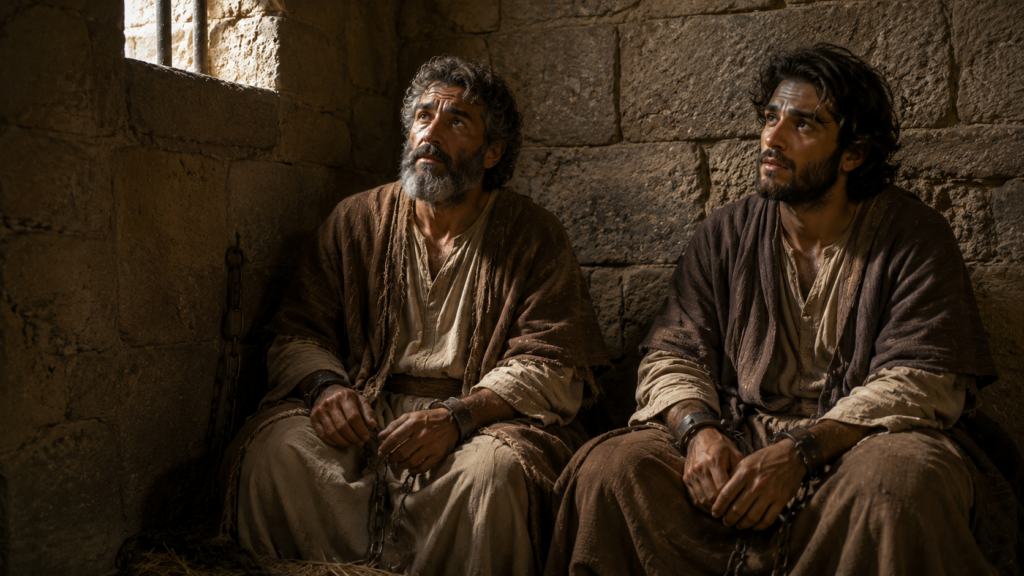

We now discover that Peter and John have spent their first night in prison and that they must appear before the , the great Jewish religious court. This institution, made up of the chief priests, the elders and the scribes, represented the highest religious authority in Judaism (Acts 4.5).
Under Roman rule, the retained important prerogatives in religious and judicial matters. Its authority extended to the whole of the worship life as well as to many questions concerning the application of the Law.
2- A particularly impressive assembly
Peter and John could have been deeply impressed by the solemnity of this assembly. Luke takes care to specify that the high priest Caiaphas is present, together with his father-in-law Annas, who had himself held that office previously (John 18.13). The evangelist also mentions a certain John, a certain Alexander and several members of the high priest's family (Acts 4.6).
Everything seems to have been arranged so as to bring together the most influential representatives of the priestly aristocracy. The very same men who had taken part in the trial of the Messiah Jesus a few weeks earlier now find themselves facing His disciples.
3- The contrast between the accusers and the accused
Clothed in their official robes and conscious of their authority, these dignitaries probably intend to remind Peter and John who holds religious power over the people of Israel. Their social standing stands in sharp contrast to that of the two apostles, mere Galileans without recognized rabbinic training (Acts 4.13).
It is possible that this solemn staging was meant to impress, even to intimidate, these preachers in order to reduce them to silence. The religious authorities had already used comparable methods during the trial of Jesus (Mark 14.53-65).
4- A new confrontation with the same authorities
The parallel with the events of the Passion is particularly striking. The religious leaders thought they had put an end to the movement stirred up by Jesus by obtaining His condemnation and execution (John 19.15-16). Yet a few weeks later, they discover that His disciples are continuing His work and publicly proclaiming His resurrection.
Thus, Peter and John find themselves before the same authorities who had judged their Master. This continuity is one of the major themes of the first chapters of Acts and shows that the opposition encountered by the apostles is a direct extension of that which Jesus Himself had experienced.
5- A particularly dangerous situation
The situation of the two apostles was particularly delicate. The held considerable authority and could pronounce severe sentences. A few years later, Stephen would be put to death following a similar appearance (Acts 7.54-60), while James, the brother of John, would be executed on the orders of Herod Agrippa I (Acts 12.1-2).
It therefore took great courage to appear before such an assembly. Even more, the assistance of the Holy Spirit, promised by Jesus to His disciples when they would be brought before the courts (Matthew 10.19-20; Luke 12.11-12), appeared more necessary than ever to face this trial.
6- The Church facing the first persecutions
It is possible that the Christian community, quickly informed of the arrest of Peter and John, gathered in prayer to seek God's help. This hypothesis seems all the more likely since Luke will report a little further on the gathering of the believers after their release (Acts 4.23-31).
The reality of persecution now tempers the enthusiasm aroused by the first successes of the apostolic preaching. The newborn Church discovers that it will have to learn to live in the midst of opposition and to rely constantly on the assistance of the Holy Spirit.
Thus, from the very first chapters of Acts, the growth of the Church and persecution appear closely linked. The opposition of the religious authorities is not an accident along the way, but one of the realities that the disciples of Christ will henceforth have to face.
7- A scene preparing Peter's testimony
Luke takes care to place the events in their historical and institutional context. The scene is now set for the confrontation between the religious authorities and the two apostles.
In the next section, we will examine more particularly as well as the remarkable attitude of the two apostles before their accusers. In keeping with the Lord's promise, those who had once abandoned their Master will now bear witness with an assurance that will surprise even the members of the (Acts 4.13).
A ?