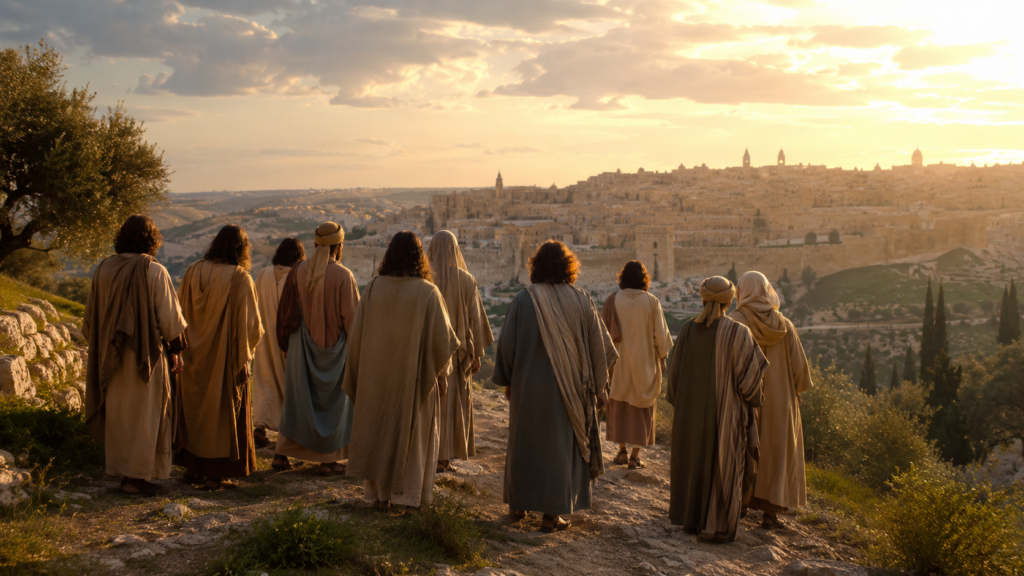

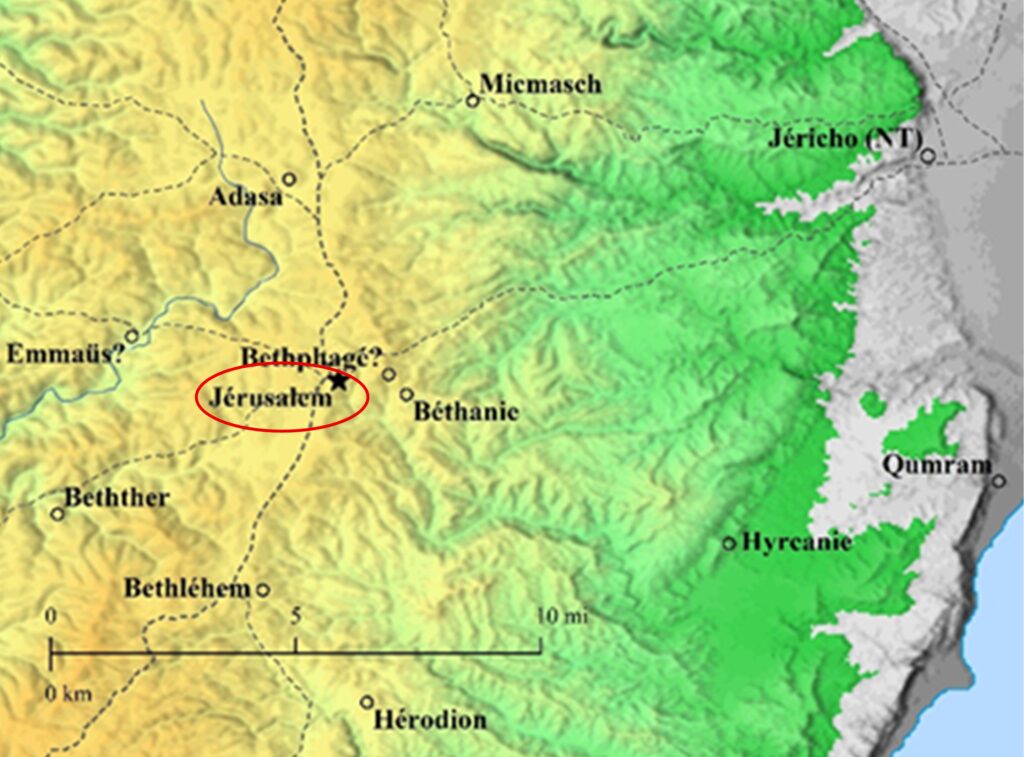
Once the emotion caused by the ascension had passed, the disciples returned to Jerusalem. One question remains, however: how long did they stay on the after seeing their Master vanish from their sight? Luke's account does not allow a certain answer.
Since the ascension took place on Thursday, May 12, 33, it seems unlikely that they left the place immediately after the appearance of the two men in white who announced to them the future return of Christ (Acts 1.10-11). Still deeply affected by the extraordinary events they had just witnessed, they probably talked among themselves and meditated on the Lord's last words (Acts 1.4-8).
2- The Sabbath day's journey
Luke specifies that the disciples returned to Jerusalem from the , which is "a away" (Acts 1.12). This expression traditionally designated the distance a pious Jew could travel on the without breaking rabbinic regulations, about two thousand cubits, which corresponds to a little less than a kilometer. Some authors consider that Luke is simply giving a geographical indication familiar to his readers. For our part, we suggest that he may also be implying that the had already begun and that the disciples were continuing to observe Jewish customs. This interpretation remains hypothetical, however, as the text gives no precise chronological indication.
If this hypothesis is accepted, the disciples would have returned to Jerusalem no earlier than Friday evening.
3- The upper room and the disciples' meeting place
The eleven apostles then returned to the house where they were accustomed to meet (Acts 1.13). Luke specifies neither the owner nor the exact location of this dwelling. In the tense climate that prevailed after the crucifixion, this discretion may have helped protect the people concerned.
Several commentators have proposed that it may have been the house of Mary, the mother of John, surnamed Mark, which later appears as a customary meeting place for believers (Acts 12.12). Others have put forward the house of Joseph of Arimathea, though no text allows this proposal to be confirmed.
The house of Mary is a plausible hypothesis. John Mark was close to Peter, whose recollections he would later gather, and which would serve as the basis for the writing of the second Gospel (1 Peter 5.13). On the other hand, Joseph of Arimathea and Nicodemus, because of their involvement in the burial of Jesus (John 19.38-42), may have been under particular surveillance the religious authorities, which would have made their homes less suitable for discreet meetings.
4- A community united in prayer
Luke then lists the names of the eleven apostles and stresses that they were continuing with one accord in prayer (Acts 1.13-14). This spiritual unity is already one of the characteristics of the nascent Church (Acts 2.42-47; Acts 4.32).
The women who had accompanied Jesus from Galilee also took part in these meetings (Luke 8.1-3; Acts 1.14). It is likely that the apostles, and Peter in particular, related in detail the events of the ascension and recalled the Lord's command to wait for the fulfillment of the promise of the Father, that is, the coming of the Holy Spirit (Acts 1.4-5).
5- Mary and the brothers of Jesus among the disciples
Among those present was also Mary, the mother of Jesus (Acts 1.14). This is the last explicit mention of Mary in the New Testament.
Another detail deserves attention: the brothers of Jesus were also part of the group. Yet during the Lord's earthly ministry, they did not believe in him (John 7.5). Their presence therefore bears witness to a profound change that probably took place after the crucifixion and above all after the resurrection. James, one of the Lord's brothers, would even receive a special appearance of the risen Christ (1 Corinthians 15.7) before becoming one of the leading figures of the Church in Jerusalem (Galatians 1.19; Acts 15.13).
The absence of any explicit mention of the sisters of Jesus (Matthew 13.55-56) does not necessarily mean that they were absent. In the culture of the time, women were frequently included in more general designations. The Gospel accounts moreover show that they played an important role in the events surrounding the death and resurrection of Christ (Luke 23.49; Luke 24.10).
6- Waiting for the Father's promise
The texts do not allow us to determine with certainty whether all the disciples lived permanently under the same roof. Nevertheless, the existence of a temporary communal life seems likely. Many believers came from Galilee and were still in Jerusalem, waiting for the promise announced by Jesus (Acts 1.4).
Moreover, since the Passover celebrations were over, most of the pilgrims had left the city. The group of disciples thus became more visible and no doubt had to be careful. In this context, these men and women remained united in prayer and in confident expectation of God's intervention and of the coming of the Holy Spirit, which would soon mark the visible birth of the Church (Acts 2.1-4).
I find that this division is close to what one encounters in the commentaries of F. F. Bruce or Craig Keener: fairly short, descriptive subheadings, and a clear distinction between Luke's text and the exegete's hypotheses. This strengthens both academic rigor and ease of reading.
The
The
The