

_29 One last small point remains to be dealt with: the Messiah Jesus had spoken of resurrection, so it is safer to place guards in front of the tomb. This is the request made to Pilate on the very day of the ; nothing stops these devout men. Matthew 27.62-66.
_30 The resurrection takes place on Sunday morning at dawn. We indeed have the 3 days and 3 nights according to the Jewish inclusive reckoning. Matthew 28.2-4 ; Mark 16.2-4 ; Luke 24.1-3. We take into account the night at midday.
_31 Now come the various appearances of the living Messiah Jesus, starting on Sunday, April 3, AD 33, early in the morning. John 20.11-18 ; Matthew 28.8-10 ; Mark 16.8 ; John 20.24-34 ; Mark 16.13-14 ; Luke 24.13-35 ; Mark 16.14 ; Luke 24.36-49 ; John 20.26-31 ; John 21.1-14.
You can consult the complete chronology in the study ANN026 : The hour of the crucifixion.
Commentary:
1- Two successive announcements to the disciples
According to one hypothesis for harmonizing the Gospel accounts, we must distinguish two successive announcements made to the disciples on the morning of the resurrection.
The first comes from Mary Magdalene. After seeing that the stone had been rolled away (John 20.1), she concludes that Jesus' body has been taken and immediately goes to Peter and the beloved disciple: “They have taken the Lord out of the tomb, and we do not know where they have laid him” (John 20.2). At that moment, nothing indicates that she had yet seen the angels or heard the announcement of the resurrection.
The second announcement comes from the other women who, after entering the tomb, receive the angels' message: “He is not here, but is risen” (Luke 24.6; Matthew 28.5-7; Mark 16.6-7). They then return to the disciples to report what they had seen and heard (Luke 24.9-10).
2- The race of Peter and John to the tomb
Following Mary Magdalene's testimony, Peter and John presumably leave their place of refuge without any information about a possible resurrection. Their only aim is to verify the disappearance of the body reported by Mary.
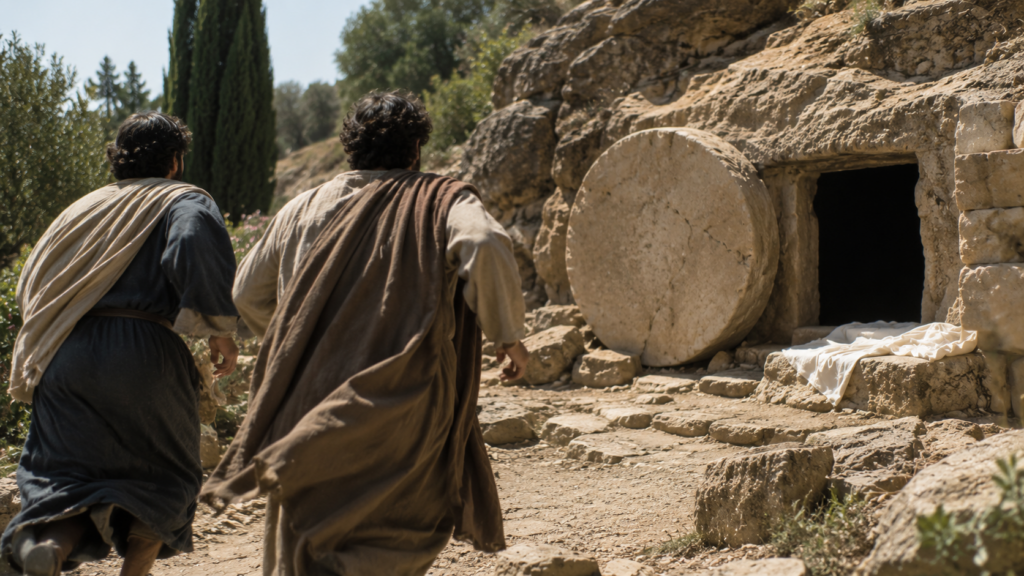
John reports that the two disciples set out running toward the sepulchre (John 20.3-4). Peter enters the tomb first, then John follows him (John 20.6-8). Both discover the burial linens lying in their place and the face cloth folded up separately (John 20.6-7).
The precision of these details suggests that the fourth Gospel is here based on the direct testimony of the beloved disciple, who was himself present at these events (John 21.24).
3- An understanding still incomplete
Although the disciples had heard Jesus announce his death and resurrection several times (Matthew 16.21; Matthew 17.22-23; Matthew 20.18-19; Mark 8.31; Luke 9.22), they are not yet able to connect these announcements with what they discover before the empty tomb.
John explicitly stresses this lack of understanding: “For as yet they did not understand the Scripture, that he must rise from the dead” (John 20.9). Luke also notes that the disciples of Emmaus, a few hours later, are still bewildered and express their disappointment: “We had hoped that he was the one who was going to redeem Israel” (Luke 24.21).
The trauma caused by the Passion and certain messianic expectations that were insufficiently understood seem to have prevented the disciples from immediately interpreting the events in the light of the Scriptures (Luke 18.31-34).
4- Why do Peter and John not meet the other women?
One difficulty nevertheless remains: how could Peter and John have gone to the tomb without meeting the women who were returning after receiving the angels' message?
The Gospels do not answer this question directly. They supply neither the routes taken nor the precise chronological details that would allow us to reconstruct all the movements of that morning.
The historical context nevertheless allows us to propose several plausible explanations. Since Jesus' arrest, the disciples have been living in fear. The religious authorities who obtained his condemnation remain hostile to his followers (John 19.15-16). On the very evening of the resurrection, the disciples are still gathered behind closed doors “for fear of the Jews” (John 20.19).
Moreover, Jerusalem is at that time full of pilgrims who have come to celebrate the Passover (John 11.55). It is therefore possible that the different groups took different paths, or that their movements took place a few minutes apart, without necessarily meeting.
5- The movements of the disciples in a climate of uncertainty
The climate prevailing among the disciples after the crucifixion is marked by fear, confusion and dispersion. Nothing indicates that there was any particular organization among the various witnesses.
On the contrary, the movements seem to have been spontaneous and in small groups. This situation probably explains certain difficulties in harmonizing the accounts. The evangelists do not seek to describe every journey or to establish a meticulous chronology of the events, but to report the essential facts on which the Christian faith is founded.
6- The gradual testimony of the women
After returning from the tomb, the other women tell the apostles what they had seen and heard (Luke 24.9-10). Their testimony is, however, received with disbelief: “These words seemed to them like idle talk, and they did not believe the women” (Luke 24.11).
Later, Mary Magdalene comes back in her turn with an even more extraordinary testimony: “I have seen the Lord” (John 20.18). Her statement is then added to that of the other women, who had themselves met Jesus on their way back (Matthew 28.9-10).
Thus the first testimonies to the resurrection come exclusively from women, a particularly remarkable detail in the context of first-century Judaism, where their testimony generally did not carry the same legal weight as that of men.
7- A sequence of events difficult to reconstruct precisely
The diversity of the Gospel accounts shows that the sacred authors did not seek to provide an exhaustive chronicle of the events. Each one selects and arranges the facts according to his theological aims and his own testimony (Luke 1.1-4; John 20.30-31).
Any attempt at harmonization must therefore be made with caution. The various hypotheses put forward make it possible to obtain a coherent reconstruction of the morning of the resurrection, without claiming, however, to resolve all the chronological difficulties.
8- The essential message of the evangelists
Beyond the secondary details, the four Gospels converge on one fundamental affirmation: the tomb is empty and Jesus is truly risen (Matthew 28.6; Mark 16.6; Luke 24.6; John 20.1-18).
This conviction will soon be confirmed by numerous appearances of the risen Christ to his disciples (Luke 24.34; John 20.19-29) and by the later testimony of the apostle Paul, who recalls that the Lord appeared to Cephas, to the Twelve, and then to more than five hundred brothers at one time (1 Corinthians 15.3-8).
Thus, despite certain difficulties of harmonization, the different testimonies converge on one and the same historical and theological reality: Jesus Christ is alive, in accordance with the Scriptures (Luke 24.44-46).
?