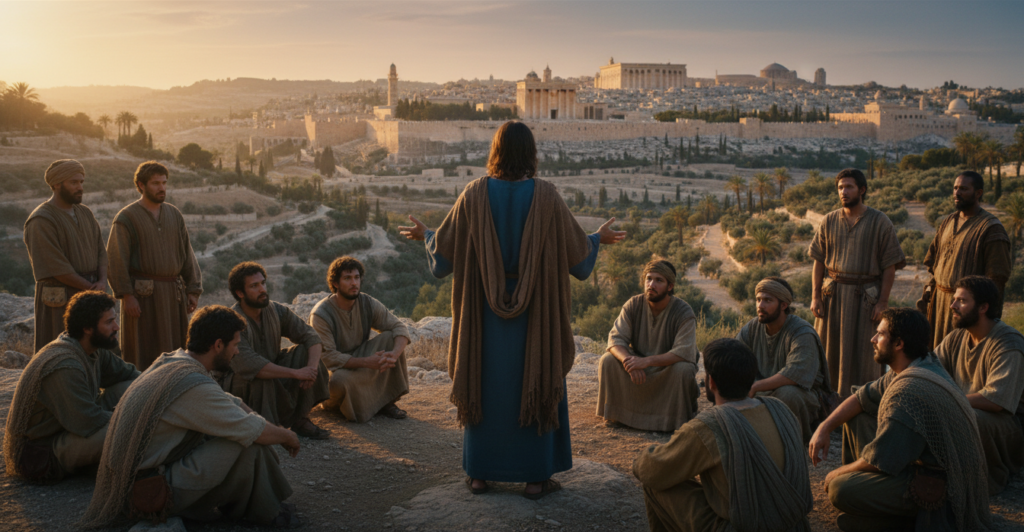

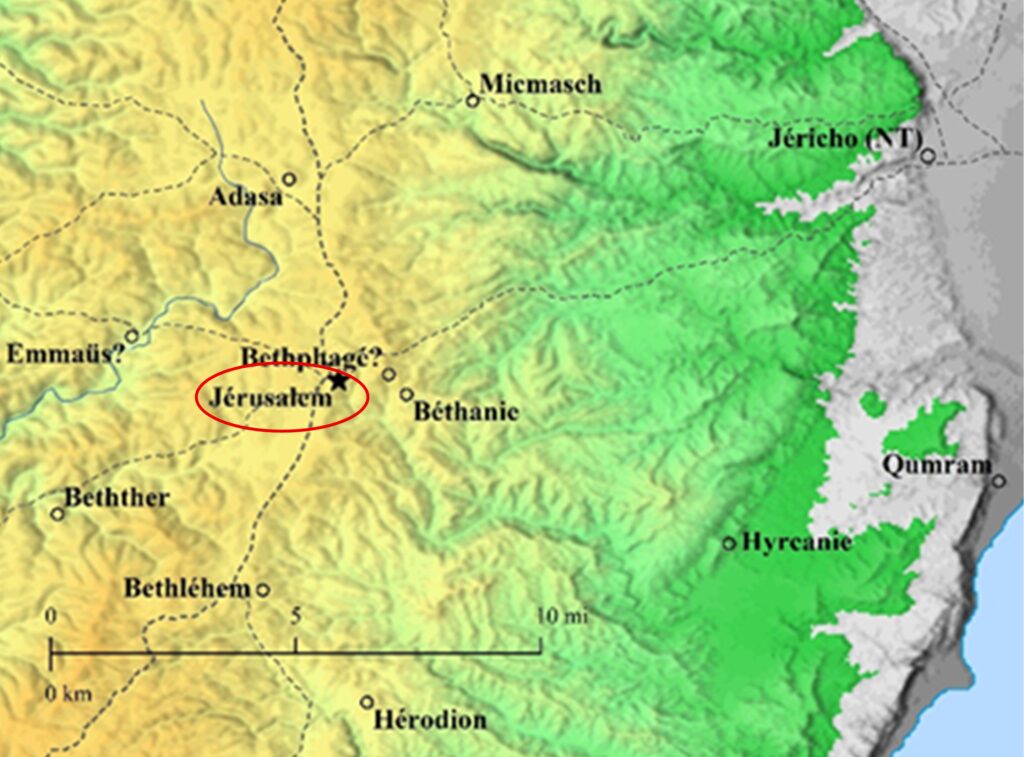

Matthew specifies that the Master gave this discourse in private (Matthew 24.3). The crowd, which had remained in Jerusalem, no doubt thought that he was simply returning to Bethany and that nothing special would happen.
Mark, for his part, mentions the names of those who asked the question: Peter, James, John and Andrew (Mark 13.3). This does not rule out that others heard the answer. The discourse therefore takes place in an intimate and peaceful setting, far from public debates and confrontations with the religious authorities.
It is the sight of Herod’s splendid temple that prompts the dialogue and the series of questions from the four disciples. Jesus the Messiah clearly announces difficult times and the destruction of this magnificent building, which, in his view, was no longer a true house of prayer (Mark 11.17). The disciples then link this announcement to the coming of the Messiah and the end of the age, understanding more readily the prospect of the Temple’s destruction than that of his glorious coming.
To grasp the significance of these words, two things must be borne in mind: first, the crucifixion and the resurrection have not yet taken place; the disciples still struggle to conceive of the Master’s victory over death.
Second, these accounts were written after the events, in the light of what the authors had lived through and understood afterwards. The eschatological declarations of Jesus the Messiah are therefore read again through the lens of history and of the nascent faith.
As for the argument that these texts were written after the destruction of the Temple in AD 70 and are not a prophetic word, it appears unfounded in view of the many demonstrations of power by Jesus the Messiah and of his knowledge of hearts (John 2.24-25).
Even though it goes beyond our human understanding, the Master had the ability to perceive certain future events and to search the thoughts of those he spoke with. Thus his discourse is not limited to announcing the ruin of the Temple; it also encompasses the promise of his return and the prospect of the end times (Matthew 24.30-31).