
John continues the account of the man born blind, healed by the Messiah Jesus. The religious authorities, namely the and the , have launched a thorough investigation to elucidate the mystery of this extraordinary deliverance. Their approach is not limited to questioning the young man himself: his parents are also summoned, as the episode reported in John 9.18-21 shows. These leaders try by every means to influence both the man who was healed and his family, hoping to obtain explanations or admissions in line with their expectations.
Yet the answer they receive proves particularly disconcerting:
Faced with the aggressive attitude of the , who go as far as expelling this man, probably from the Temple esplanade, the account does not stop at this sanction. John continues his testimony by stressing that the Messiah Jesus goes once more to meet the healed man. This new exchange, reported in detail, sheds light on the importance of the event and no doubt explains why John carefully passes on all its elements.
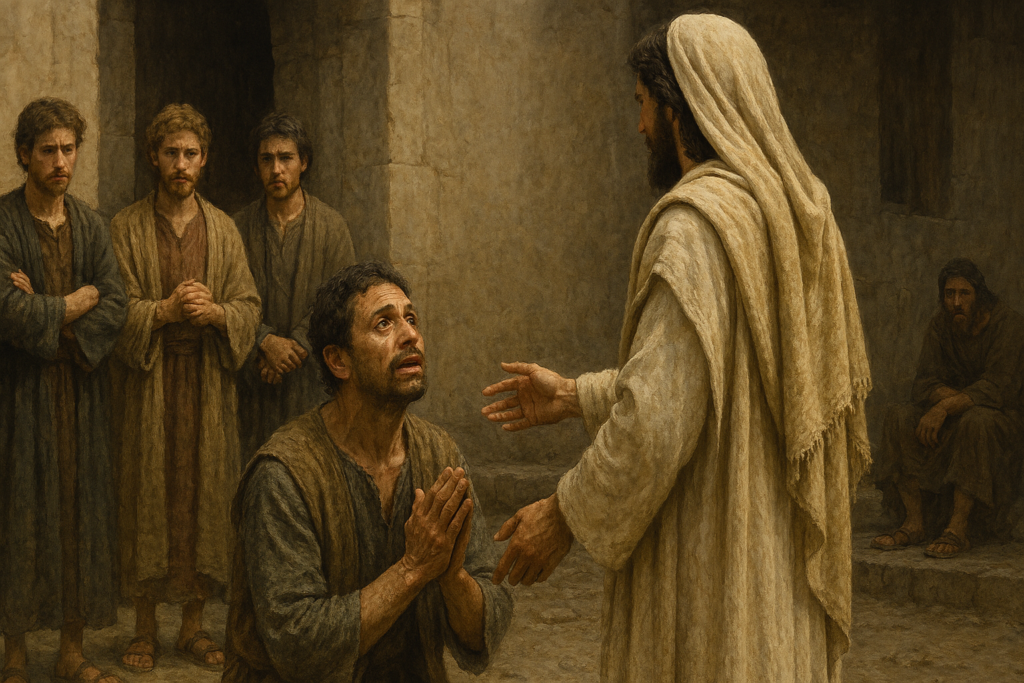
We can read the summary of the conversation that will upend this man’s whole life. In this passage, the healed man experiences a true conversion: he moves from the mere recognition of a miracle to personal faith in Jesus the Messiah. Rejected by the religious leaders, he finds himself sought out and joined by the Messiah Jesus himself, as if the physical healing were only the first step toward a deeper healing. When the Messiah Jesus reveals to him that he is the Son of Man, the man opens himself with total humility, recognizes the one who is speaking to him, and bows down in worship.
By contrast, the , though witnesses of the same facts, refuse to see what is right in front of them. Their certainty of being in the light locks them into a spiritual blindness graver than the physical blindness of the healed man. The Messiah Jesus thus shows that true sight is born of humility and of truth of heart, whereas religious pride can make one blind even in the face of the light.
John contrasts two forms of blindness. First there is that of the man born blind, a physical blindness from which the Messiah Jesus delivers him. But this man also bore another, deeper blindness: the one that kept him from entering the kingdom of heaven. Yet when he meets the Messiah Jesus and welcomes his revelation with simplicity and humility, his eyes truly open. He passes from physical light to spiritual light, and enters into faith.
By contrast, the , convinced that they see clearly, remain locked in their unbelief. Their refusal to recognize Jesus keeps them in a spiritual blindness far graver than that of the healed man. They consider themselves guides, yet remain blind; they think they are close to God, yet do not enter his kingdom. Thus the one who was blind now sees, while those who claimed to see remain in darkness.
Let us now look at this astonishing text:
In their question, the feel targeted and ask the Messiah Jesus whether they too are “blind.” The Messiah Jesus answers that if they were truly blind, that is, ignorant but aware of their need, they would not be guilty, for God opens the eyes of those who acknowledge their wretchedness. But they declare “we see,” claiming to be able to discern the truth by themselves. It is precisely this claim that condemns them: by refusing to admit their spiritual blindness, they close themselves to the light that the Messiah Jesus brings. Their sin remains not because they lack knowledge, but because they refuse the light that stands before them.