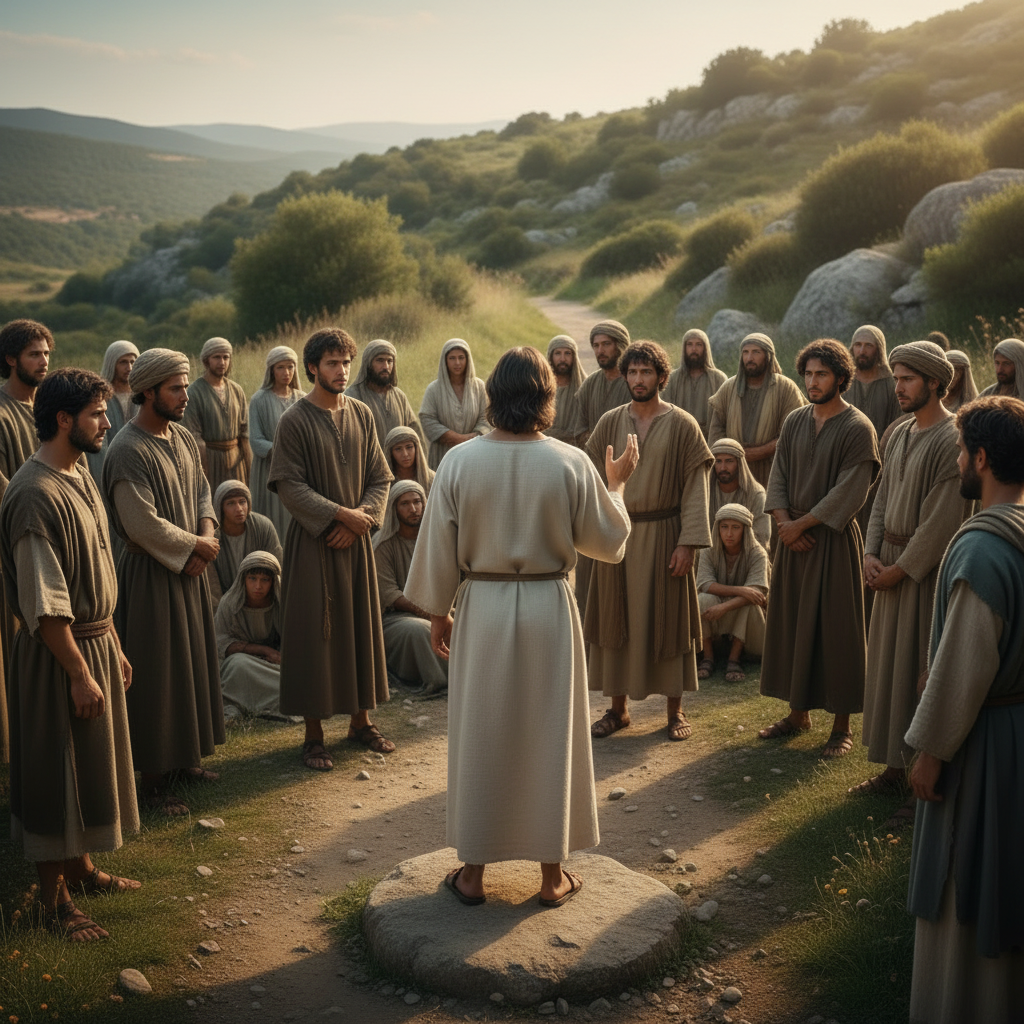

This passage follows the conversation with the disciples in which Peter rebuked his Master. It seems that the latter withdrew for a time and then called his disciples, together with the crowd, to come near (Mark 8.34). The teaching given concerns how to become a disciple.
At that time the Jews were familiar with the master-disciple relationship, since preachers traveled throughout the land of Israel and recruited disciples. John the Baptist also had many disciples who followed him.
In this discourse, Jesus the Messiah sheds light on the true notion of a disciple, which demands total commitment and a deep relationship, beyond popular understanding, and requires sacrifices in order to enter the kingdom of God.
The passages of Matthew 16.24-27, Mark 8.34-38 and Luke 9.23-26 therefore present a common theme: Jesus’ call to his disciples to deny themselves, take up their cross and follow him. These texts underline the idea of personal sacrifice and faithfulness to the teaching of Christ, highlighting the notion of spiritual loss and gain.
Summary of the passages
Matthew 16.24-27 : Jesus the Messiah urges his disciples to deny themselves and take up their cross. He stresses the paradox that whoever seeks to save his life will lose it, while whoever loses it for his sake will find it. He also mentions the future judgment in which each one will be rewarded according to his deeds.
Mark 8.34-38 : This passage takes up the same ideas, but insists more on the shame that some might feel toward Christ and his words. Jesus warns that those who are ashamed of him will be rejected when he returns in the glory of the Father.
Luke 9.23-26 : Luke adds an important nuance by specifying that denying oneself and taking up the cross must be daily. He also highlights the loss of oneself and the futility of gaining the whole world if it leads to the loss of one’s soul.
Comparison of the texts
Self-denial and sacrifice : The three gospels stress the idea that following Jesus the Messiah involves denying oneself and total commitment. Luke is the only one to specify that this self-denial must be daily.
Loss and gain : All the texts stress the paradox of salvation: seeking to preserve one’s earthly life leads to spiritual loss, whereas accepting sacrifice for Christ leads to eternal life.
Judgment and reward : Matthew and Mark stress future retribution, whereas Luke puts more emphasis on shame and the loss of the soul.
All the gold in the world : The three texts highlight the inestimable value of the salvation of our soul. No amount of gold in the world can make up for the incalculable value of our soul.
The eschatological aspect : Matthew and Mark mention Christ’s glorious return and the judgment, whereas Luke highlights individual responsibility in the decision to follow Jesus.
These passages are a fundamental call to faith and Christian commitment, underlining the need for a radical choice and uncompromising faithfulness to the teaching of Christ.
It emerges that the demands made by Jesus the Messiah represent a radical change for his audience, in sharp contrast with the teachings of the religious leaders of that period. The way that leads to the kingdom of God is hard (Matthew 7.13-14).