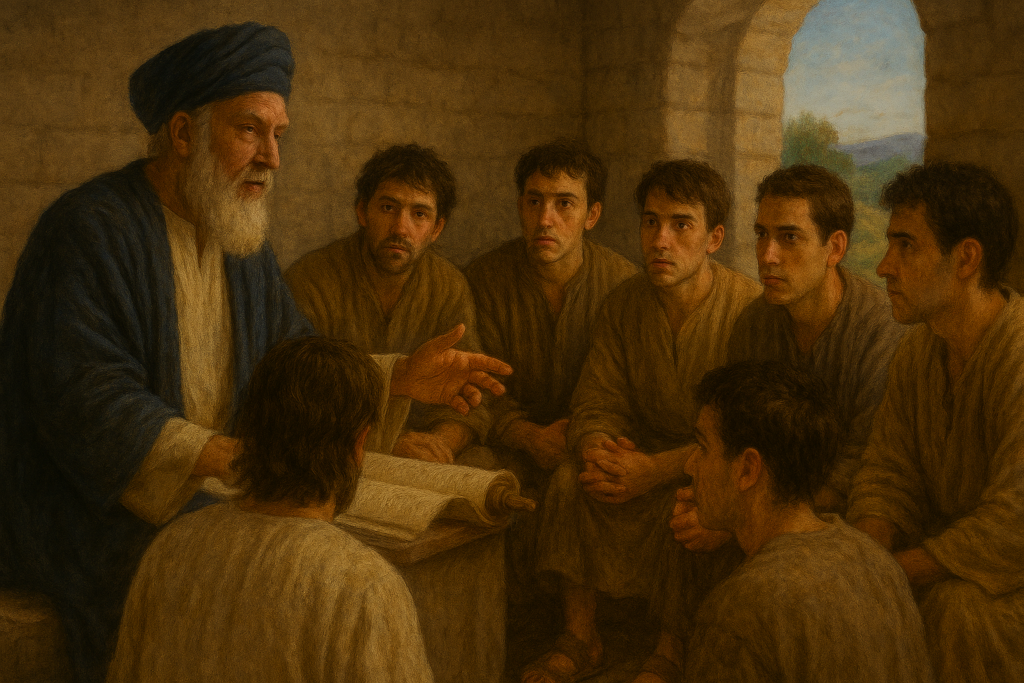


We now come to the end of this long discourse that Matthew has related to us in great detail.
What matters here is the Master's question: "Have you understood all this?" The disciples answer in the affirmative.
It is worth asking about the meaning of the and their concrete application. Did the disciples truly understand the whole message the Master wished to convey to them? Did they fully grasp the seven reported by Matthew? The advantage of this literary form is that even with only partial understanding, an essential aspect of the message could be perceived. Moreover, they will have the opportunity to deepen their understanding in the future.
How to understand:
Meaning
Scribe instructed in the kingdom of heaven: The scribes were experts in the law and the Scriptures. Here, Jesus speaks of scribes who have been trained in the new understanding of the kingdom of heaven. This means that they not only have a thorough knowledge of the Scriptures, but also understand the new truths brought by Jesus.
Householder: The householder symbolizes someone who is responsible for feeding and caring for his household. Likewise, scribes and teachers are responsible for spiritually nourishing those around them.
Bringing out of his treasure things new and old: The treasure represents the wealth of teachings and spiritual truths. The "new things" refer to the new teachings and to Jesus' revelation about the kingdom of heaven. The "old things" refer to the Old Testament and to teachings already known. A good Christian teacher is able to combine and explain the teachings of the Old and New Testaments in order to give a complete understanding of the faith.
This verse highlights the importance of knowledge and a thorough understanding of the Scriptures. It also underscores the responsibility of teachers and spiritual guides to draw on both ancient traditions and new revelations in order to nourish and guide believers. This implies continuity and growth in the understanding of the Christian faith.
The disciples who listen to the Master will soon have to adopt this approach in order to ensure a faithful and enriched transmission of the teaching of the Messiah Jesus.
Thus, being under the new covenant does not mean that the Old Testament must be set aside. Indeed, the Word of God encompasses both constituent parts of our Bibles.