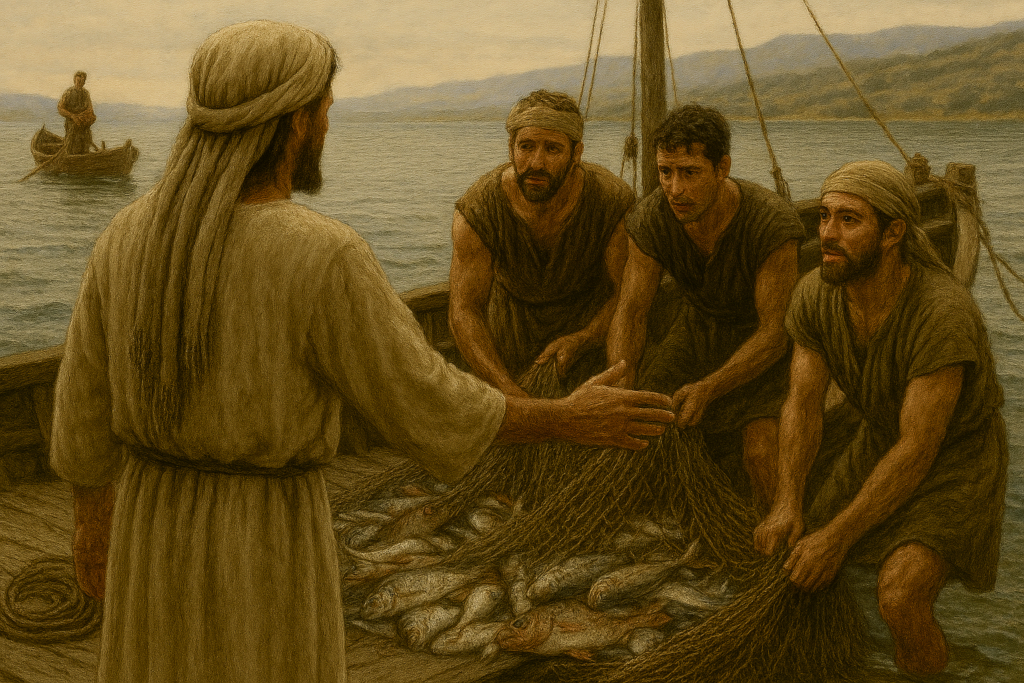

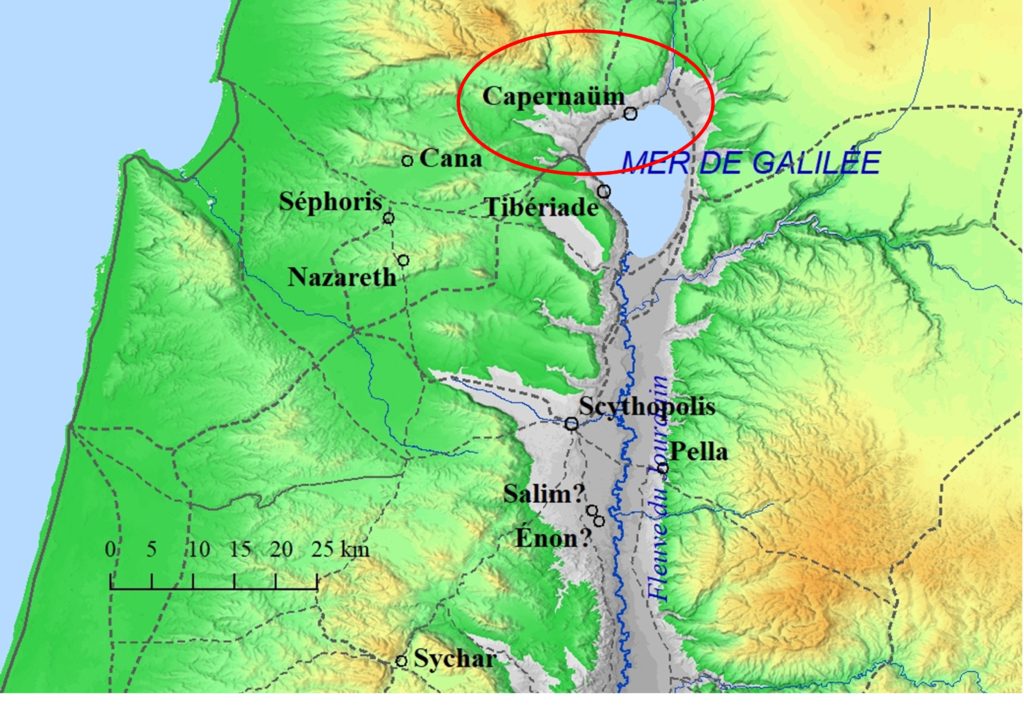
We note here that the disciples had not yet left their work as fishermen when the Messiah Jesus proposes to Simon Peter that he become a 'fisher of men'. It is interesting to note that neither Matthew nor Mark mentions this episode.
It is well known that the Messiah Jesus never performed a miracle simply to display his power. Each of his miracles had a specific reason and purpose. Since winter is not the best season for fishing, it was not surprising that, after a whole night of work, they came back with nothing. This happened more often at that time of year.
Overfishing, caused by the arrival of poor populations seeking better conditions in Galilee, was endangering the survival of various species of fish. This situation seriously affected the professional fishermen, who found it harder and harder to fill their nets.
In this account we find again the four men mentioned by Matthew and Mark, but Andrew is not named.
Why does such a miracle happen just when they are about to give up their professional activity?
We have no precise details and can only make suppositions. It was probably unthinkable for these men to leave behind debts that would then fall solely on their families.
Selling all this quantity of fish, rather like the flour and oil of the widow of Zarephath (1 Kings 17.8), could have sheltered from hardship these families who depended on their work as fishermen.
We note that the Messiah Jesus was teaching the crowd before this miracle (verse 1), so that everyone witnessed this unusual catch.
It is important not to confuse this first miraculous catch of fish with the one reported by John 21.1-14, since the details of the two events are clearly different.