
PER029

The ministry of John the Baptist

The article examines John the Baptist's role in preparing for Jesus' coming. Appearing in Matthew, Mark and Luke, John baptises and preaches in the Judean wilderness. Regarded as Christ's forerunner, he never claimed to be the Messiah. His teachings prepared the people to welcome Jesus, the royal Messiah.

8 min John the Baptist ministry Jesus Messiah 6 verses 6 books

Resources

Biblical texts

Matthew
Matthew 3.1-12 (King James Version)

In those days came John the Baptist, preaching in the wilderness of Judaea,

And saying, Repent ye: for the kingdom of heaven is at hand.

For this is he that was spoken of by the prophet Esaias, saying, The voice of one crying in the wilderness, Prepare ye the way of the Lord, make his paths straight.

And the same John had his raiment of camel’s hair, and a leathern girdle about his loins; and his meat was locusts and wild honey.

Then went out to him Jerusalem, and all Judaea, and all the region round about Jordan,

And were baptized of him in Jordan, confessing their sins.

But when he saw many of the Pharisees and Sadducees come to his baptism, he said unto them, O generation of vipers, who hath warned you to flee from the wrath to come?

Bring forth therefore fruits meet for repentance:

And think not to say within yourselves, We have Abraham to our father: for I say unto you, that God is able of these stones to raise up children unto Abraham.

And now also the axe is laid unto the root of the trees: therefore every tree which bringeth not forth good fruit is hewn down, and cast into the fire.

I indeed baptize you with water unto repentance: but he that cometh after me is mightier than I, whose shoes I am not worthy to bear: he shall baptize you with the Holy Ghost, and with fire:

Whose fan is in his hand, and he will throughly purge his floor, and gather his wheat into the garner; but he will burn up the chaff with unquenchable fire.

Mark
Mark 1.1-8 (King James Version)

The beginning of the gospel of Jesus Christ, the Son of God;

As it is written in the prophets, Behold, I send my messenger before thy face, which shall prepare thy way before thee.

The voice of one crying in the wilderness, Prepare ye the way of the Lord, make his paths straight.

John did baptize in the wilderness, and preach the baptism of repentance for the remission of sins.

And there went out unto him all the land of Judæa, and they of Jerusalem, and were all baptized of him in the river of Jordan, confessing their sins.

And John was clothed with camel’s hair, and with a girdle of a skin about his loins; and he did eat locusts and wild honey;

And preached, saying, There cometh one mightier than I after me, the latchet of whose shoes I am not worthy to stoop down and unloose.

I indeed have baptized you with water: but he shall baptize you with the Holy Ghost.

Luke
Luke 3.1-18 (King James Version)

Now in the fifteenth year of the reign of Tiberius Cæsar, Pontius Pilate being governor of Judæa, and Herod being tetrarch of Galilee, and his brother Philip tetrarch of Ituraea and of the region of Trachonitis, and Lysanias the tetrarch of Abilene,

Annas and Caiaphas being the high priests, the word of God came unto John the son of Zacharias in the wilderness.

And he came into all the country about Jordan, preaching the baptism of repentance for the remission of sins;

As it is written in the book of the words of Esaias the prophet, saying, The voice of one crying in the wilderness, Prepare ye the way of the Lord, make his paths straight.

Every valley shall be filled, and every mountain and hill shall be brought low; and the crooked shall be made straight, and the rough ways shall be made smooth;

And all flesh shall see the salvation of God.

Then said he to the multitude that came forth to be baptized of him, O generation of vipers, who hath warned you to flee from the wrath to come?

Bring forth therefore fruits worthy of repentance, and begin not to say within yourselves, We have Abraham to our father: for I say unto you, That God is able of these stones to raise up children unto Abraham.

And now also the axe is laid unto the root of the trees: every tree therefore which bringeth not forth good fruit is hewn down, and cast into the fire.

And the people asked him, saying, What shall we do then?

He answereth and saith unto them, He that hath two coats, let him impart to him that hath none; and he that hath meat, let him do likewise.

Then came also publicans to be baptized, and said unto him, Master, what shall we do?

And he said unto them, Exact no more than that which is appointed you.

And the soldiers likewise demanded of him, saying, And what shall we do? And he said unto them, Do violence to no man, neither accuse any falsely; and be content with your wages.

And as the people were in expectation, and all men mused in their hearts of John, whether he were the Christ, or not;

John answered, saying unto them all, I indeed baptize you with water; but one mightier than I cometh, the latchet of whose shoes I am not worthy to unloose: he shall baptize you with the Holy Ghost and with fire:

Whose fan is in his hand, and he will throughly purge his floor, and will gather the wheat into his garner; but the chaff he will burn with fire unquenchable.

And many other things in his exhortation preached he unto the people.

John
John (King James Version) not cited in the book

Technical details

Location: The Temple of Jerusalem, then the Judean wilderness

Date: Passover on Monday, 19 April 26 (beginning of John the Baptist's ministry)

Method: We return to Matthew

Note on the method: Matthew is the first of the Gospels

Pericope 30 map
Pericope 29 map

John the Baptist is an important figure in Jesus the Messiah's life.

The ministry of John the Baptist

The ministry of John the Baptist

Comments

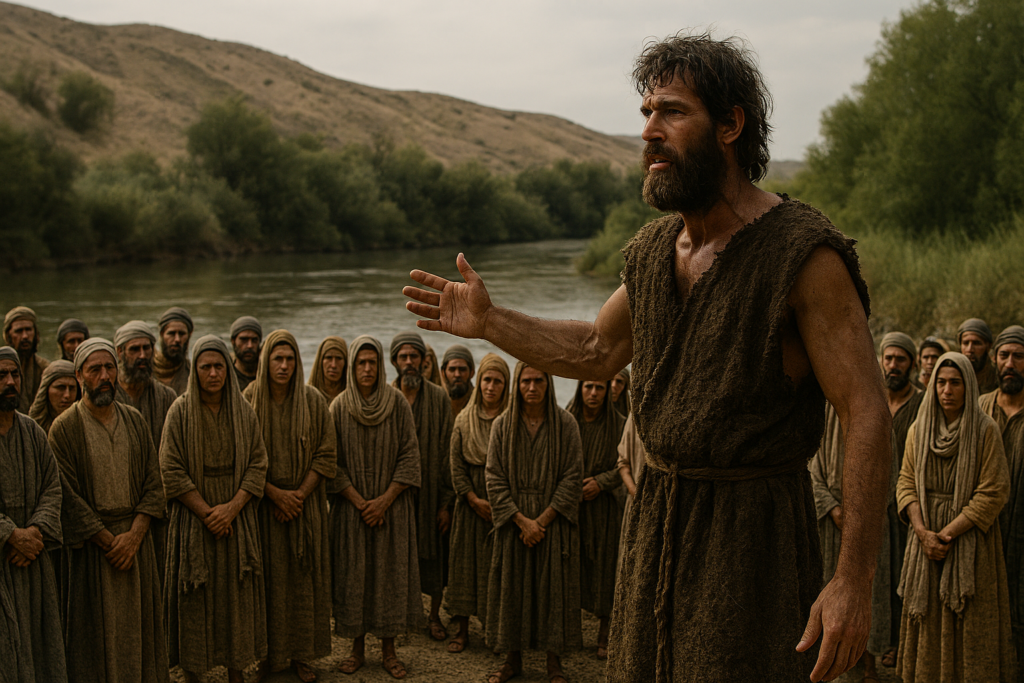
Thanks to the writings of the prophet Daniel and information in the Gospels, we can estimate that John the Baptist's ministry began in April of the year 26. These sources suggest that he left his family home after the death of his parents, already elderly when he was born, to settle in the Judean wilderness.

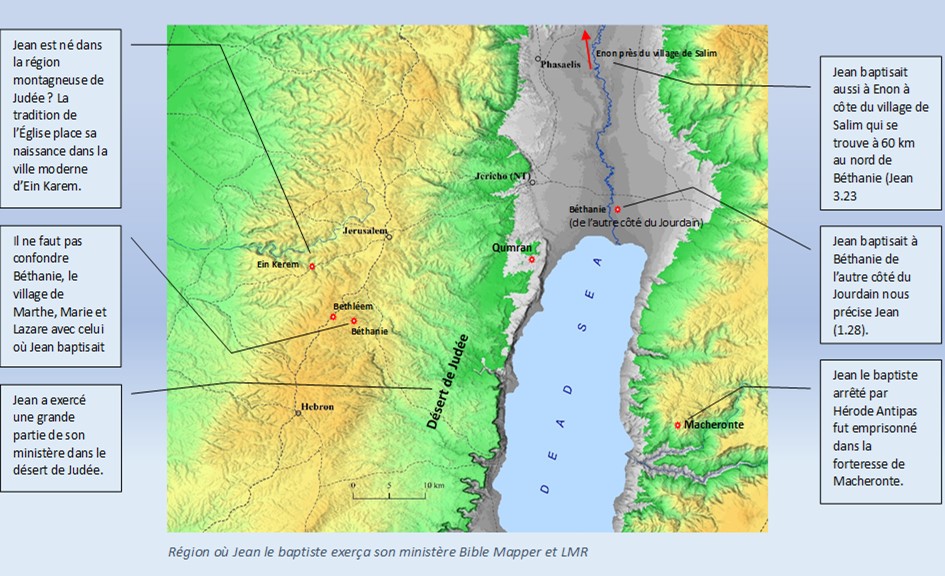
According to some interpretations, John the Baptist may have preached to the crowds on the Temple esplanade during the great festivals in Jerusalem. Towards the end of his ministry, he seems to have stopped making these pilgrimages, a point we examine further below. His life and clothing reminded his contemporaries of the great prophet Elijah, raising many questions. Seeking answers, many found him preaching near Bethany beyond the Jordan.

Matthew specifies that John the Baptist began his ministry in the Judean wilderness, and the apostle John tells us that he later settled on the banks of the Jordan at Bethany beyond the river, introducing a new baptism. While many see him as the messiah, he clearly states that they are mistaken and that his ministry consists solely in preparing for the Messiah's imminent coming.

This explanation accounts for the crowds around him. People believed they had found the Messiah in him. He thus naturally became the one crying out in the wilderness, announcing the coming of the long-awaited, hoped-for Messiah. He embodied the priestly Messiah who precedes the royal Messiah.

It would be mistaken to think that John the Baptist's success came from proposing a new doctrine. His preaching rested on announcing the coming of the royal Messiah, Jesus. Jesus therefore had to meet John the Baptist.

Mark begins his account by quoting several prophets, including Malachi 3.1 and Isaiah 40.3. This is his text's only reference to prophets apart from Jesus' direct quotations.

For Mark, the author of the second Gospel, everything begins with John the Baptist's arrival. He mentions John chiefly because he announced Jesus' coming. John the Baptist thus introduces the central figure of Mark's account: Jesus, the Messiah.

Tensions between the disciples of John the Baptist and those of Jesus are documented (John 3.25). Mark emphasises that John's mission was limited to announcing the coming of someone far greater than himself: Jesus, the Messiah.

Mark thus puts each person's place in salvation history into perspective. Indirectly, he asks John the Baptist's disciples a fundamental question: will they follow the servant who announces the Master's coming, or choose Jesus, the one true Master?

Luke alone provides these essential historical details to place his events within secular history. He seeks to show that the chronology of Jesus the Messiah's life fits harmoniously into world history.

Thus there are not two separate chronologies, one of the world with its rulers, kings and emperors, and another of Jesus the Messiah. There is a single historical reality in which the Messiah naturally takes his place.

Luke seems to have had documents now lost. The almost two thousand intervening years have erased evidence on which he relied when writing. This does not mean, however, that his information contains errors in dates or names.

Theophilus, like the earliest readers, was not shocked by references they knew and could still verify at the time. On the contrary, this highlights the quality of Luke's investigation.

The precision of these details helps confirm the truthfulness of the prophet Daniel's writings and establish a chronology of the reported events. We explore this further in the appendices mentioned at the beginning of this passage.