ANN032

Judas Iscariot, one of the 12

Judas Iscariot, famous for his betrayal, is examined in this article, which explores his selection as one of the twelve apostles and the theological implications of this betrayal. The text raises questions about divine foreknowledge, the fulfillment of Scripture, and human responsibility, drawing on the Gospels and analyzing Judas's possible motives.

63 min Judas Iscariot betrayal apostles 91 verses 14 books

Further information

Introduction

The figure of Judas Iscariot has long raised many questions. His name has become almost synonymous with betrayal, to the point that his presence among the twelve disciples can seem hard to understand. How could the Messiah Jesus choose a man who was going to hand him over? Was he surprised by his behavior, or did he know from the beginning how this story would end? These questions touch on the person of Judas, the mission of Jesus, the fulfillment of Scripture, divine foreknowledge, and human responsibility.

In this study, we will seek to examine the main biblical data concerning Judas Iscariot. We will see what the Gospels actually say about him, what motives may have contributed to his betrayal, how to understand the role of the chief priests, what the thirty pieces of silver represent, and how to reconcile the accounts of his death with those concerning the purchase of the field of blood. Finally, we will attempt to answer the central question: did the Messiah Jesus know that Judas would betray him when he chose him from among the twelve (John 6.64, John 6.70-71)?

I. Judas among the twelve

Judas Iscariot was fully a member of the group of twelve chosen by Jesus. His name appears in the lists of the apostles given by the Synoptic Gospels, where he is often mentioned last, with the note that he is the one who handed Jesus over (Matthew 10.2-4, Mark 3.13-19, Luke 6.12-16). After his death, he disappears from the list given at the beginning of Acts, where Matthias takes his place (Acts 1.13-26).

It is important to stress that Judas was neither a passing disciple nor a mere sympathizer. He belonged to the Master's closest circle. He heard his teaching, witnessed his miracles, shared the common life of the group, and received, like the others, a place in the apostolic college. This is precisely what makes his betrayal so grave: it does not come from an outside enemy, but from a man admitted into the intimacy of the Messiah (John 13.18, Psalms 41.10).

John reports a particularly strong saying of Jesus: "Did I not choose you, the twelve? And one of you is a devil" (John 6.70-71). This statement shows that Judas was indeed chosen by Jesus himself. The question, then, is not whether he was truly one of the twelve, but why Jesus chose him and kept him in this group to the very end.

II. What the Gospels say about him

The Gospels remain relatively sparing about the personal life of Judas. Unlike Peter, Andrew, James, John, Philip, or Matthew, his calling is not recounted. We know only that he is called Judas Iscariot and that he is described as the son of Simon (John 13.2, John 13.26). His surname distinguishes him from the other men named Judas mentioned in the New Testament.

Despite this discretion, certain elements stand out clearly. Judas kept the group's common purse (John 12.6, John 13.29). He therefore held an important practical function, which presupposed a certain trust the other disciples. Nothing indicates that he was suspected. On the contrary, at the last meal, when Jesus speaks to him, the disciples think that he is going out to buy what is needed for the feast or to give something to the poor (John 13.27-29). This shows that in the eyes of the group, Judas remained a trustworthy man.

John, however, provides a decisive piece of information: Judas was a thief, and he took what was put into the purse (John 12.4-6). The text does not specify how this reality became known later, but John affirms it clearly. This helps us better understand the inner logic of the character. The betrayal did not arise in a heart that had remained sound until then; it appears as the outcome of a corruption already in place.

III. The possible motives for his betrayal

The Gospels show explicitly that money played a role in Judas's decision. He went to the chief priests and asked what they were willing to give him if he handed Jesus over to them; they then counted out thirty pieces of silver for him (Matthew 26.14-16). From this standpoint, greed is indeed one of the motives for his betrayal. John's testimony about the embezzlement from the common purse confirms this direction (John 12.6).

However, it is possible that money was not the only factor. Several disciples were still hoping for a political deliverance of Israel. After the crucifixion, the disciples on the road to Emmaus confess their disappointment: "We had hoped that he was the one who was going to redeem Israel" (Luke 24.21). This saying shows that some expected from the Messiah a visible, national, and political intervention. It is therefore not impossible that Judas shared, at least in part, such an expectation.

If that was the case, he could have been disappointed by the attitude of Jesus, who refused to let himself be made king (John 6.15) and did not fit into the logic of the nationalist or Zealot movements of his time. Without being able to affirm it with certainty, we may therefore consider that his betrayal arose from several combined causes: the love of money, disappointment with a Messiah who did not match his expectations, and a moral corruption of long standing. The Gospels add to this the action of the devil. Luke says that Satan entered Judas (Luke 22.3-4), and John specifies that the devil had already put into his heart the plan to hand Jesus over (John 13.2). This demonic influence does not erase Judas's responsibility; rather, it shows that his heart allowed evil to take root instead of rejecting it.

IV. The ties with the chief priests

The religious leaders had been seeking for some time a way to arrest Jesus without causing an uproar among the people (Matthew 26.3-5, Mark 14.1-2, Luke 22.1-2). Jesus' public ministry, his denunciations of religious hypocrisy, and the authority he exercised over the crowds made him a threat in the eyes of the . They therefore needed a favorable opportunity to seize him away from the crowd.

It is in this context that Judas's offer takes on its full importance. Luke reports that Judas went and discussed with the chief priests and the captains of the guard how he might hand Jesus over to them (Luke 22.3-6). This is therefore not only a moral betrayal; it is also a concrete collaboration with the authorities who were seeking to do away with the Messiah. Judas brought them what they did not have: discreet access to the Master, far from the crowd, at a favorable place and time.

Judas's role was not to make an impossible identification, as if Jesus were unknown, but to facilitate an arrest without popular unrest. Jesus taught publicly in the temple (Matthew 26.55), but arresting him in broad daylight before the crowds could provoke unpredictable reactions. Judas therefore provided the sought-after opportunity by leading the troop to the place where Jesus customarily withdrew with his disciples (Luke 22.39, John 18.1-5).

Matthew is the only evangelist to specify the sum agreed upon between Judas and the chief priests: thirty pieces of silver (Matthew 26.14-16). This detail carries considerable symbolic weight. In the Old Testament, thirty pieces of silver correspond to the price of a slave (Exodus 21.32). The Messiah is thus valued at the paltry price of an injured or lost servant. The contrast is striking between the dignity of Jesus and the amount for which he is handed over.

Matthew then links this sum to the prophecy of Zechariah, in which the prophet receives thirty pieces of silver as a contemptuous wage and then throws them into the house of for the potter (Zechariah 11.12-13). This is why, after Judas's remorse, the return of the money, and the purchase of the potter's field, Matthew sees in it the fulfillment of Scripture (Matthew 27.9-10). Even though Matthew mentions Jeremiah, he seems to be combining here several prophetic themes, in particular those of Zechariah and Jeremiah concerning the potter, judgment, and the field (Jeremiah 18.1-6, Jeremiah 19.1-13, Jeremiah 32.6-15).

As for the real value of these thirty pieces, it is difficult to be absolutely precise. They nonetheless represented a relatively modest sum on the scale of the chief priests, even if they could seem significant to an ordinary man. The contrast with the costly perfume poured out by Mary is striking, since that perfume is valued at three hundred denarii (John 12.3-5). This reinforces the idea that Judas's betrayal probably cannot be explained by money alone. Such a limited sum does not seem sufficient to account, by itself, for such an act.

VI. The death of Judas: Matthew and Luke

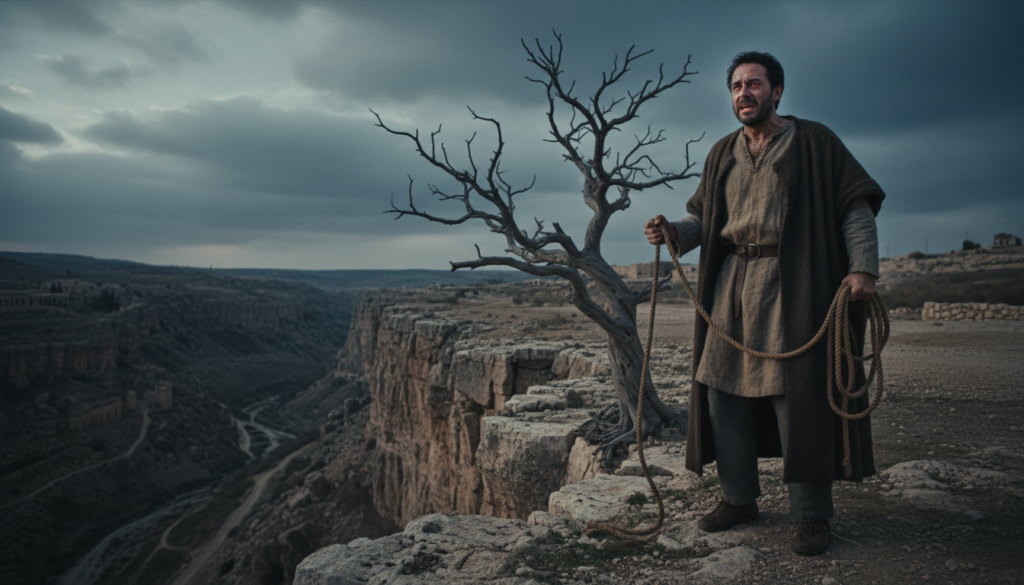
The is reported differently by Matthew and by Luke. Matthew simply says that Judas, after throwing the pieces of silver into the temple, withdrew and went and hanged himself (Matthew 27.5). Luke, in Acts, states for his part that Judas fell headlong, burst open in the middle, and all his intestines spilled out (Acts 1.18). At first reading, these two descriptions may seem incompatible.

It is nevertheless possible to understand them as complementary rather than contradictory. Matthew mentions the initial act of suicide; Luke describes the condition of the body discovered afterward. One can imagine that Judas hanged himself in a steep place and that, subsequently, his body fell and was torn open. This explanation remains a harmonizing hypothesis, but it accounts for both texts without sacrificing either.

Be that as it may, the two accounts agree on the essential point: Judas's end is dramatic, shameful, and closely tied to the price of his betrayal. Matthew stresses his remorse, his confession—"I have sinned by betraying innocent blood"—and his suicide (Matthew 27.3-5). Luke, for his part, underlines the public and striking character of his death, to the point that the place became known to all (Acts 1.19). The two perspectives thus complement one another more than they oppose one another.

VII. The field of blood: who bought it?

Another apparent difficulty concerns the purchase of the potter's field. According to Matthew, Judas brought the thirty pieces of silver back to the chief priests, and it was they who decided to use this sum to buy the potter's field in order to bury strangers in it (Matthew 27.3-8). Yet Luke declares concerning Judas: "This man acquired a field with the reward of his wickedness" (Acts 1.18).

The simplest solution is to recognize that Luke does not intend to describe the transaction in legal terms, but to attribute the field to Judas because it was bought with the money that came from his wrongdoing. The priests materially carried out the acquisition, but the field remains linked to Judas by its moral origin. It is his money, the price of his betrayal, that was used for this purchase (Acts 1.18-19).

This manner of speaking is consistent with biblical usage. Solomon is said to have built the Temple, although workmen carried out the work (1 Kings 6.1-14, 2 Chronicles 3.1). Likewise, the inhabitants of Jerusalem are said to have crucified Jesus, whereas it was the soldiers who physically put him on the cross (Mark 15.24, Acts 2.23). It is therefore legitimate to attribute an action to the one who is its underlying cause. It is moreover likely that the thirty pieces of silver were not enough on their own to cover the entire cost of the land, and that the religious authorities made up the necessary sum. This takes nothing away from the fact that the field was acquired with the wages of wrongdoing (Matthew 27.6-8).

This piece of land was called both the potter's field and the field of blood (Matthew 27.8, Acts 1.19). The first name seems to be linked to the ancient use of the place; the second recalls both the origin of the money and the tragic end of Judas. Matthew sees in it the fulfillment of the Scriptures in connection with the thirty pieces of silver and the potter's field (Matthew 27.9-10, Zechariah 11.12-13).

VIII. Did Jesus know?

The central question remains the following: did the Messiah Jesus know, when he chose Judas, that Judas would betray him? The testimony of the Gospel of John strongly leads us to answer yes. John states that Jesus knew from the beginning who those were who did not believe and who the one was who would hand him over (John 6.64). A few verses later, Jesus declares: "Did I not choose you, the twelve? And one of you is a devil" (John 6.70-71).

Other passages in John point in the same direction. Jesus knows Nathanael even before he comes toward him (John 1.47-48). He has no need for anyone to inform him about men, for he knows what is in man (John 2.24-25). He perceives the thoughts of the crowd and the inner murmuring of his disciples (John 6.15, John 6.61). John thus presents Jesus as the Word made flesh, displaying a knowledge that surpasses that of an ordinary man (John 1.1, John 1.14).

We must nevertheless understand this knowledge in the light of the incarnation. Jesus truly took on the human condition: he prays all night before choosing the twelve (Luke 6.12-13), he grows in wisdom (Luke 2.52), and he lives in dependence on the Father (John 5.19, Philippians 2.6-8). Nevertheless, according to John's explicit testimony, it is difficult to maintain that he would have been unaware until the last moment of what Judas was going to do (John 13.21). It seems rather that Jesus then publicly reveals what he already knew.

IX. Why did he choose him and keep him?

If Jesus knew what Judas would do, why choose him from among the twelve and why keep him to the end? First, the idea of an error of judgment must be ruled out. Jesus was not mistaken about Judas. The choice of this man resulted neither from ignorance nor from a lack of discernment. It is part of the very unfolding of the Messiah's mission (John 6.64, John 6.70-71).

Next, keeping Judas among the twelve contributes to the fulfillment of Scripture. At the last meal, Jesus cites the psalm that speaks of the betrayal by a close friend who shares his bread (John 13.18, Psalms 41.10). This does not reflect a weakness in Jesus, but his full awareness of the path he must follow to the cross (John 10.17-18, John 17.12).

Finally, Jesus lets Judas go all the way to the end of his own responsibility. He does not expel him at the first signs of his evil, but gives him time to reveal what he carries in his heart. Judas receives the same teachings as the others, he shares the same table, and he benefits to the end from the Master's patience (Matthew 26.20-25, John 13.21-27). This highlights both the patience of Jesus and the gravity of Judas's hardening.

X. Prophecy, freedom, and responsibility

The last meal particularly illuminates the link between prophecy and responsibility. Jesus declares: "He who eats my bread has lifted his heel against me" (John 13.18-19), thus taking up the (Psalms 41.10). Judas's betrayal is therefore not an unforeseen accident, but an event already known to God and announced in Scripture.

This does not mean, however, that Judas was deprived of freedom. The Bible affirms both that God knows in advance what must happen and that man remains responsible for his own actions (Isaiah 46.9-10, Isaiah 55.10-11). Jesus says that the Scripture must be fulfilled, but he also declares: "woe to that man by whom the Son of Man is betrayed" (Matthew 26.24). Judas therefore acts freely, while accomplishing what God had announced.

The Gospels moreover show a progression in his hardening. The devil first puts into his heart the plan to hand Jesus over (John 13.2), then Judas sinks deeper into his decision until the moment when Satan enters him (John 13.27). This is not a mechanical compulsion, but a voluntary surrender to evil. Thus, divine sovereignty and human guilt appear together in the drama of the Passion (Acts 2.23, James 1.13).

Conclusion

The study of Judas Iscariot brings to light a deeply troubling reality, yet one essential for understanding the Gospels. Judas was indeed one of the twelve. He lived in the closest proximity to the Messiah Jesus, heard his teaching, saw his works, and shared the life of the group. Yet he let evil grow in him until he handed over his Master for a paltry sum (Matthew 26.14-16, John 12.4-6).

The biblical texts lead us to think that Jesus was not surprised by this betrayal. According to John, he knew from the beginning who would hand him over (John 6.64, John 6.70-71). He therefore did not choose Judas by mistake. If he kept him among the twelve, it was both because this act was part of the fulfillment of Scripture and because he let Judas go all the way to the end of his own responsibility (John 13.18, Psalms 41.10).

Judas appears neither as an innocent carried along against his will, nor as a mere passive instrument. He acts freely and guiltily, and yet his act fits into the sovereign plan of God (Matthew 26.24, Acts 1.16, Acts 2.23). This is doubtless the most difficult teaching of this study, but also the most important: divine foreknowledge does not cancel human freedom, and the fulfillment of the word of God never removes man's moral responsibility.