

_1 The slaughter of the lambs begins on Thursday and continues on Friday. – appendix ANN027 : The Last Passover Meal.
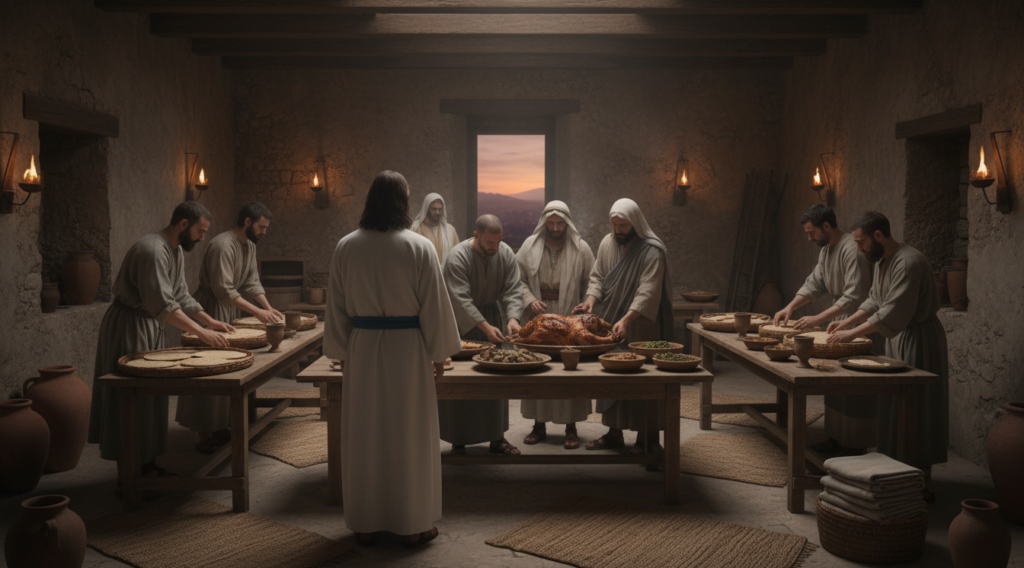
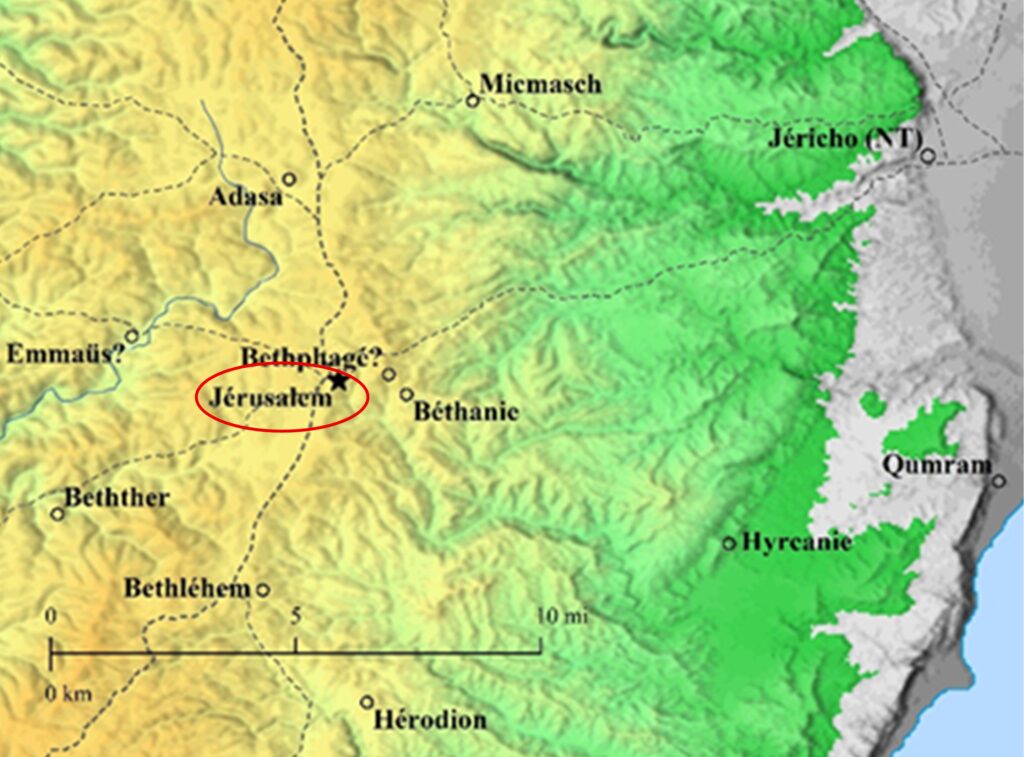
_2 The search for and preparation of the place for the Passover take place on Thursday afternoon. (Mark 14.12-16, Matthew 26.17-19, Luke 22.7-13).
You can consult the complete chronology in the study ANN026 : The hour of the crucifixion.
Commentary:
1- The first day of Unleavened Bread: a double feast
The expression used in the three Synoptic Gospels, ‘the first day of Unleavened Bread’, refers to the beginning of the great festival of Passover, which also encompassed the Feast of Unleavened Bread (Matthew 26.17-19; Mark 14.12-16; Luke 22.7-13). At that time, these two celebrations were regarded as a single liturgical period, commemorating both the departure from Egypt and the people's faithfulness in clearing their homes of all leaven, a symbol of sin and moral corruption (Exodus 12.1-20; Exodus 13.3-10). This merging of the calendar reflects the theological unity between Israel's historical deliverance and its calling to ritual holiness (Deuteronomy 16.1-8).
2- The slaughter of the Passover lamb and practical adaptations
According to the Mosaic prescription, the Passover lamb was to be slaughtered ‘between the two evenings’, that is, between sunset and nightfall (Exodus 12.6; Numbers 9.3). In Jesus' time, however, the considerable influx of pilgrims to Jerusalem made it difficult to apply this prescription within so short a period. The Temple, the focal point of Israelite worship, had to accommodate tens of thousands of worshippers who had come to offer the prescribed sacrifice (Deuteronomy 16.5-6), creating endless queues in the sacred courts.
Out of pastoral and logistical necessity, the religious authorities had therefore adapted the Mosaic rule, spreading the slaughter of lambs over two consecutive days. This adaptation reflects the continuing tension between the letter of the Law and the practical demands of applying it on a large scale.
3- Thursday, 13 Nisan: a day of preparation
It is highly likely that Thursday, 13 Nisan, was devoted to careful preparations: selecting unblemished lambs (Exodus 12.5), ritual slaughter under priestly supervision, cooking according to the prescriptions (Exodus 12.8-9), and arranging the meal so that, when evening came, each family could celebrate the festival fittingly in its home. Some families even had to keep the meat until the following day to take part in the official Seder on Friday evening.
John the evangelist explicitly alludes to this moment when he writes, ‘Before the feast of Passover…’ (John 13.1), thus clearly referring to the day of preparation. Over time, this preparatory day also became part of the Feast of Unleavened Bread, so deeply rooted was the connection between the two celebrations in Jewish religious consciousness.
4- Cleansing the homes: the spiritual dimension of preparation
In Israelite households, preparing for the festival had a profoundly spiritual dimension. Each family had to ensure that no trace of leaven remained in the home, thus performing a symbolic act of inner purification (Exodus 12.15; Exodus 13.7). This ritual practice foreshadowed the disposition of a heart ready to stand before God in integrity and holiness.
The apostle Paul would take up this symbolism with remarkable Christological depth: ‘Cleanse out the old leaven, so that you may be a new batch, since you are unleavened; for Christ, our Passover, has been sacrificed’ (1 Corinthians 5.7-8). Thus, as 14 Nisan approached, everything had to be ready: the houses cleared of all yeast, the lamb prepared according to the rites, and the table set for the sacred meal.
5- The mission entrusted to Peter and John
Peter and John then received a particular mission from the Master: to go and prepare the Passover meal (Luke 22.8). Following instructions that seem mysterious yet prove remarkably precise, they were to find a man carrying a jar of water and follow him to the house where everything would already be prepared (Mark 14.13-15; Luke 22.10-12).
This detail has particular significance: carrying water was normally women's work in first-century Palestinian society. A man performing this task would therefore stand out immediately among the crowd of pilgrims. This precise indication attests to the Lord's prophetic foreknowledge and his sovereign command of the events to come (Isaiah 46.10).
6- The upper room: a providential place
According to the most firmly established church tradition, this house probably belonged to Mary, the mother of John Mark, a disciple of the early Christian community (Acts 12.12). The host, a faithful and discreet man, had already reserved the upper room (anagaion in Greek, meaning a room upstairs) and prepared everything needed for the Passover meal (Mark 14.15).
This place would become a major symbol for the Church: the setting of the last meal and the institution of the Lord's Supper (Luke 22.19-20; 1 Corinthians 11.23-26), and later of the disciples' gathering on the day of Pentecost, when the Holy Spirit descended upon the emerging Church (Acts 1.13; Acts 2.1-4). The upper room thus constitutes the geographical cradle of the new covenant.
7- The religious leaders' plot: a preparation in darkness
While the disciples devoted themselves to these holy preparations, others were preparing an event of a radically opposite nature: the plot against the Messiah. That same Thursday, the religious leaders were at work in the shadows. Caiaphas, the high priest that year (John 11.49-51; John 18.14), and the members of the , eager to finish before the festival to avoid any popular unrest (Matthew 26.3-5; Mark 14.1-2), were summoning false witnesses, seeking the assistance of the Temple guards and meticulously finalising the arrest plan.
The agreement with Judas Iscariot had now been sealed for thirty pieces of silver, thus fulfilling Zechariah's prophecy (Zechariah 11.12-13; Matthew 26.14-16). The rapid succession of events reveals careful organisation. Caiaphas urged Judas to act without delay, to hand over Jesus the Messiah in an isolated place, away from the gaze of the crowd that had acclaimed him only a few days earlier (Matthew 21.8-11).
8- The theological contrast: communion and betrayal
This narrative contrast is striking and carries profound theological meaning: on one side, the disciples prepare the meal of communion and the new covenant sealed in the Messiah's blood (Luke 22.20; Hebrews 9.15); on the other, the religious authorities prepare the betrayal and execution of the Son of God (Acts 2.23).
Everything converges on the same night, surely the most meaningful in human history. Light and darkness confront one another in a cosmic drama in which, paradoxically, darkness will serve as the instrument for fulfilling God's redemptive purpose (John 1.5; Colossians 1.13-14).
9- The Messiah's prophetic discretion
We are struck by the precision of the details Jesus the Messiah gives his disciples. He conveys directions that suggest a coded route, yet every element remains marked by sovereign divine control. Matthew records these words: ‘Go into the city to a certain man’ (Matthew 26.18), or, according to some versions, ‘to the man you know’.
This deliberate discretion is no accident. The disciples clearly knew the place, but the evangelists deliberately omitted its name as a precaution, to protect these friends of Jesus the Messiah who were still alive when the Gospels were written. This editorial precaution reflects both the persecution faced by the early Christian communities and the pastoral care of the inspired authors (John 21.24-25).
10- The mystery of salvation: the Lamb who prepares his own Passover
Thus, behind these material preparations lies the great mystery of salvation. While everything seems to converge inexorably towards death, God fulfils his perfect purpose, determined before the foundation of the world (1 Peter 1.19-20; Ephesians 1.4-7). The Messiah stands at the centre of this divine orchestration: he prepares his own Passover, fully knowing that he will become its sacrificed Lamb (John 1.29; Revelation 5.6-9).
Nothing escapes him. Everything is foreseen, ordered and willed by an infinite love for the world: ‘For God so loved the world that he gave his only Son, so that whoever believes in him should not perish but have eternal life’ (John 3.16-17). Jesus the Messiah, the Lamb of God without blemish or spot, willingly offers himself as an atoning sacrifice, thus fulfilling all the prefigurations of the old covenant (Hebrews 10.1-14).