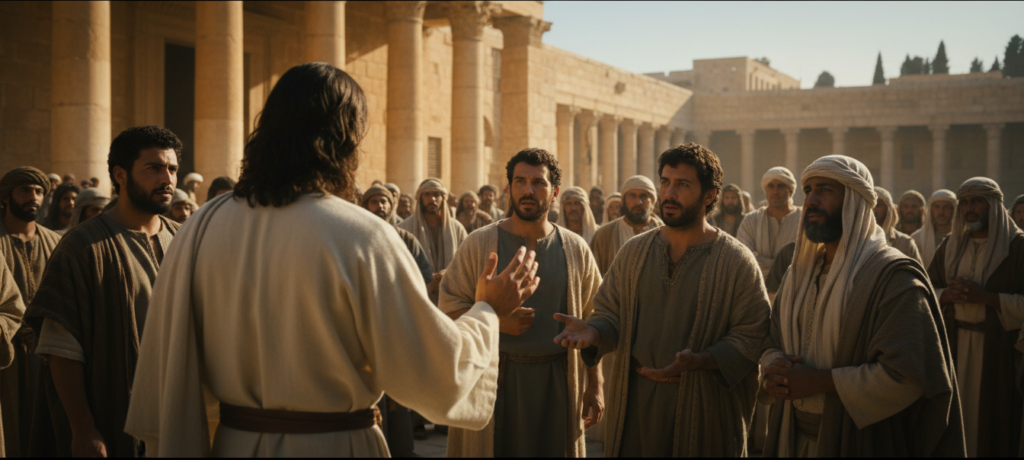
In the Epistle to the Hebrews, the author addresses a pressing exhortation to believers: he urges them to remain attached to the message of Jesus Christ and not to turn away from the teaching they received. This passage underlines the importance of remaining faithful to the Word, so as not to drift from it or abandon it.
The term “neglect,” used here, is not limited to the idea of deliberate rejection. It also encompasses ignorance, trivialization, or even procrastination in the face of the call to salvation. The author stresses the incomparable greatness of this salvation, initiated by the Son (see 1 Corinthians 15.20-22), confirmed by God (John 14.26; Acts 2.33) and attested by the Spirit (Romans 8.16). Thus, salvation in Jesus presents itself as a unique and essential reality for humanity.
Neglecting this salvation is not trivial: the text reminds us that the Law transmitted by angels already carried penalties for disobedience. All the more so, rejecting the salvation proclaimed by the Son brings consequences of an eschatological nature, engaging divine justice and the responsibility of each person.
This salvation is not limited to a mere moral or social improvement. It is reconciliation with God, access to eternal life, and entry into the Kingdom. To refuse or neglect this salvation is to deprive oneself of communion with God and to expose oneself to a final separation (see Hebrews 10.26-31; Matthew 25.41).
Many people perceive God as a fundamentally benevolent being, even infinitely good. This view, widespread in certain circles, sometimes leads to the thought that God could never condemn anyone.
From this follows a tendency, among some, to downplay the possibility of an rejection. To avoid considering the consequences of their actions, they look for conciliatory solutions or reassure themselves by comparing their own faults with those that others judge more serious. The attitude of Talleyrand illustrates this well: “When I look at myself, I despair; when I compare myself, I take comfort.”
Yet the many warnings of the Messiah Jesus in his invite everyone to reflect seriously on the reality and consequences of rejecting salvation. Jesus does not promise prosperity or easy well-being to attract the crowds, unlike some political speeches. He states plainly the consequences tied to accepting or refusing his salvation: the decision belongs to each person, but the outcomes are clearly set out, and God will accomplish what He has said.
Each reader is thus placed before his or her own spiritual responsibility. An future is decided here and now, yet it is always still possible to change course. Individual freedom remains complete: it is essential to understand the consequences of one’s choices.
One may question the truthfulness of the biblical writings: that is a matter of each person’s freedom. However, from the biblical perspective, the fulfillment of divine words does not depend on their acceptance by the majority or by the individual.
The example of the belief in a flat Earth for centuries illustrates this point: the fact that the majority believed it did not change reality. The Earth remained spherical, regardless of human convictions. This fact underlines the importance of distinguishing between majority belief and objective truth.
There are many historical examples where a minority upheld the truth against the general opinion. For example, Galileo, defending heliocentrism in the 17th century, opposed the majority who claimed that the Earth stood motionless at the center of the universe. Despite the opposition, it was indeed the minority that held the scientific truth. This example reminds us that following the majority is not always a guarantee of correctness, especially in the spiritual or moral realm.
Seeking spiritual truth therefore requires a personal, sincere, and attentive approach. It is not enough to follow the prevailing beliefs: one must dare to question one’s certainties, open one’s heart to revelation, and distinguish eternal truth from collective comfort.
Dominique Lormier